
EN71 Toy Safety Standards for Plush Toys are essential guidelines that help manufacturers ensure plush products meet strict European safety requirements for materials, mechanical safety, chemical limits, and overall child protection. Understanding mechanical, chemical, and flammability requirements for plush toys sold into the European market
EN71 is not a single test or a single certificate. It is a family of European harmonized standards that together define what “safe” means for a toy sold in the European Economic Area, and for plush toys specifically, compliance touches nearly every component in the product — the outer fabric, the filling, the safety eyes, the embroidery thread, the sewn seams, and the printed labels. A plush toy that passes EN71 testing has been evaluated against physical hazards, flammability behavior, and chemical migration limits, and every one of those evaluations traces back to a real injury or exposure pattern that regulators identified in children’s products over decades of market surveillance.
For buyers, brands, and anyone sourcing plush toys intended for the EU market, understanding EN71 at more than a surface level is not optional. A factory that says a product is “EN71 tested” without specifying which parts of the standard were applied, what age grading was used, and what documentation supports the claim has told you almost nothing useful. This guide walks through the structure of EN71, how each relevant part applies specifically to plush toy construction, what the testing process actually verifies, and what buyers should require before they accept a compliance claim at face value.
Plush toys present a particular compliance challenge compared to many other toy categories because of how many distinct materials and processes are combined in a single finished unit. A rigid plastic toy might involve one or two material types and a molding process; a plush toy typically combines woven or knit outer fabric, one or more filling materials, sewn and often embroidered surface decoration, and multiple attached accessory components, each sourced from a different supplier and each carrying its own independent compliance risk. Understanding EN71 as it applies to plush toys means understanding how the standard’s requirements map onto this specific multi-component structure, rather than treating the toy as a single undifferentiated product.

What Is EN71 and Why Does It Apply to Plush Toys?
EN71 is the European harmonized standard for toy safety, developed and maintained by the European Committee for Standardization (CEN) and referenced directly by the EU Toy Safety Directive (2009/48/EC). A toy manufactured or imported for sale in the EU must demonstrate conformity with the applicable parts of EN71 before it can legally carry the CE mark, and plush toys — because they are classified as toys intended for use by children under 14 — fall squarely within its scope regardless of whether they are sold as character merchandise, promotional items, or standard stuffed animals.
The standard exists because soft toys present a specific and well-documented set of hazard categories that differ from rigid plastic or wooden toys. Small detachable parts like safety eyes and noses present choking hazards. Loose or accessible filling materials present ingestion and inhalation risks. Fabric and stuffing materials can support combustion if not tested and selected correctly. And the dyes, adhesives, and surface treatments used throughout plush construction can introduce chemical exposure risks if not controlled to the migration limits the standard specifies. EN71 addresses each of these hazard categories through a distinct, numbered part of the standard.
EN71 vs. Other International Toy Safety Standards
Plush toys sold into multiple markets are frequently tested against more than one national or regional standard, and understanding how EN71 relates to these other frameworks helps buyers plan testing budgets and timelines realistically.
Comparison of Major International Toy Safety Standards
| Standard | Governing Region | Primary Focus | Relationship to EN71 |
|---|---|---|---|
| EN71 (Parts 1–13) | European Union / EEA | Mechanical, flammability, chemical migration | Reference standard for this guide |
| ASTM F963 | United States | Mechanical, flammability, chemical, labeling | Similar structure, different specific limits |
| ISO 8124 | International (base for many national standards) | Mechanical, flammability, chemical migration | EN71 mechanical and flammability parts closely mirror ISO 8124 |
| CPSIA / CPSC regulations | United States | Lead, phthalates, third-party testing requirements | Overlaps with EN71-3 chemical scope but with different limits |
| AS/NZS ISO 8124 | Australia / New Zealand | Mechanical, flammability, chemical migration | Adapted from ISO 8124, broadly aligned with EN71 intent |
While these standards share a great deal of structural overlap — small parts testing, flammability assessment, and heavy metal migration limits appear in nearly all of them — the specific numeric thresholds, required test methods, and documentation formats differ enough that passing one standard does not automatically satisfy another. A plush toy tested and passed under ASTM F963 for the US market still requires separate EN71 testing before it can legally be sold in the EU.
What Are the Different Parts of EN71 and Which Ones Apply to Plush Toys?
EN71 is organized into numbered parts, each addressing a distinct hazard category. Not every part applies to every toy category, but plush toys typically fall under several of the most commonly enforced parts.
EN71 Parts Relevant to Plush Toy Manufacturing
| Part | Title | What It Covers | Relevance to Plush Toys |
|---|---|---|---|
| EN71-1 | Mechanical and physical properties | Small parts, sharp points, tension/torque, seam strength | Core requirement for all plush toys |
| EN71-2 | Flammability | Burn rate and flame spread of materials | Core requirement for fabric, filling, trims |
| EN71-3 | Migration of certain elements | Heavy metal migration from accessible materials | Applies to dyed fabric, plastic accessories, paint |
| EN71-9 | Organic chemical compounds — requirements | General organic compound migration framework | Applies where relevant material categories are used |
| EN71-10 / 11 | Organic chemical compounds — sample prep and methods | Testing methodology for organic compounds | Applies together with EN71-9 where triggered |
| EN71-12 | N-Nitrosamines and N-nitrosatable substances | Restricted substances in materials contacting mouth | Relevant for plush toys intended for under-36-month use |
| EN71-13 | Olfactory board games, cosmetic kits, and gustative games | Scented product safety | Applies only to scented plush products |
Tip: Ask any supplier claiming EN71 compliance to specify which parts of the standard the product was tested against. “EN71 compliant” without a part number is an incomplete claim — a product could pass EN71-1 mechanical testing and still fail EN71-3 chemical migration if it was never tested for it.
How Does EN71-1 Mechanical and Physical Safety Apply to Plush Toys?
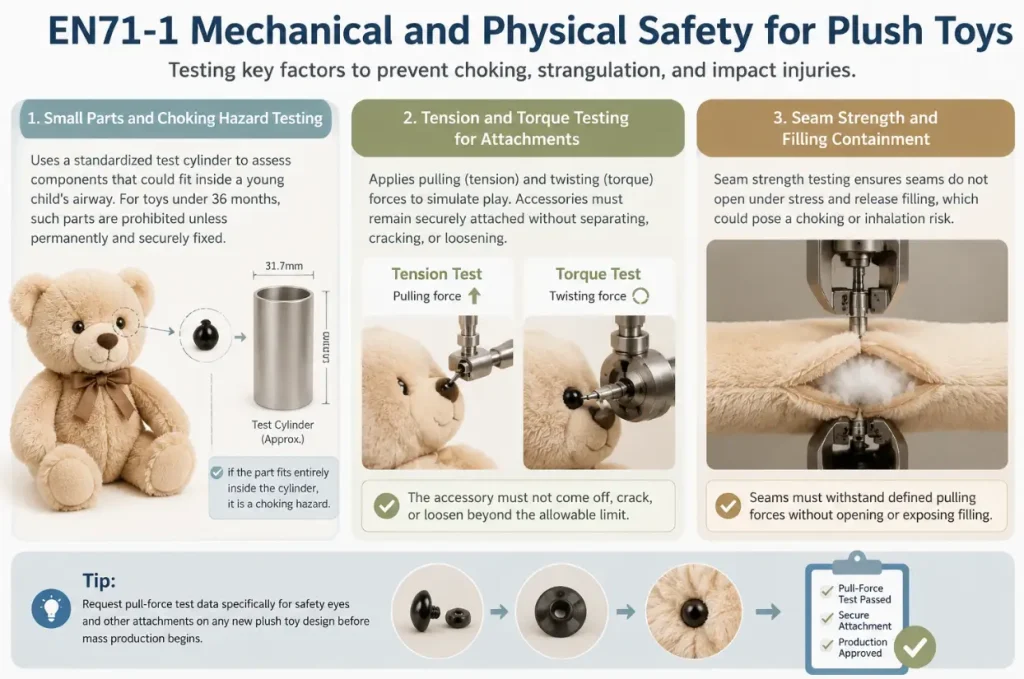
EN71-1 is the foundation of toy safety testing and the part most directly responsible for preventing choking, strangulation, and impact injuries. For plush toys, EN71-1 testing evaluates every component that could separate from the toy, every edge or point that could injure a child, and the structural integrity of the seams and closures that hold the toy together.
Small Parts and Choking Hazard Testing
The small parts test uses a standardized test cylinder that approximates the dimensions of a young child’s airway. Any component that fits entirely within this cylinder — a safety eye, a small accessory, a detached button — is assessed as a potential choking hazard, and for toys intended for children under 36 months, such components are generally prohibited unless they are permanently and securely fixed to the toy in a way that cannot be separated by the tension and torque forces defined elsewhere in the standard.
Tension and Torque Testing for Attachments
Safety eyes, noses, and other rigid accessories attached to plush toys are subjected to a defined pulling force (tension test) and a defined twisting force (torque test) applied repeatedly to simulate a child pulling, twisting, or chewing on the component. To pass, the accessory must remain securely attached without separating, cracking, or loosening beyond the standard’s allowable threshold. This is one of the most frequently failed tests in plush toy production, because attachment security depends heavily on manufacturing process consistency rather than just the design of the component itself.
Seam Strength and Filling Containment
EN71-1 also evaluates the structural integrity of seams under stress, since a seam that opens under normal play force can release loose filling material — a hazard in its own right if the filling is small enough to present a choking or inhalation risk, and a functional failure regardless of the specific filling material used. Seam strength testing applies defined pulling forces across critical seam points and checks for any opening, fraying, or filling exposure.
Tip: Request pull-force test data specifically for safety eyes and other attachments on any new plush toy design before mass production begins. A component that passes visual inspection can still fail tension testing if the attachment washer, backing, or stitching technique was not executed to the specification used during sample approval.
How Does EN71-2 Flammability Testing Apply to Plush Fabrics?
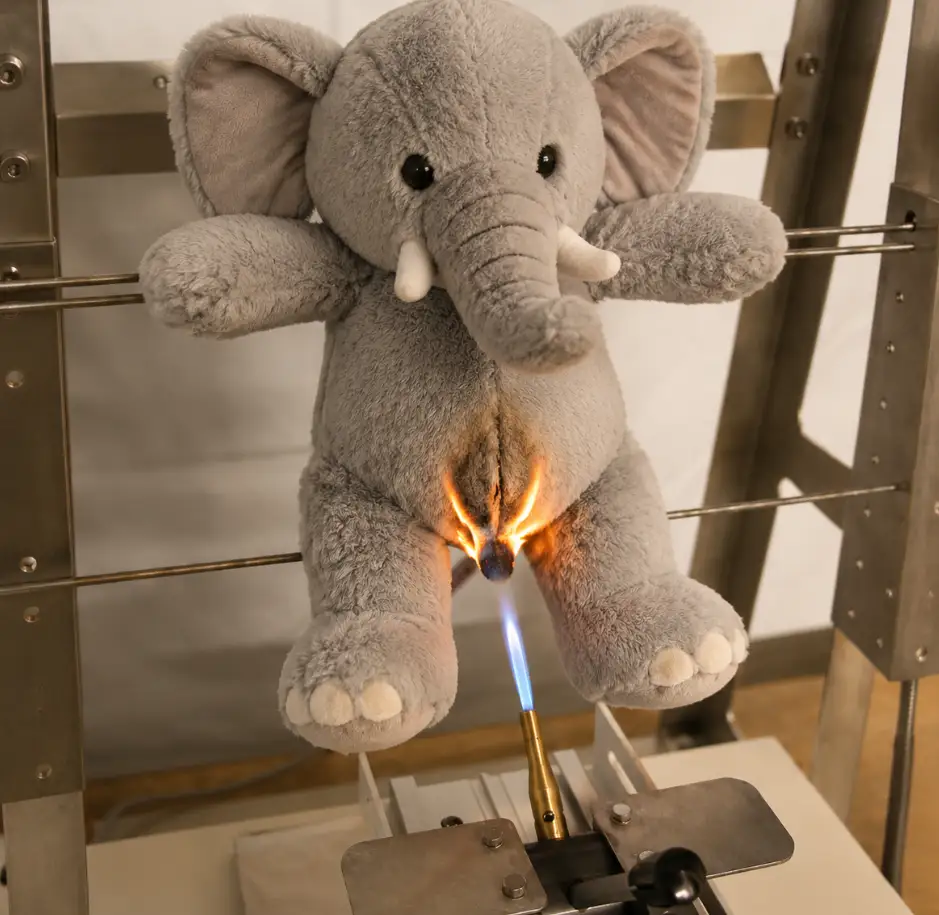
EN71-2 evaluates how quickly and in what manner a toy’s materials burn when exposed to a small flame under controlled laboratory conditions. Most plush toy fabrics — polyester-based plush, cotton blends, and common filling materials — are tested to confirm they do not exhibit rapid or uncontrolled flame spread, and that any burning that does occur self-extinguishes within the timeframes the standard specifies.
The standard distinguishes between toys intended to be worn (such as costumes) and general toys, applying different and generally stricter criteria to wearable items because of the proximity of burning material to a child’s skin during use. Most plush toys fall under the general toy category, but hybrid products such as plush hats, plush costume accessories, or wearable plush items should be evaluated against the wearable-toy flammability criteria specifically.
Flammability Testing Criteria Under EN71-2
| Test Element | What Is Measured | Pass Criteria (General Category) |
|---|---|---|
| Flame application | Time material is exposed to test flame | Standardized exposure per test method |
| Burn rate | Speed at which flame spreads across material | Must not exceed defined maximum spread rate |
| After-flame time | Duration material continues burning after flame source removed | Must self-extinguish within specified time |
| Flaming debris | Whether burning material drips or detaches | No flaming debris permitted to fall from material |
How Does EN71-3 Chemical Migration Testing Work for Plush Toy Materials?
EN71-3 addresses a different category of risk entirely — not physical injury but chemical exposure through skin contact, saliva contact, or ingestion of small material fragments. The test measures how much of a restricted element migrates out of a toy material under simulated digestive or contact conditions, rather than simply measuring how much of that element is present in the raw material. This distinction matters because a material can contain a restricted element in a bound, non-migratory form that presents negligible actual exposure risk, which is why migration testing — not total content testing — is the standard EN71-3 methodology.
Heavy Metals Tested Under EN71-3
EN71-3 sets migration limits for a defined list of elements, with different limits depending on the material category being tested (dry/brittle/powder-like materials, liquid/sticky materials, and scraped-off materials each have distinct limit categories). For plush toys, the most relevant applications are dyed and printed fabric, plastic safety eyes and accessories, and any surface coatings or paints used in decoration.
Selected EN71-3 Migration Limits for Dry/Brittle Toy Materials
| Element | Migration Limit (mg/kg) | Common Plush Toy Source |
|---|---|---|
| Antimony | 45 | Polyester fiber processing residues |
| Arsenic | 3.8 | Certain pigments and dyes |
| Barium | 4500 | Some plastic accessory compounds |
| Lead | 2 | Pigments, low-grade plastic accessories |
| Cadmium | 1.3 | Certain colorants and pigments |
| Chromium | 0.02 (III) / 0.02 (VI) | Certain dyes and metal-plated accessories |
| Mercury | 0.5 | Rare, legacy pigment sources |
These limits are deliberately conservative, reflecting the standard’s assumption of prolonged and repeated contact typical of how children actually use plush toys — mouthing, hugging, and extended skin contact — rather than the brief, incidental contact assumptions used for some other product categories.
Tip: Request EN71-3 test reports at the raw material level, not just the finished product level, for any new fabric color or accessory supplier. Testing at the material stage catches non-compliant dye lots before they are cut into a full production run, rather than after thousands of finished units have already been produced.
What Age Grading Requirements Affect Plush Toy Safety Testing?
Age grading is one of the most consequential decisions in the EN71 compliance process, because it determines which tests apply and how strictly they are enforced. A plush toy labeled for children 36 months and under is held to substantially stricter small parts and mouthing-related chemical requirements than the same design labeled for older children, and mislabeling a product’s intended age range — whether to avoid stricter testing or by simple oversight — is one of the more serious compliance failures a buyer can encounter.
Age Category Impact on EN71 Testing Requirements
| Age Category | Small Parts Rule | Additional Testing Considerations |
|---|---|---|
| 0–36 months | Strictest — no detachable small parts permitted | N-Nitrosamine testing (EN71-12) applies to mouth-contact materials |
| 36 months and above | Small parts permitted if securely fixed and warning label applied | Standard mechanical and chemical testing applies |
| All ages / general market | Testing conducted to the strictest applicable threshold | Recommended when target age range is unclear or mixed |
The age grading decision should be made deliberately and early in product development, since it affects component selection — whether safety eyes can be used at all, whether embroidered features are required instead, and what filling materials and containment methods are appropriate — rather than being treated as a labeling detail decided after the product design is finalized.
Tip: When a plush toy’s target audience spans both under- and over-36-month age ranges, design and test to the stricter under-36-month requirements rather than assuming the toy will only reach the intended older audience. Products routinely end up in the hands of younger siblings regardless of the age range printed on the label.
How Is EN71 Testing Conducted and What Documentation Should Buyers Require?
EN71 testing is performed by accredited third-party laboratories using standardized test methods defined within each part of the standard. Testing is destructive in most cases — samples are pulled apart, burned, or chemically extracted — which is why testing is performed on representative samples rather than on every individual unit produced.

Sampling and Batch Testing Protocol
A defensible EN71 testing program tests at two distinct points: once during product development, on pre-production or counter samples, to confirm the design and material combination meets the standard before mass production begins; and again on production batch samples, to confirm that actual production units — using bulk materials and full-scale manufacturing processes — continue to meet the same standard. Testing only the development sample and assuming production units will automatically match is a common and risky shortcut, since material substitutions, supplier changes, or process drift between development and mass production can introduce compliance gaps that pre-production testing would never catch.
Test Reports and Certificates of Compliance
A proper EN71 test report identifies the specific parts of the standard tested, the specific test methods used, the sample description and date of testing, the testing laboratory’s accreditation details, and a clear pass or fail result for each individual test parameter — not just an overall summary conclusion. Buyers should request the full test report rather than accepting a one-page certificate of compliance alone, since the certificate typically summarizes results without providing the detail needed to verify testing scope and sample representativeness.
Budgeting Testing Costs Across a Product Line
Testing costs scale with the number of parts tested, the number of material and color variations submitted, and how frequently retesting is triggered by supplier or material changes. For buyers managing a plush toy product line with multiple SKUs and frequent seasonal or promotional variants, testing costs can become a meaningful line item if not planned deliberately.
A practical approach groups similar products by shared construction and material base, testing a representative sample from each group rather than treating every minor color or trim variation as requiring a completely independent test program — while still respecting the chemical migration retesting requirement that generally applies per colorway. Planning testing scope during the product development phase, rather than reactively after a product line has already expanded, consistently produces lower total testing costs without compromising the compliance coverage each individual SKU requires.
Tip: Verify the testing laboratory’s accreditation independently rather than relying solely on the logo or name printed on the report. Reputable laboratories are typically accredited under ISO/IEC 17025, and their accreditation status can be checked against the relevant national accreditation body’s public registry.
What Common Plush Toy Components Most Often Fail EN71 Testing?
Understanding where compliance failures most commonly originate helps buyers focus quality oversight on the components that carry the highest risk, rather than spreading equal scrutiny across every part of the product.
Common EN71 Failure Points in Plush Toy Components
| Component | Typical Failure Mode | Relevant EN71 Part |
|---|---|---|
| Safety eyes/noses | Detachment under tension or torque testing | EN71-1 |
| Dyed outer fabric | Heavy metal migration above allowable limit | EN71-3 |
| Filling material | Excessive burn rate or after-flame time | EN71-2 |
| Printed labels and tags | Chemical migration from ink or coating | EN71-3 / EN71-9 |
| Plastic accessories (bows, buttons) | Small parts hazard for under-36-month products | EN71-1 |
| Sewn seams | Filling exposure under seam strength testing | EN71-1 |
| Scented components | Restricted allergenic fragrance compounds | EN71-13 |
Tip: Treat safety eye and accessory attachment as a process control issue, not just a component sourcing issue. Even a compliant, tested safety eye component can produce a failing tension test result if the attachment technique, backing washer alignment, or stitching reinforcement is not executed consistently on the production line.
How Does CE Marking Relate to EN71 Compliance?
CE marking is the visible declaration that a product meets all applicable EU regulatory requirements, and for toys, EN71 compliance is the primary technical basis supporting that declaration under the Toy Safety Directive. Affixing a CE mark to a plush toy without having conducted the underlying EN71 testing — or without maintaining the technical documentation file that supports the declaration of conformity — is a compliance violation regardless of whether the product would have actually passed testing if it had been conducted.
The technical documentation file that supports a CE declaration typically includes the EN71 test reports, a risk assessment identifying potential hazards specific to the product design, the declaration of conformity itself, and manufacturing and material traceability records sufficient to demonstrate that production units match the tested sample. This file must be maintained and available for inspection by market surveillance authorities for a defined period after the product is placed on the market, which is why documentation retention is as much a part of ongoing compliance as the initial testing itself.

Organic Compounds and N-Nitrosamines: EN71-9 Through EN71-12
Beyond the heavy metal migration limits set by EN71-3, the EN71-9 through EN71-11 series establishes a broader framework for restricting organic chemical compounds — including certain flame retardants, plasticizers, and solvent residues — that may be present in toy materials. These parts work together: EN71-9 sets the requirements and limits, while EN71-10 and EN71-11 define the sample preparation and analytical test methods laboratories use to verify compliance. For plush toys, this framework is most relevant to plastic accessory components, printed surface decoration, and any adhesive used in construction.
EN71-12 addresses N-nitrosamines and N-nitrosatable substances specifically, a category of concern because certain rubber and some plastic compounds can release these substances under conditions similar to mouth contact. For plush toys designed for children under 36 months — where mouthing behavior is expected and normal — any rubber or rubber-like components accessible to the mouth must meet the restrictive limits this part establishes. Most plush toys use fabric, filling, and hard plastic or metal accessories rather than rubber components, which limits EN71-12’s direct applicability, but any product incorporating rubber teething elements, rubber-backed safety eyes, or similar components should be evaluated against this requirement specifically.
What Special EN71 Considerations Apply to Weighted, Electronic, or Scented Plush Toys?
Standard plush toys — fabric shell, polyester filling, sewn or embroidered features — represent the most straightforward EN71 compliance scenario. Several increasingly common plush product categories introduce additional materials or functions that trigger additional testing requirements beyond the baseline parts already described.
Additional EN71 Testing Considerations by Plush Product Type
| Product Type | Additional Material or Function | Additional Testing Consideration |
|---|---|---|
| Weighted plush toys | Glass beads or pellet filling in internal compartments | Filling containment seam strength under increased stress; choking hazard assessment if compartment fails |
| Electronic/interactive plush | Batteries, circuit boards, speakers | Battery compartment security testing; electrical safety requirements beyond EN71 mechanical scope |
| Scented plush toys | Fragrance additives or scent capsules | EN71-13 requirements for restricted allergenic fragrance compounds |
| Plush with rubber components | Rubber teethers, rubber-backed accessories | EN71-12 N-nitrosamine testing for mouth-contact rubber |
| Plush with magnetic components | Small magnets used for closures or accessories | Additional magnet safety assessment for ingestion hazard |
Electronic plush toys deserve particular attention because battery-related hazards fall partly outside the core EN71 mechanical and chemical framework and into additional electrical safety requirements that must be assessed alongside standard EN71 testing. A battery compartment that is not sufficiently secured — typically requiring a tool or two simultaneous actions to open — represents both an EN71-1 mechanical compliance gap and a distinct battery ingestion safety hazard that regulators treat with particular seriousness given the severe injury patterns associated with battery ingestion in young children.
Tip: For any plush product outside the standard fabric-and-filling category — weighted, electronic, scented, or incorporating rubber or magnetic components — confirm with the testing laboratory in advance which additional standard parts apply before submitting samples. Discovering an additional testing requirement after the initial test report is issued adds avoidable time to the product development schedule.
How Should Buyers Evaluate a Manufacturer’s EN71 Testing Capability Before Placing an Order?
Not every plush toy manufacturer maintains the same depth of compliance capability, and evaluating this capability before committing to a production order is one of the most effective risk management steps available to a buyer sourcing for the EU market.
Questions for Evaluating Manufacturer EN71 Compliance Capability
| Evaluation Area | Question to Ask | What a Strong Answer Looks Like |
|---|---|---|
| Testing history | Can you provide EN71 test reports for products similar to ours? | Specific reports naming test parts, methods, and results — not just certificates |
| Material traceability | How do you track which material lot was used in which production batch? | Documented lot tracking system linked to purchase and production records |
| Internal quality checks | Do you conduct any internal pre-testing before submitting to a third-party lab? | Internal tension, torque, or basic flammability screening before formal testing |
| Change management | What is your process when a material supplier changes? | Documented retesting trigger tied to any material substitution |
| Laboratory relationships | Which accredited laboratories do you work with? | Named, independently verifiable ISO/IEC 17025 accredited labs |
A manufacturer that answers these questions with specific, documented processes rather than general reassurances is demonstrating a genuine compliance capability rather than simply asserting one. This distinction matters most for buyers working with a new manufacturing partner for the first time, where no production history yet exists to validate compliance claims against actual outcomes.
Tip: For a first order with a new manufacturing partner, commission independent EN71 testing on the pre-production sample even if the manufacturer provides their own test reports. This establishes an independent baseline and verifies that the manufacturer’s documented testing capability produces results consistent with third-party verification before committing to full production volume.
What Steps Should Buyers Take to Ensure Ongoing EN71 Compliance Across Production Runs?
EN71 compliance is not a one-time achievement tied to a single test report — it is an ongoing condition that must hold true across every production batch, every material lot, and every minor design revision made after the original testing was completed.
- Require batch-level retesting whenever a material supplier, fabric dye lot, or accessory component changes from what was originally tested.
- Maintain a documented change log for any design revision, however minor, and assess whether the revision requires updated testing before it is approved for production.
- Request updated test reports on a defined periodic basis for long-running products, since material formulations from suppliers can shift over time without a corresponding notification.
- Build EN71 documentation requirements directly into purchase agreements, specifying which parts of the standard must be tested, what age grading applies, and what report detail is required before shipment.
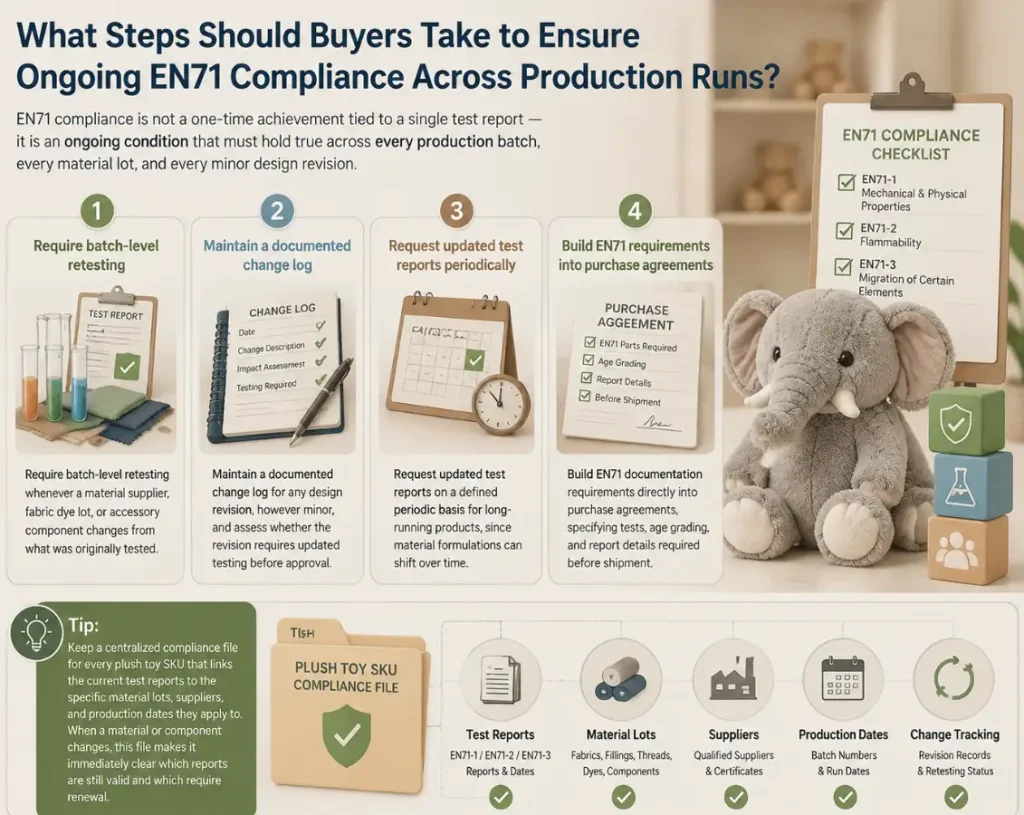
Tip: Keep a centralized compliance file for every plush toy SKU that links the current test reports to the specific material lots, suppliers, and production dates they apply to. When a material or component changes, this file makes it immediately clear which previously issued test reports are still valid and which require renewal.
Frequently Asked Questions
Q1: Is EN71 testing legally required to sell plush toys in the European Union?
Yes. Any toy, including plush toys, placed on the market in the European Economic Area must comply with the EU Toy Safety Directive, and EN71 is the harmonized standard used to demonstrate that compliance. A plush toy sold without the underlying testing and documentation to support a CE declaration is being sold in violation of EU market access requirements, regardless of whether the product itself would have passed testing if it had been conducted. Market surveillance authorities in EU member states can and do request this documentation, and non-compliant products can be removed from sale or recalled.
Q2: Does EN71 testing need to be repeated for every color variation of the same plush toy design?
In most cases, yes, at least for the chemical migration testing under EN71-3, because different dye colors and formulations can introduce different heavy metal migration profiles even when the base fabric and construction are identical. Mechanical testing under EN71-1 may not need to be repeated if the physical construction, attachment methods, and dimensions are unchanged between color variants, but chemical testing is generally required per colorway unless the dye supplier can provide documentation confirming the specific colors used were included in an already-completed test.
Q3: What is the difference between EN71-3 total content limits and migration limits?
EN71-3 specifically measures migration — the amount of a restricted element that can be extracted from the material under simulated digestive or contact conditions — rather than the total amount of that element present in the raw material. A material can contain a restricted element in a chemically bound form that does not readily migrate, meaning it could pass a migration test even though total content testing might show measurable presence of the element. This is a deliberate design choice in the standard, reflecting the actual exposure risk to a child rather than the theoretical presence of a substance in the material.
Q4: Can a plush toy pass EN71-1 mechanical testing but still be unsafe for its intended age group?
This is possible if the age grading applied during testing does not match the toy’s actual likely audience. A toy tested and passed against the requirements for children 36 months and older — which permit certain small parts if securely fixed — could present a genuine choking hazard if it ends up in the hands of a younger child, whether through mislabeling, gifting to a younger sibling, or simple parental oversight of the age recommendation. This is why conservative age grading, particularly for products with any realistic chance of reaching a younger audience, is a meaningful safety decision and not just a testing formality.
Q5: How long does EN71 testing typically take, and how should it be scheduled into a production timeline?
Testing duration varies by laboratory workload and the specific parts of the standard being tested, but buyers should generally plan for one to three weeks from sample submission to receiving a complete test report, with chemical migration and flammability testing typically taking longer than mechanical testing. Because testing should be completed on a pre-production or counter sample before mass production begins, this timeline needs to be built into the overall product development schedule rather than treated as a final step that happens in parallel with bulk production — testing after mass production has already started risks discovering a compliance failure after the cost of production has already been incurred.
Q6: Are handmade or small-batch plush toys exempt from EN71 requirements?
No. EN71 and the underlying Toy Safety Directive apply based on whether a product is placed on the market as a toy intended for children, not based on production volume or manufacturing method. Small-batch and handmade plush toy makers selling into the EU market are subject to the same fundamental compliance obligations as large-scale manufacturers, though the practical testing strategy — which specific parts to prioritize, how to manage testing costs across a smaller product range — may differ from the approach a high-volume manufacturer would take.
Q7: What should a buyer do if a supplier cannot provide a full EN71 test report and only offers a general compliance statement?
A general compliance statement without an accompanying test report from an accredited laboratory should be treated as insufficient documentation, not as evidence of compliance. Buyers should request the full test report showing the specific standard parts tested, the test methods used, the sample description, and detailed pass/fail results for each parameter. If a supplier cannot produce this documentation, the appropriate response is to commission independent third-party testing before accepting the product for the EU market, since the commercial and regulatory risk of relying on an unverified compliance claim falls on the party placing the product on the market, not on the supplier making the claim.
