
How to Make Plush Toys Look More Premium starts with thoughtful design, high-quality materials, refined craftsmanship, and attention to every small detail that improves the overall look, feel, and customer experience.
A practical guide to the fabric, construction, finishing, and packaging decisions that separate a plush toy that reads as premium on the shelf from one that reads as generic — with the specific levers that move perceived quality the most per dollar of added cost.
Two plush toys can be built from the same pattern, filled with the same amount of stuffing, and produced in the same factory — and still land completely differently in a buyer’s hands. One feels like a $9.99 impulse-aisle item. The other feels like something worth $28, gift-wrapped, and kept on a shelf rather than thrown in a toy bin. The difference is rarely one dramatic design choice. It is almost always the accumulation of a dozen smaller decisions — about fabric, stuffing, stitching, finishing, and packaging — each of which moves the perceived value of the product a small amount, and which together determine whether a plush toy reads as premium or as generic.
This matters commercially because premium perception is one of the few product attributes that supports pricing power without requiring an entirely different product category. A brand that understands which levers actually shift perceived quality can raise average selling price meaningfully without a proportional increase in production cost — because many of the highest-impact levers cost very little to implement and are simply overlooked in standard production briefs.
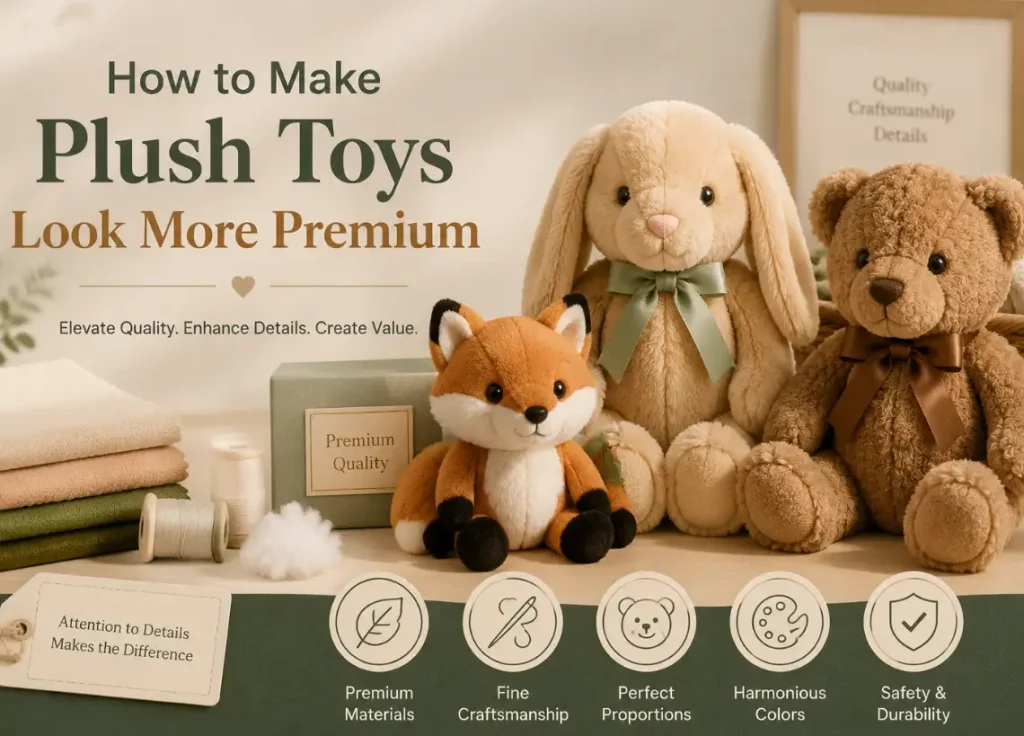
This guide works through the specific design and production decisions that make plush toys look and feel premium, organized in the order they typically get decided during development — from fabric selection through final packaging — with the practical detail needed to brief a factory correctly and evaluate samples against a genuine premium standard.
It is worth stating upfront that none of the levers covered in this guide require a fundamentally different manufacturing process or an exotic material that is difficult to source. Every attribute discussed here — fabric grade, stuffing density, stitch type, embroidery symmetry, packaging finish — is available from the same category of factories already producing mass-market plush, using the same broad production methods.
The difference between a premium result and a mass-market result is almost entirely a matter of specifying these attributes precisely in the brief, verifying them at the sample stage, and holding the production run to the same standard the sample achieved. This is, in a sense, encouraging: it means premium perception is largely a decision-quality problem rather than a capital-investment problem, and it means the gap between a brand’s current plush toy line and a noticeably more premium version of the same line is often closer than it appears.
What Makes a Plush Toy Look Premium Instead of Cheap?
Before addressing individual levers, it is worth being precise about what “premium” actually means in a plush toy context, because the term gets used loosely and this looseness leads to briefs that ask for “a more premium feel” without specifying anything a factory can actually act on.
A plush toy reads as premium when its material quality, construction precision, and finishing details all exceed what the buyer unconsciously expects at the price point being signaled by the product’s category and packaging. Premium perception is fundamentally a mismatch in the buyer’s favor — the product feels like it should cost more than it does, or behaves as if it belongs to a higher price tier than its neighbors on the shelf. Conversely, a plush toy reads as cheap when any one of these dimensions — material, construction, or finishing — falls visibly short of what the category and price point lead the buyer to expect, even if the other dimensions are strong.
This asymmetry is the single most important fact about premium perception in plush toys: buyers evaluate quality on the weakest link, not the average. A plush toy with beautiful fabric, generous stuffing, and sloppy seam stitching will be remembered for the sloppy stitching. A design brief that improves nine attributes while leaving one attribute at a mass-market standard will not produce a premium-feeling product — it will produce a product that feels inconsistent, which reads as a different and less trustworthy kind of cheap.
Perceived Quality Signals: What Buyers Notice First When Handling a Plush Toy
| Sense Buyers Use | What They’re Actually Evaluating | Typical First Impression Window |
|---|---|---|
| Touch (hand contact) | Fabric pile softness, seam smoothness, stuffing firmness | Under 3 seconds |
| Sight (close inspection) | Stitch evenness, embroidery crispness, color saturation | 3–8 seconds |
| Weight in hand | Stuffing density, fabric weight (GSM), overall heft | Immediate, subconscious |
| Smell | Chemical odor from uncured adhesives or low-grade filling | Immediate, and disqualifying if negative |
| Sound (squeeze test) | Whether stuffing shifts, settles, or crunches unnaturally | Often tested unconsciously by adult buyers |
Understanding this sequence matters because it tells a design team where to concentrate limited budget. If a buyer forms a negative first impression from touch within three seconds, no amount of packaging sophistication recovers that impression once the toy is out of the box. Premium plush design therefore prioritizes the attributes buyers notice in the first several seconds of physical contact — fabric and stuffing — ahead of attributes that matter more on the shelf, before the toy is touched, such as packaging graphics.
Tip: Audit a sample the way a first-time buyer would: close your eyes, pick it up, and squeeze it before you look at it. If the first three seconds of touch don’t already feel premium, no amount of packaging or branding will fully correct the impression once the buyer’s hands are on the product.
Why Fabric Choice Is the Single Biggest Driver of Perceived Quality
If a single lever accounts for the largest share of perceived premium quality in a plush toy, it is the outer fabric. Fabric is the first thing touched, the largest surface area on the product, and the material property most directly responsible for the “soft” sensation that anchors a buyer’s overall quality judgment. Upgrading fabric quality is consistently the highest-leverage change available in a plush toy redesign, because it affects the dominant sense — touch — more than any other single decision.
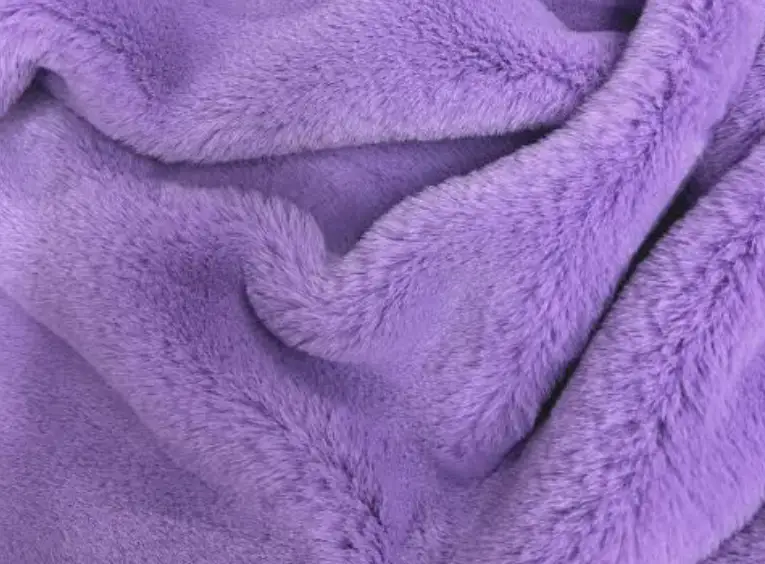
Fabric quality is determined by several measurable properties that most sourcing briefs never specify explicitly: pile height, pile density, fiber composition, and finishing treatment. Two fabrics can look identical in a photograph and feel dramatically different in hand, because photographs do not capture pile density or the surface finishing that determines whether a fabric feels silky, plush, or coarse against skin.
Plush Fabric Grades and Their Effect on Perceived Premium Quality
| Fabric Attribute | Mass-Market Standard | Premium Standard | Perceived Effect |
|---|---|---|---|
| Pile height | 3–5 mm, short and uniform | 8–15 mm depending on style, or engineered variable pile | Longer, well-groomed pile reads as plusher and more huggable |
| Pile density | Sparse, base fabric visible when parted | Dense, base fabric hidden even when brushed against grain | Density is what the hand actually registers as “soft” |
| Fiber type | Standard polyester with coarse hand-feel | Fine-denier polyester or polyester-microfiber blends | Finer denier fiber feels silkier at the same pile height |
| Surface finish | Unfinished or minimally brushed | Brushed, sheared, or anti-pilling treated | Finishing removes the “synthetic” feel buyers associate with cheap plush |
| Colorfastness | Basic dye, prone to fading and bleeding | High colorfastness rating, resistant to fading in wash and sun | Retained color saturation over time supports long-term premium perception |
The practical implication is that a fabric upgrade brief should never simply say “use nicer fabric.” It should specify pile height ranges, request fine-denier or microfiber options where budget allows, and explicitly request brushed or sheared finishing on the outer pile — because these are the specific, orderable attributes that separate a coarse, mass-market hand-feel from a soft, premium one.
Fabric Selection by Product Category
Different plush categories benefit from different fabric strategies, and applying a single fabric standard across an entire product line often wastes budget on categories where the upgrade delivers little perceived benefit, while underinvesting in categories where fabric quality is the dominant purchase driver.
- Huggable companion plush (bedtime toys, comfort objects): Fabric quality is the dominant purchase driver. This is where the highest-pile, finest-denier fabric investment pays off most directly, because the product’s entire value proposition is physical comfort.
- Character and licensed plush: Fabric quality matters, but color accuracy and surface detail fidelity to the source character compete for budget with fabric upgrades. A mid-tier fabric with excellent color matching often outperforms a premium fabric with a slightly off-color.
- Collectible and display plush: Fabric sheen and structure matter more than softness, since these products are handled less and displayed more. A shorter, denser, more structured pile that holds its shape often reads as more premium than a long, loose pile that flattens.
- Interactive and functional plush: Fabric must balance softness against durability and washability, since these products see heavier physical use. Anti-pilling treatments and reinforced high-wear zones matter more here than maximum pile height.
Tip: Request physical fabric swatches with named grades and certification status before committing to a bulk fabric decision — never approve a fabric upgrade from a photograph or a written description alone. Pile density and fiber fineness are tactile properties that do not translate reliably through images.
How Does Stuffing Density and Distribution Change the Way a Plush Feels?
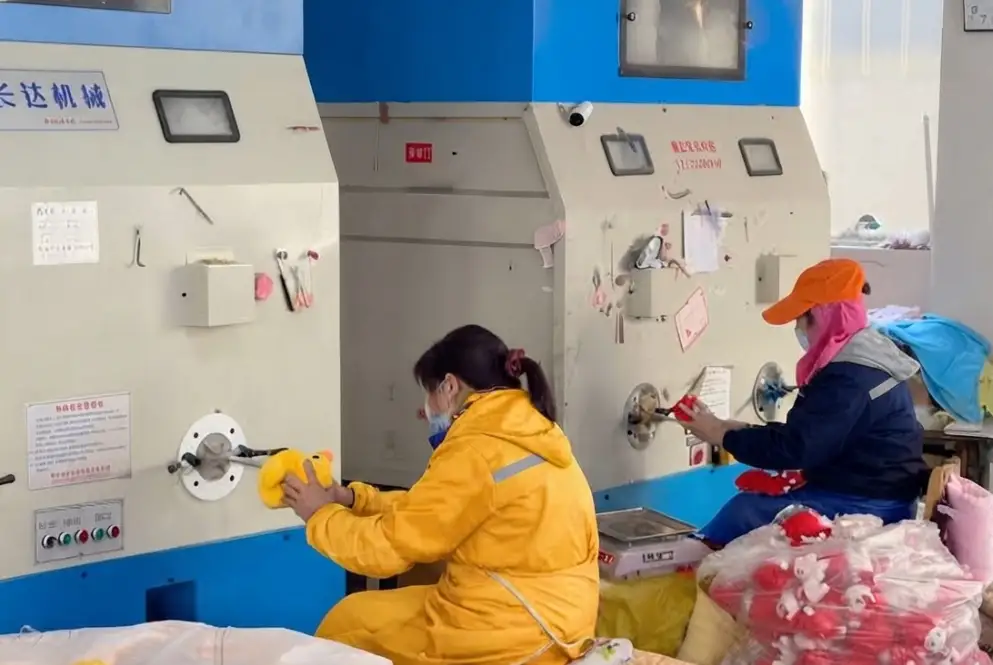
Stuffing is the second-largest contributor to perceived quality, and it operates through a different sense than fabric: weight and firmness in hand, rather than surface touch. A plush toy that is under-stuffed feels hollow and cheap regardless of how good the outer fabric is, while one that is over-stuffed in the wrong places feels stiff and loses the soft, yielding quality that makes plush toys appealing to hold.
The premium standard for stuffing is not simply “more filling.” It is filling distributed with intention — firm enough in structural areas like the head and torso to hold shape, soft enough in areas meant to be squeezed or hugged to yield naturally under pressure, and consistent enough across the production run that no units feel noticeably lumpy or under-filled compared to others.
Stuffing Density Targets by Plush Toy Body Zone
| Body Zone | Stuffing Intent | Common Mass-Market Mistake |
|---|---|---|
| Head | Firm enough to hold facial shape and prevent sagging | Under-stuffed, causing the face to look “deflated” over time |
| Torso/body | Medium-firm, structural but still soft to hug | Overstuffed to save labor, producing a stiff, ball-like feel |
| Limbs/ears | Soft and pliable, should droop or bend naturally | Stuffed as firmly as the torso, eliminating natural movement |
| Seams and extremities | Light stuffing to avoid seam strain | Packed tightly, causing visible seam stress and premature failure |
Filling material choice also affects perceived quality independent of quantity. Standard polyester (PP cotton) fiberfill is the industry default and, at higher grades, performs well. Lower grades of PP cotton clump after washing or handling, producing lumpy distribution that reads as a defect even when the initial fill was even. Requesting a named fiberfill grade — rather than accepting “standard filling” as a specification — is a low-cost way to protect stuffing quality across a full production run.
The Weight-in-Hand Test
One of the most reliable predictors of how a plush toy will be judged is its weight relative to its size — a property buyers register almost instantly and largely subconsciously when picking a product off a shelf. A toy that feels lighter than its visual size suggests reads as hollow and cheap, even if the buyer cannot articulate why. Weighing finished samples against a target gram-per-liter-of-volume benchmark, and comparing that figure against premium competitor products in the same category, is a concrete way to validate that a plush toy will pass this instinctive test before mass production begins.
Tip: Weigh your finished sample against a known premium competitor product of similar size. If your sample is meaningfully lighter, buyers will register it as “cheap” within the first second of picking it up — even if they never consciously notice the weight difference.
What Stitching and Seam Details Signal Quality to a Buyer’s Hands?
Stitching is the attribute most likely to be inspected closely by a buyer who is already interested in a product, because seams are where a plush toy’s construction becomes visible and tactile at the same time. A buyer who has already decided the fabric feels good will often run a finger along a seam next — and what they find there either confirms or contradicts the quality impression the fabric created.
Premium stitching is defined by three properties: stitch evenness, seam strength, and seam concealment. Stitch evenness means consistent stitch length and tension along the entire seam, without visible puckering or loose loops. Seam strength means the seam can withstand the stress of stuffing, handling, and normal play without gapping or splitting. Seam concealment means the stitching itself is either hidden inside the seam allowance or executed cleanly enough that it reads as intentional rather than crude.
Stitching and Seam Quality Benchmarks
| Construction Element | Mass-Market Approach | Premium Approach |
|---|---|---|
| Stitch type | Single-needle straight stitch throughout | Reinforced double-stitching at stress points (neck, limb joints) |
| Thread quality | Standard polyester thread, visible sheen mismatch | Color-matched, higher tensile-strength thread |
| Seam allowance | Minimal, prone to fraying and gapping under stress | Generous, with seam finishing to prevent fraying |
| Closing stitch (ladder stitch) | Visible, uneven closing seam after stuffing | Hand-finished or precision-machine ladder stitch, nearly invisible |
| Attachment points (limbs, ears, tail) | Single-layer stitching, prone to detachment | Reinforced attachment with bar-tack or box stitching |
The closing stitch — the seam used to sew the toy shut after stuffing — deserves particular attention because it is frequently the weakest point in mass-market production and one of the first places an inspecting buyer looks. A visibly uneven or loose closing stitch undermines the quality impression of an otherwise well-made toy, because it signals that finishing quality control is inconsistent even where the bulk construction is solid.
Reinforcement at Predictable Stress Points
Certain construction points on a plush toy experience disproportionate mechanical stress during normal handling: limb and ear attachment points, neck seams on toys that get carried by the head, and tail attachments on toys with hanging appendages. Premium construction reinforces these points specifically — through bar-tack stitching, box-stitch patterns, or double-layer fabric at the attachment — rather than applying uniform stitching strength across the entire toy.
This targeted reinforcement is inexpensive relative to the failure it prevents, and failure at these points (a detached ear, a gaping neck seam) is one of the most damaging quality failures a plush toy can experience, because it appears to buyers as a safety and durability failure rather than a cosmetic one.
Tip: Specify reinforced stitching by name — bar-tack or box-stitch — at every limb, ear, and appendage attachment point in the production brief. This is one of the least expensive upgrades available and prevents the single most damaging type of quality failure: a detached part.
How Do Embroidery and Surface Detailing Elevate Perceived Value?
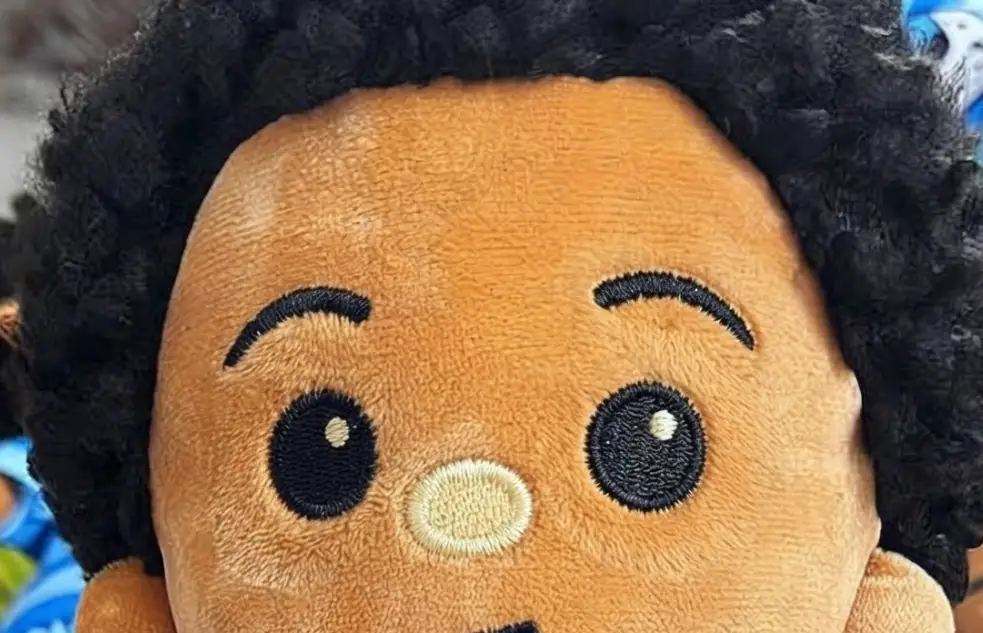
Facial features and surface details carry disproportionate weight in premium perception because they are what give a plush toy character and expression — the qualities that create emotional attachment rather than purely tactile appeal. A plush toy with excellent fabric and stuffing but a crude, asymmetrical embroidered face will still be perceived as lower quality, because facial asymmetry is processed by human vision almost instantly and reads as a flaw even to buyers who cannot articulate what looks wrong.
Embroidery quality is determined by stitch density, digitizing precision, thread quality, and — critically — symmetry. Embroidered eyes, noses, and mouths that are even slightly misaligned between the left and right side of a face produce a subconscious unease in viewers, an effect well documented in how humans process facial symmetry generally. This makes embroidery digitizing and placement accuracy one of the highest-leverage, lowest-cost quality investments available in plush toy production.
Facial and Surface Detail Elements That Drive Perceived Character Quality
| Detail Element | Common Failure Mode | Premium Standard |
|---|---|---|
| Eye placement | Slight left-right asymmetry, uneven height | Templated, jig-guided placement verified against a symmetry standard |
| Embroidered mouth/nose | Thin, flat stitch density; visible backing fabric | Higher stitch density; satin-stitch fill without gaps |
| Safety eyes/nose (plastic components) | Visible mold seams, inconsistent gloss | Polished, seam-free components with consistent gloss and color |
| Applique details (patches, layered fabric accents) | Raw edges, visible fraying, uneven placement | Sealed or bonded edges, precision placement, reinforced stitching |
| Printed or heat-transfer details | Cracking, fading, or peeling after limited handling | Durable ink or embroidery substitution for high-wear printed areas |
Where budget allows, substituting embroidery for printed detail on high-wear or high-visibility areas — even on a single feature, such as the eyes or a chest emblem — often produces a disproportionate perceived-value gain relative to its cost, because printed detail is precisely the kind of surface treatment that mass-market plush relies on, and its absence (replaced with dimensional embroidery) is one of the most immediate visual signals of a higher production tier.
Tip: Insist on a symmetry check at the first sample stage — hold the sample face-on and compare left and right eye height, spacing, and mouth alignment directly. Asymmetry that is barely visible in a factory photo becomes obvious and off-putting the moment a buyer holds the product in their hands.
What Role Do Color Matching and Finishing Play in Premium Perception?
Color plays a subtler but still significant role in premium perception, operating primarily through consistency and saturation rather than the specific hue chosen. Premium plush toys use colors that are richly saturated, evenly applied, and consistent from unit to unit — while mass-market plush frequently exhibits color variation between production batches, faded or muted tones from lower-grade dye processes, and visible color bleed at fabric edges or seams.
Batch-to-batch color consistency matters more for perceived premium quality than most buyers consciously realize, because it affects trust rather than aesthetics directly. A buyer who orders the same product twice and receives visibly different shades on each order interprets the discrepancy as a quality control failure — even if each individual unit looks acceptable on its own. This is a particular risk in plush toy production because dye lot variation between fabric batches is common, and factories without disciplined color-matching processes will not flag the variation before shipment.
Finishing Touches That Reinforce a Premium Read
Beyond color and embroidery, several smaller finishing decisions contribute to overall premium perception disproportionately to their cost:
- Trimmed and groomed pile: Fabric pile that has been trimmed to an even length and brushed in a consistent direction reads as more deliberate and higher-grade than pile left in its raw, uneven post-cutting state.
- Consistent gloss on plastic components: Safety eyes, noses, and any plastic accessory should have matched gloss and finish — mismatched matte-and-glossy components on the same face read as a mixed-quality assembly.
- Clean thread trimming: Loose thread ends, a common and inexpensive-to-fix defect, are one of the fastest ways to undo an otherwise strong quality impression during final inspection.
- Even hem and edge finishing on accessories: Bows, collars, and fabric accents should have finished, non-fraying edges — raw-cut fabric edges on accessories are a common tell of cost-cutting in mass-market production.
How Does Packaging Change the Perceived Value of the Same Plush Toy?
Packaging operates on the buyer before the product is ever touched, which makes it the first opportunity — and in retail and e-commerce contexts, often the only opportunity before purchase — to set a quality expectation. Because packaging is judged first and the physical product is judged second, premium packaging that oversells a mediocre physical product produces disappointment, while modest packaging that undersells a genuinely well-made plush toy leaves value on the table by failing to signal the quality that the product itself actually delivers.
The goal, therefore, is not simply “better packaging” but packaging that accurately signals the actual quality tier of the product inside it — while taking advantage of the specific packaging levers that most efficiently communicate premium quality relative to their cost.
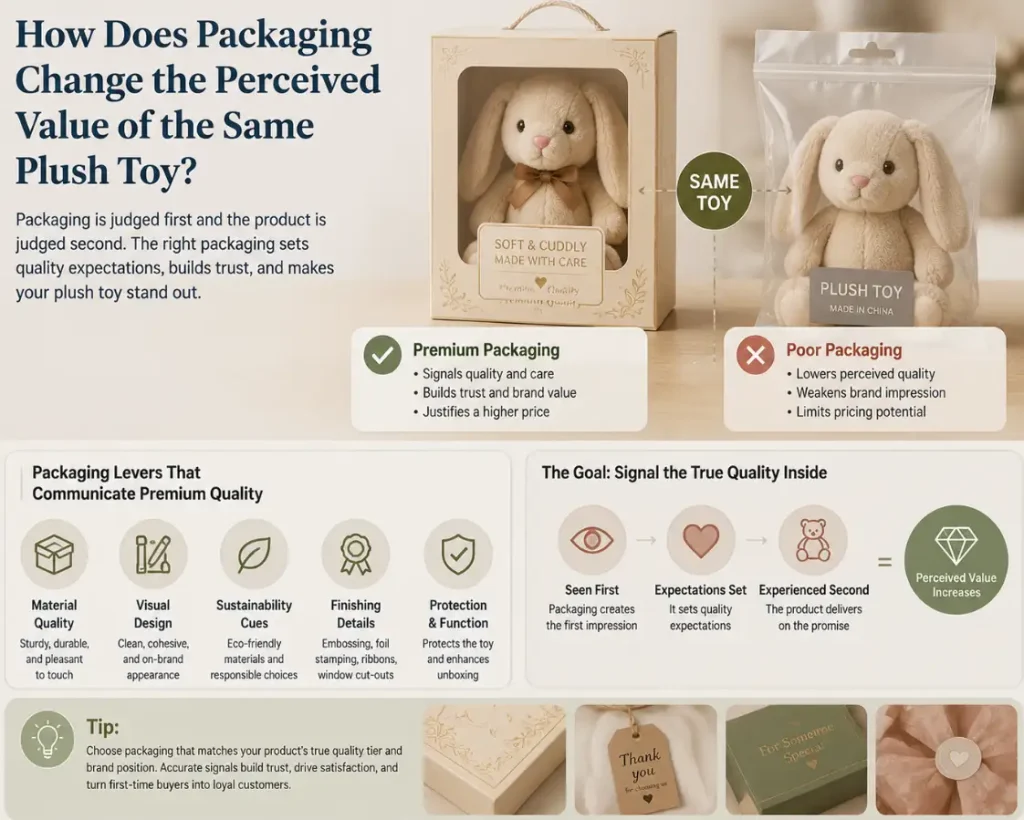
Packaging Elements Ranked by Perceived-Value Impact per Unit Cost
| Packaging Element | Relative Cost | Perceived-Value Impact | Notes |
|---|---|---|---|
| Rigid or semi-rigid gift box vs. poly bag | High | Very high | Strongest single lever, but adds meaningful unit cost and shipping volume |
| Branded tissue paper or interior wrap | Low | High | Disproportionately strong impact given minimal cost |
| Printed hang tag with premium paper stock | Low–medium | Medium–high | Paper weight and finish (matte vs. glossy) matter more than tag size |
| Matte lamination vs. gloss on printed packaging | Low | Medium | Matte finishes are broadly associated with premium positioning currently |
| Ribbon or fabric closure detail | Low | Medium | Small tactile detail at the moment of unboxing |
| Clear poly bag with header card only | Very low | Low | Standard mass-market default; sets a low quality expectation |
The most efficient packaging investments, per this framework, are the low-cost, high-impact choices — interior tissue wrap, matte finishes, paper stock quality on tags — that most mass-market briefs skip by default rather than by deliberate cost decision. Moving from a standard poly bag to even a modest branded interior treatment often produces more perceived-value gain per dollar spent than a full transition to rigid packaging, which carries much higher unit and shipping costs for a comparatively smaller marginal gain in perception once tissue and finish upgrades are already in place.
Tip: Before committing to expensive rigid packaging, test the cheaper packaging upgrades first — interior tissue wrap, matte lamination, and paper-stock hang tags. These low-cost changes frequently deliver a larger perceived-value gain per dollar than a full packaging tier upgrade, and they can be layered together within a modest budget increase.
What Small Design Details Separate Premium Plush From Mass-Market Plush?
Beyond the major categories already covered, a set of smaller design decisions consistently distinguishes premium plush toys from mass-market equivalents. None of these individually determines a product’s perceived quality tier, but each contributes incrementally, and together they explain much of the gap between plush toys that feel “designed” and those that feel merely “produced.”
Proportional Design and Silhouette
Premium plush toys tend to follow deliberate proportional rules — head-to-body ratios, limb length relative to torso, and eye size relative to face — that produce a pleasing, cohesive silhouette rather than proportions dictated purely by manufacturing convenience. Mass-market plush frequently defaults to whatever proportions minimize pattern complexity and fabric waste, which can produce an “off” silhouette that undermines an otherwise well-executed product.
Pose and Structural Support
Plush toys designed to sit, stand, or hold a pose — rather than simply flopping into a shapeless pile when placed down — read as more considered and premium. This can be achieved through internal wire or plastic armature in limbs, weighted bottoms using pellet filling, or structural stitching that encourages a specific resting posture. A plush toy that can be posed or that sits attractively on a shelf extends its perceived value beyond the moment of hugging into the moment of display.
Tactile Variety Within a Single Product
Premium plush design frequently introduces tactile contrast within a single product — a short, smooth fabric on the face contrasted with a longer, plusher pile on the body, or a soft fabric body paired with a slightly textured fabric accessory. This contrast gives the product more sensory interest than a single uniform fabric throughout, and it signals a level of design intention that a single-fabric mass-market plush toy typically lacks.
Small Design Levers and Their Typical Cost-to-Impact Ratio
| Design Lever | Added Production Cost | Typical Perceived-Value Impact |
|---|---|---|
| Tactile fabric contrast (2+ fabric types per unit) | Low–medium | Medium–high |
| Weighted base for sitting posture | Low | Medium |
| Wire or bendable armature in limbs/ears | Medium | Medium–high |
| Refined proportional silhouette (design-stage only) | None at production; design time only | High |
| Branded interior tag or paw print detail | Very low | Low–medium |
The proportional silhouette lever is worth emphasizing because it costs nothing in production once finalized — the entire cost is invested at the design stage, in pattern development and sample iteration, before mass production begins. This makes it one of the highest-return investments available, since a well-proportioned silhouette benefits every unit produced at zero incremental manufacturing cost, unlike fabric or packaging upgrades that add cost to every single unit.
Tip: Invest disproportionately in pattern and proportion refinement during the design and sampling stage, even if it means additional sample rounds. Silhouette and proportion cost nothing extra at mass production once finalized, but a poorly proportioned pattern will undermine perceived quality on every single unit produced.
What Common Mistakes Undermine an Otherwise Premium Plush Toy Design?
Even design teams that get the major levers right — fabric, stuffing, stitching, embroidery, packaging — frequently see a premium product underperform in the market because of a small number of recurring mistakes that quietly cancel out the investment made elsewhere. These mistakes are worth naming specifically, because each one is common enough to have a predictable pattern and specific enough to be prevented once a design team knows to look for it.
Treating “Premium” as a Single Fixed Recipe
One of the most common mistakes is applying the same premium recipe — the same fabric grade, the same packaging tier, the same finishing details — uniformly across an entire product line regardless of category, price point, or audience. A premium recipe calibrated for a large companion plush does not automatically translate to a small keychain-format plush or a licensed character plush with strict color-accuracy requirements. Applying a single template without adjusting for category-specific priorities wastes budget on attributes that matter less for a given product while sometimes underinvesting in the attributes that matter most for that specific category.
Approving Samples From Photographs Rather Than Physical Handling
Because so much of premium perception is tactile — fabric hand-feel, stuffing firmness, weight in hand — evaluating samples primarily through factory photographs rather than physical inspection is a structural blind spot that allows real quality gaps to pass undetected until mass production has already begun. A photograph cannot convey pile density, fiber fineness, or stuffing firmness with any reliability, which means photograph-based approval is effectively approving a description of the product rather than the product itself.
Inconsistent Execution Across a Production Run
A premium sample that is never replicated consistently across the full production run creates a worse outcome than a modest but consistent standard, because buyers who receive an inconsistent unit — even a small percentage of a run — generalize that experience to the entire brand. This is particularly common with hand-finished details like ladder stitching and embroidery symmetry, where quality depends on individual worker skill and attention rather than a machine-controlled process. Without in-line quality checkpoints specifically targeting the highest-variability construction steps, the gap between a golden sample and the average unit in a production run can widen considerably as volume increases and inspection attention is spread thinner.
Over-Investing in Visible Details While Neglecting Structural Ones
It is common for design teams to over-invest in the details that are easiest to photograph and market — bright color combinations, elaborate printed packaging, decorative accessories — while under-investing in structural attributes that are less visually obvious but more consequential to how the product actually feels in hand, such as stuffing distribution and seam reinforcement. Because structural attributes are less visible in marketing materials, they are more likely to be cut when budget pressure arrives late in development, even though cutting them causes more damage to the buyer’s actual physical experience than cutting a more visible but less structurally important detail.
Common Premium-Undermining Mistakes and Their Corrective Practice
| Mistake | Why It Happens | Corrective Practice |
|---|---|---|
| Uniform premium recipe across product categories | Convenience; one spec sheet reused across briefs | Prioritize levers by category-specific buyer expectations |
| Sample approval from photographs only | Time pressure; remote sourcing relationships | Require physical samples for tactile attributes before approval |
| Inconsistent execution across production volume | Reliance on hand-finished steps without in-line checks | Add mid-run inspection checkpoints on the highest-variability steps |
| Over-investing in visible details, under-investing in structural ones | Structural quality is less visible in marketing photos | Protect structural budget lines even under late-stage cost pressure |
Recognizing these patterns before a project reaches mass production is considerably less expensive than discovering them afterward, when the corrective options are limited to accepting a compromised run, requesting costly rework, or absorbing the reputational cost of a product that reads as inconsistent or hollow relative to its positioning.
A Premium Plush Toy Checklist Before Mass Production
Bringing all of the preceding sections together, the following checklist consolidates the decision points that most directly affect whether a plush toy reads as premium once it reaches a buyer’s hands. This is intended as a pre-production review tool — a list to walk through against a pre-production sample before bulk manufacturing is approved, since correcting any of these issues after mass production begins is dramatically more expensive than catching them at the sample stage.
Pre-Production Premium Quality Checklist
| Category | Checklist Item | Pass Standard |
|---|---|---|
| Fabric | Pile height, density, and finish confirmed against approved swatch | Matches approved swatch under direct touch comparison |
| Fabric | Colorfastness verified | No visible fading or bleeding after standard wash/rub test |
| Stuffing | Density verified by zone (head, body, limbs) | Matches specified firmness map with no lumping |
| Stuffing | Weight-in-hand comparison against benchmark product | Within target weight range for size and category |
| Stitching | Reinforcement present at limb, ear, and appendage joints | Bar-tack or box-stitch visible and consistent |
| Stitching | Closing seam inspected | Even, tight, minimal visibility |
| Facial detail | Symmetry check performed face-on | No visible asymmetry in eye height, spacing, or mouth alignment |
| Facial detail | Embroidery stitch density inspected | No visible gaps or thin coverage in satin-stitch areas |
| Finishing | Loose threads and raw edges checked | Zero loose threads; all accessory edges finished |
| Finishing | Plastic component gloss and seams inspected | Consistent gloss; no visible mold seams |
| Packaging | Interior treatment and hang tag stock confirmed | Matches approved packaging sample |
| Overall | Blind comparison against a premium benchmark product | Sample holds up in side-by-side handling comparison |
The final line item on this checklist — a blind, side-by-side comparison against an established premium benchmark product — is worth treating as a mandatory final gate rather than an optional nicety. Every individual quality attribute can pass its own specific test while the product as a whole still falls short of a genuine premium impression, because premium perception is ultimately a holistic, comparative judgment rather than a sum of independently verified specifications. Placing the pre-production sample directly next to a product the target buyer already considers premium, and evaluating both without labels, is the most reliable way to catch a gap that a checklist of individual specifications will miss.
Building the Checklist Into the Factory Brief
A checklist is only useful if it is communicated to the factory before sampling begins, not applied only as a post-hoc evaluation tool. Translating this checklist into explicit, numbered specifications in the production brief — named fabric grades, zone-specific stuffing density targets, named stitch types at named locations, an explicit symmetry tolerance for facial features — converts subjective quality language like “make it feel premium” into instructions a factory’s production team can actually execute against and be held accountable to during quality inspection.
This translation step is frequently the actual point of failure in premium plush toy development. Design teams correctly identify that a product needs to feel more premium, but the brief that reaches the factory floor still says “improve quality” rather than specifying the concrete fabric, stuffing, stitching, and finishing parameters covered in this guide — leaving the factory to interpret “premium” using its own default assumptions, which are calibrated to its existing production standard rather than the buyer’s aspiration.
Frequently Asked Questions
Q1: What is the single most cost-effective upgrade for making an existing plush toy design look more premium?
For most existing designs, the highest-return single upgrade is improving fabric pile quality — specifically moving to a finer-denier fiber with a brushed or sheared surface finish — because fabric is the first and most heavily weighted quality signal a buyer registers through touch. This upgrade typically adds a modest per-unit material cost while producing a disproportionately large improvement in the immediate hand-feel impression, which is the impression most likely to determine whether a buyer perceives the rest of the product favorably. Reinforced stitching at joint and appendage attachment points is a close second, since it is inexpensive to specify and prevents the most damaging type of visible quality failure.
Q2: How much does making a plush toy look more premium typically add to per-unit production cost?
The cost impact varies widely depending on which levers are pulled and how many are combined. Low-cost, high-impact changes — reinforced stitching at stress points, embroidery symmetry verification, interior tissue wrap, matte lamination on tags — typically add only a few percentage points to unit cost. Higher-cost changes — a full fabric grade upgrade to fine-denier fabric, rigid gift packaging, added structural armature — can add a more meaningful percentage to unit cost, often in a moderate double-digit range depending on the specific materials involved. A disciplined approach starts with the low-cost, high-impact levers first and adds higher-cost changes only where the product category and price point justify the additional investment. It is also worth tracking these costs against the retail or wholesale price increase a premium positioning typically supports, since in many categories a well-executed set of upgrades supports a price increase that comfortably exceeds the added production cost, producing a net margin improvement rather than a net cost.
Q3: Can packaging alone make a mass-market-quality plush toy feel premium, without changing the toy itself?
Packaging can shift the initial quality expectation before purchase, which affects conversion and first impression, but it cannot fully compensate for a mass-market physical product once the buyer removes it from the packaging and handles it directly. Because buyers evaluate quality on the weakest link rather than the average impression, premium packaging around a mediocre physical toy tends to produce a sharper disappointment than modest packaging around the same toy, since the packaging raised an expectation the product then failed to meet. Packaging upgrades deliver the most value when paired with genuine improvements to fabric, stuffing, and construction, rather than as a substitute for them.
Q4: How early in the design process should premium quality standards be locked in, and can they be added later?
Several of the most impactful levers — proportional silhouette, pattern structure, and the overall size and shape relationships between body parts — are effectively locked in once the pattern is finalized, and revisiting them later requires a full re-pattern and re-sampling process rather than a simple production adjustment. Fabric, stuffing density, stitching reinforcement, and packaging can generally be upgraded on an existing pattern without redesigning it. For this reason, proportional and structural design decisions deserve the most scrutiny at the earliest design stage, while material and finishing decisions retain more flexibility to be revised later in development or even mid-production-run if early samples reveal a gap.
Q5: How should a brand evaluate whether a factory sample actually meets a premium standard, rather than just trusting the factory’s own quality claims?
The most reliable evaluation method is a structured, checklist-based inspection performed directly on the physical sample — checking named fabric grade against an approved swatch, verifying stuffing density by zone through direct handling, inspecting stitching at every reinforcement point, and checking facial symmetry face-on — combined with a blind side-by-side comparison against an established premium benchmark product in the same category. Written specifications and factory assurances are a starting point, but they should always be verified against the physical sample rather than accepted on their own, since the gap between a specification on paper and its execution on the factory floor is exactly where most premium-quality shortfalls originate.
Q6: Do premium quality levers differ significantly between plush toys designed for children versus those designed for adult collectors?
The core levers — fabric quality, stuffing density, stitching integrity, facial symmetry, and packaging — apply to both audiences, but their relative priority shifts. For children’s plush, tactile softness, safety-appropriate construction, and huggability tend to dominate the premium perception, with durability and washability as important secondary factors given heavier handling. For adult collector plush, proportional accuracy, surface detail fidelity, structural pose-ability, and display packaging tend to carry more weight relative to pure softness, since collector products are frequently displayed and handled less roughly than a child’s daily companion toy. A production brief should weigh these levers according to the primary use case and audience rather than applying a single premium standard uniformly across both categories.
