
Plush Toy Hang Tags Design plays an important role in enhancing product presentation, communicating brand value, and providing essential information to customers. A well-designed hang tag not only improves the retail appeal of plush toys but also helps display safety details, care instructions, materials, and brand identity while creating a professional and trustworthy buying experience.
A complete reference on hang tag content requirements, materials, attachment methods, and design choices that keep plush toys compliant, sellable, and shelf-ready across major markets.
A plush toy hang tag is a small piece of retail real estate that carries an outsized amount of responsibility. It has to satisfy consumer product safety regulators, communicate brand identity to a shopper standing in an aisle, and survive shipping, warehousing, and shelf handling without tearing loose. Getting the design wrong does not just look unpolished — it can trigger a customs hold, a retailer compliance rejection, or a recall notice, and it can just as easily cost a sale to a shopper who never understood what made the toy worth buying.
This guide walks through what a plush toy hang tag actually needs to contain, which materials and attachment methods hold up under real production and retail conditions, how design choices affect both compliance and conversion, and where most hang tag projects go wrong. It is written for product developers, sourcing managers, and brand teams who are specifying hang tags for a plush toy program — whether that program is a single character launch or a multi-SKU retail line.
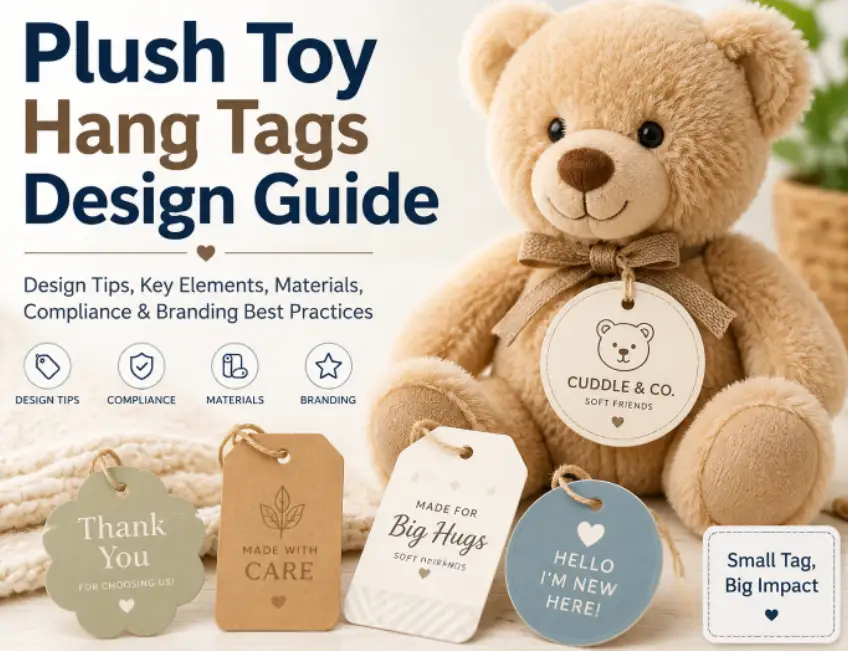
What Is a Plush Toy Hang Tag and Why Does It Matter?
A plush toy hang tag is the printed card attached to a stuffed toy — typically through the seam, an ear, a limb, or a dedicated loop — that carries regulatory information, brand content, or both. It is distinct from the sewn-in care label, which is a fabric label permanently attached inside a seam, and from the printed carton or polybag, which covers the outer packaging rather than the toy itself. A hang tag is removable by design; a care label generally is not.
The hang tag matters for three separate reasons that rarely get equal attention in early product development. The first is legal: in most consumer markets, certain safety and content information must physically accompany the toy at the point of sale, and a hang tag is one of the accepted ways to deliver it. The second is retail: buyers at big-box and specialty retailers routinely reject shipments where hang tag content, placement, or barcode formatting does not match their vendor manual, regardless of how good the toy itself is. The third is commercial: a hang tag is frequently the only piece of branded copy a shopper reads before deciding whether to buy, which makes it one of the highest-leverage, lowest-cost pieces of content in the entire product package.
Because these three functions pull in different directions — regulatory text wants to be exhaustive, retail specifications want to be exact, and brand copy wants to be short and persuasive — hang tag design is a genuine design discipline rather than an afterthought bolted onto the end of a production run. Treating it that way from the start of a product development cycle avoids the common scenario where a hang tag is redesigned twice: once when a retailer’s compliance team rejects it, and again when marketing notices it does not represent the brand.
Tip: Draft the hang tag brief at the same time as the toy’s product specification sheet, not after the sample is approved. Regulatory content, retailer formatting rules, and brand copy each need input from a different stakeholder, and starting the tag late is the single most common reason for last-minute redesigns before a shipment date.
What Information Must Appear on a Plush Toy Hang Tag?
The information that legally must appear on or with a plush toy varies by destination market, but a core set of content categories recurs across the United States, the European Union, the United Kingdom, and most other major toy markets. Getting this content correct — and current, since labeling requirements are updated periodically — is the non-negotiable foundation of hang tag design, ahead of any aesthetic consideration.
A compliant plush toy hang tag or accompanying label set typically needs to communicate age grading, safety warnings relevant to the product’s construction, country of origin, manufacturer or importer identity, fiber or material content where applicable, and any market-specific certification marks. Some of this content can live on the hang tag itself; some is more commonly carried on a sewn-in label or the retail packaging, with the hang tag referencing or reinforcing it.
Core content categories commonly required on plush toy labeling in major markets
| Content Category | What It Communicates | Typical Location | Why It Is Required |
|---|---|---|---|
| Age grading | Minimum recommended age, small parts warnings | Hang tag and packaging | Prevents unsafe use by age groups the design was not tested for |
| Choking hazard warning | Small parts, small ball, or button battery warnings where applicable | Hang tag or packaging | Mandatory disclosure tied to age grading under most toy safety frameworks |
| Country of origin | Where the toy was manufactured | Hang tag or sewn-in label | Required for customs clearance and consumer disclosure |
| Manufacturer or importer identity | Legally responsible party for the product in the destination market | Hang tag or packaging | Establishes accountability for compliance and recalls |
| Fiber or filling content | Outer fabric composition, filling material | Sewn-in label, sometimes hang tag | Consumer disclosure requirement in several markets |
| Certification marks | CE, CPC, UKCA, or other applicable safety marks | Hang tag or packaging | Demonstrates conformity assessment has been completed |
| Care instructions | Washing, cleaning, and maintenance guidance | Sewn-in label, occasionally hang tag | Consumer protection and product longevity disclosure |
One point of confusion in early-stage development is which of these categories belong on the removable hang tag versus the permanent sewn-in label. Regulators in most markets accept either location for many categories, but a practical rule is that anything the consumer needs after unboxing — care instructions, fiber content, ongoing safety guidance for parents — should live on the sewn-in label, since the hang tag is typically removed and discarded shortly after purchase. Anything needed only at the point of sale — age grading prominent enough for a shopper to see, country of origin for customs and retail compliance, certification marks a retail buyer will check during intake — belongs on the hang tag, where it is guaranteed to be visible before the toy is ever removed from its packaging.
Market-Specific Content Differences
Buyers selling into more than one market often try to design a single universal hang tag rather than market-specific versions, and this is rarely successful in practice. US requirements under the relevant consumer product safety framework differ in specific wording and format from EU requirements under the Toy Safety Directive, which differ again from UK post-Brexit requirements. A tag that satisfies one market’s exact wording requirements frequently fails another market’s formatting rules even when the underlying safety information is equivalent. The more reliable approach is to design one master content structure and produce market-specific print variants, changing only the regulatory block while keeping brand layout consistent.
What Hang Tag Materials Work Best for Plush Toys?
Hang tag material selection affects three practical outcomes: how the tag looks and feels in a shopper’s hand, how well it survives the supply chain from factory to shelf, and how much it costs at the order volumes typical of a plush toy program. The material decision is usually made on paper stock weight, coating, and finish, with texture and sustainability positioning as secondary but increasingly important factors.
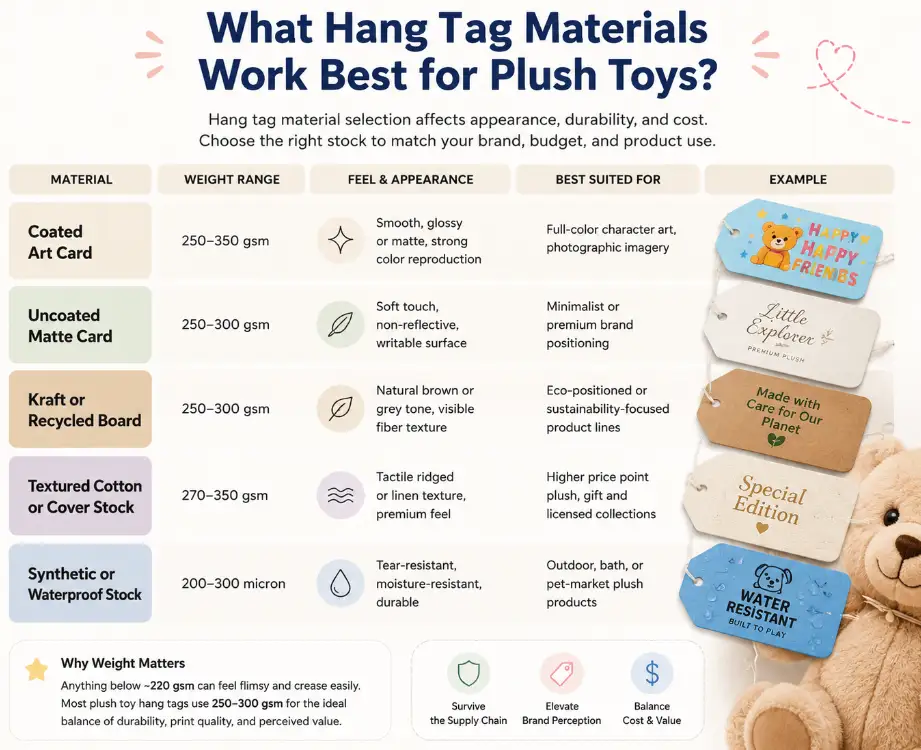
Common hang tag paper stocks and their typical plush toy applications
| Material | Weight Range | Feel and Appearance | Best Suited For |
|---|---|---|---|
| Coated art card | 250–350 gsm | Smooth, glossy or matte, strong color reproduction | Full-color character art, photographic imagery |
| Uncoated matte card | 250–300 gsm | Soft touch, non-reflective, writable surface | Minimalist or premium brand positioning |
| Kraft or recycled board | 250–320 gsm | Natural brown or grey tone, visible fiber texture | Eco-positioned or sustainability-focused product lines |
| Textured cotton or cover stock | 270–350 gsm | Tactile ridged or linen texture, premium feel | Higher price point plush, gift and licensed collections |
| Synthetic or waterproof stock | 200–300 micron | Tear-resistant, moisture-resistant | Outdoor, bath, or pet-market plush products |
Weight matters more than most first-time buyers expect. Anything below roughly 220 gsm tends to feel flimsy once printed and die-cut, and thin stock is more prone to creasing in transit, which undermines the premium impression a hang tag is often designed to create. Most plush toy hang tags land in the 250 to 300 gsm range, which balances a substantial, quality feel against cost and against the practical limits of the string or pin attachment method, since very heavy stock can tear at the attachment point under repeated handling.
Tip: Request a physical stock sample before committing to a paper weight, not just a digital proof. Screen renderings do not communicate how a card weight will actually feel, and a tag that photographs well at 200 gsm can feel noticeably cheap once it is in a shopper’s hand next to a competitor’s 300 gsm tag on the same shelf.
Sustainability Considerations in Material Choice
Retailer sustainability scorecards and consumer demand have made recycled or FSC-certified paper stock a meaningful factor in hang tag specification, particularly for buyers selling into the EU and UK, where packaging waste directives are increasingly relevant even for a component as small as a hang tag. Specifying FSC-certified stock, water-based rather than solvent-based inks, and avoiding laminate coatings that complicate recycling are all changes that can be made without altering the tag’s visual design, and increasingly these specifications are requested directly by retail buyers as a condition of listing.
What Hang Tag Shapes and Sizes Suit Different Plush Products?
Shape and size decisions should follow the size of the plush toy itself and the amount of required content, in that order — brand aesthetics come third. A tag that is proportionally too large for a small plush toy looks awkward on shelf and creates handling problems in packing; a tag too small to hold required regulatory text in a legible font size creates a compliance problem regardless of how attractive the layout is.
Typical hang tag dimensions matched to plush toy size categories
| Plush Toy Size | Typical Tag Size | Common Shape | Content Capacity |
|---|---|---|---|
| Small — keychain, mini plush (under 15 cm) | 3.8 x 6.4 cm to 5 x 7.5 cm | Rectangle, rounded corner, die-cut character silhouette | Logo, character name, basic safety symbol, QR code |
| Medium — standard plush (15–30 cm) | 5 x 9 cm to 7.6 x 12.7 cm | Rectangle, arch top, custom die-cut | Full brand block, short story copy, core compliance text |
| Large — jumbo plush (over 30 cm) | 7.6 x 15 cm to 10 x 20 cm, or folded multi-panel | Rectangle, folded booklet tag | Full compliance block, extended brand story, care instructions |
| Licensed or collectible plush | Varies by IP guideline, often larger folded formats | Custom die-cut matching IP shape or logo | IP legal text, authentication marks, collector information |
Folded, multi-panel hang tags are worth particular consideration for larger plush toys or product lines carrying dense compliance requirements across multiple markets. A single-panel tag forces a compromise between legible type size and total content volume, while a folded two- or four-panel tag effectively doubles or quadruples usable surface area within roughly the same footprint on the toy. The tradeoff is added print and finishing cost and a slightly higher chance of the fold being damaged in transit if the paper weight is too light, which is another reason the material and shape decisions need to be made together rather than in isolation.
How Should Hang Tags Be Attached to Plush Toys?
Attachment method is where hang tag design intersects most directly with toy safety, and it is an area where design preference has to yield to age-grading requirements. The core question that determines acceptable attachment methods is the intended age range of the toy: products intended for or accessible to very young children face far stricter attachment rules than products aimed at teens, collectors, or adult gift buyers.
Common hang tag attachment methods and their typical age-appropriate use
| Attachment Method | Description | Typical Age Suitability | Key Consideration |
|---|---|---|---|
| Plastic snap pin/tag gun barb | Plastic filament fastener fired through the seam | Not for infant or toddler products without removal before sale prep review | Small parts risk; must be fully removed before the toy reaches a young child |
| Safety pin | Metal pin through fabric or a fabric loop | Generally avoided for children’s plush entirely | Sharp point and small parts risk; increasingly restricted by retailers |
| String or cotton cord loop | Tag threaded on cord, tied or knotted through a seam | Acceptable for most age grades with cord length limits observed | Cord length restrictions apply under most toy safety frameworks |
| Plastic loop pin (barbed T-end) | Plastic loop fastener commonly used in apparel and plush | Widely used across age grades when fully seated and inspected | Must be inspected for secure seating and residual sharp edges |
| Sewn-in tag tab | Tag attached via a fabric tab sewn directly into a seam | Suitable across all age grades including infant plush | More secure but adds a sewing step and cost to production |
| Adhesive or sticker tag | Tag adhered directly to packaging rather than the toy | Common for infant-safe products where nothing attaches to the toy itself | Keeps the toy itself free of any attachment hardware |
For plush toys intended for infants or very young children, the safest and increasingly the standard approach is to keep all hang tag hardware on the packaging rather than the toy, or to use a sewn-in fabric tab that becomes effectively part of the toy’s permanent construction rather than a separate small part. This avoids the small-parts and choking-hazard review entirely for the tag itself, since there is no removable fastener present on the product a young child will handle.
Tip: Confirm attachment method against age grading before finalizing hang tag shape, not after. A tag designed around a plastic loop pin attachment point often needs a different die-cut hole placement than one designed for a sewn-in fabric tab, and catching this after tooling is finalized creates avoidable rework.
Attachment Point Placement on the Toy
Where the tag attaches to the toy’s body affects both the shopper’s first impression and the toy’s structural integrity. Ear attachment is common on animal-shaped plush because it keeps the tag visible without obscuring the face, but it places stress on a relatively delicate seam if the tag is pulled or the toy is picked up by the tag itself, which happens often in retail handling. A reinforced seam allowance or a dedicated fabric loop at the attachment point — rather than attaching directly through single-layer fabric — meaningfully reduces the rate of tag-related seam failure during shipping and shelf handling, and is a low-cost specification to add to a construction brief.
What Design Elements Make a Plush Hang Tag Effective for Retail?
Once compliance content and physical construction are settled, the remaining hang tag surface area is where a brand either uses the opportunity well or wastes it. Effective retail hang tag design balances four elements: immediate character or product identification, a short piece of story or benefit copy, clear pricing or barcode integration where required, and a call to action that extends the relationship past the point of sale.
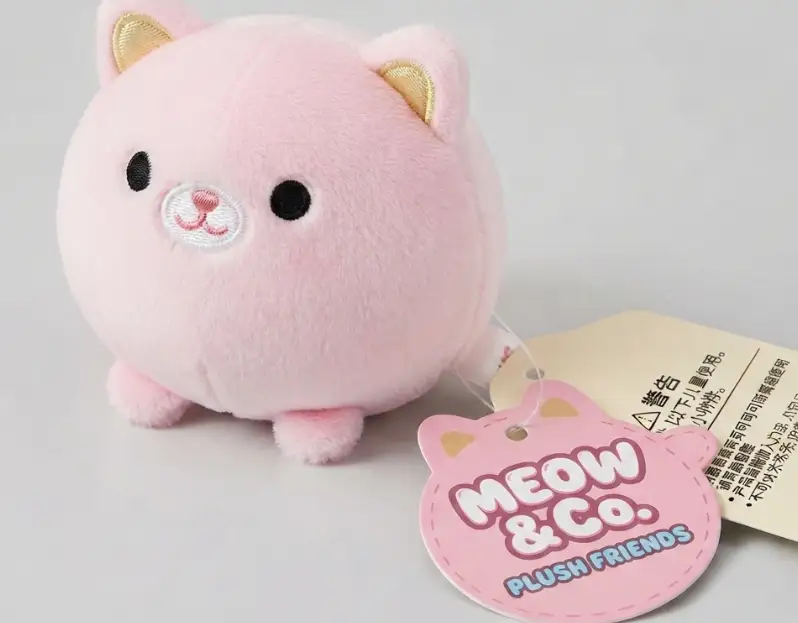
Hang tag design elements ranked by typical impact on retail conversion
| Design Element | Purpose | Common Execution | Common Mistake |
|---|---|---|---|
| Character or product name | Immediate identification and recall | Large type, front-panel placement | Buried below other copy or brand logo |
| Short story or benefit copy | Emotional connection, gift justification | One to two sentences, front or inside panel | Copy too long to read in a retail glance |
| Barcode and SKU block | Point of sale scanning, retailer compliance | Back panel, standardized placement per retailer spec | Barcode size or placement violating retailer vendor manual |
| QR code or digital link | Extends engagement, links to registration or content | Small, back panel, paired with a short value statement | QR code with no stated reason to scan it |
| Brand logo and identity system | Brand recognition across a product line | Consistent placement across all SKUs in a line | Logo treatment that changes SKU to SKU |
The most common design mistake in this category is treating the hang tag as a compliance document with decoration added, rather than as a piece of retail copywriting with compliance content included. A hang tag that leads with a dense regulatory paragraph before a shopper ever sees the character name or the reason to care about the toy is optimizing for the wrong reader — the compliance content needs to be present and correct, but it does not need to be the first thing a shopper’s eye lands on.
Tip: Reserve the front panel for identity and story, and push the full regulatory block to the back panel or an inside fold. This satisfies disclosure requirements without forcing a shopper to read a compliance paragraph before they see what the toy actually is.
Using QR Codes Effectively on Plush Hang Tags
QR codes have become a standard hang tag element, but their effectiveness depends entirely on what they link to and whether the tag gives the shopper a reason to scan. A QR code linking to a generic homepage performs far worse than one linking to a specific piece of content tied directly to the toy in hand — a short character backstory video, a product care guide, or a warranty registration page. Pairing the QR code with a short, specific instruction, rather than the code alone, measurably increases scan rates in most retail environments, since shoppers respond to a concrete reason more than to the presence of the code itself.
What Printing Techniques and Finishes Are Available for Hang Tags?
Printing method and finish selection is where hang tag cost and perceived quality diverge most sharply from each other — a well-chosen finish can make a modestly priced stock look premium, while a poorly matched printing method can make an expensive stock look flat. The right combination depends on order volume, color complexity, and the brand positioning of the toy line.
Printing and finishing options for plush toy hang tags
| Technique | Best For | Typical Volume Threshold | Visual Effect |
|---|---|---|---|
| Digital printing | Small runs, frequent SKU changes, sample development | Low volume, no minimum | Full color, moderate color accuracy, faster turnaround |
| Offset printing | Larger production runs with stable artwork | Higher volume, cost-efficient at scale | Superior color consistency and accuracy at volume |
| Foil stamping | Logos, premium accents, licensed branding | Any volume, adds per-unit cost | Metallic or reflective accent, strong shelf presence |
| Embossing or debossing | Texture-based branding without added color | Any volume, adds tooling cost | Raised or recessed tactile detail |
| Spot UV coating | Highlighting specific design elements against matte stock | Any volume, adds per-unit cost | Glossy highlight contrast against matte base |
| Die-cutting | Custom shapes beyond standard rectangles | Any volume, requires die tooling | Distinctive silhouette matching character or brand shape |
For most plush toy programs below a few thousand units per SKU, digital printing is the more economical choice despite a slightly higher per-unit cost, because it avoids the plate and setup costs of offset printing that only pay off at higher volumes. Programs producing tens of thousands of units of a stable design typically shift to offset printing, where the per-unit cost drops meaningfully and color consistency across large runs improves.
Tip: Request a physical printed proof — not a screen proof — before approving any run that includes foil, spot UV, or embossing. These finishes are difficult to evaluate accurately on screen, and color or registration issues that are invisible in a digital mockup often only appear once the finish is physically applied.
How Do Hang Tags Support Compliance Across Different Markets?
Because a hang tag is frequently the fastest and cheapest place to carry required disclosure content, it plays an outsized role in customs clearance and retail compliance review, ahead of documents like test reports that are checked less immediately at the point of sale. Understanding how hang tag content maps to specific market frameworks avoids the common and costly problem of a shipment being held at customs or rejected by a retail distribution center over a labeling detail that could have been corrected before the print run.
Regional labeling and hang tag requirements at a glance
| Market | Governing Framework | Key Hang Tag Implication | Common Pitfall |
|---|---|---|---|
| United States | Consumer product safety and labeling regulations for toys | Age grading and choking hazard warnings must be clearly legible | Warning text too small or low-contrast to be considered clearly legible |
| European Union | Toy Safety Directive and related packaging regulations | CE marking and specific warning wording requirements | Using outdated warning wording after a directive update |
| United Kingdom | UKCA marking framework, post-transition requirements | UKCA mark required in addition to or instead of CE depending on channel | Assuming CE marking alone satisfies UK market entry |
| Australia / New Zealand | Mandatory toy safety standards enforced by consumer regulators | Specific warning label requirements for age-inappropriate items | Applying US or EU wording without adapting to local requirements |
| Retailer-specific requirements | Individual vendor manuals from major retail chains | Exact barcode placement, size, and hang tag format rules | Meeting regulatory compliance but failing a retailer’s internal format spec |
A frequent and avoidable source of delay is treating retailer vendor manual requirements as secondary to government regulatory requirements. Both matter, but they are enforced by different parties at different points in the supply chain, and a hang tag can be fully compliant with a country’s toy safety law while still being rejected by a specific retailer’s intake team for a barcode placed a few millimeters outside their specified zone. Reviewing the destination retailer’s current vendor manual alongside the applicable regulatory framework — rather than relying on a general template — is the more reliable path to a shipment that clears both checks on the first attempt.

Tip: Build market-specific hang tag artwork as separate print files from the start of a project, rather than trying to maintain a single file with swappable text layers. Separate files reduce the risk of a regulatory update in one market accidentally propagating into another market’s approved artwork.
What Common Mistakes Weaken Plush Toy Hang Tag Design?
Most hang tag problems that surface during production or at customs trace back to a small, recurring set of avoidable mistakes rather than to genuinely difficult design tradeoffs. Recognizing these patterns early in a project timeline is considerably cheaper than correcting them after artwork has gone to print.
Recurring hang tag design mistakes and their downstream consequences
| Mistake | Why It Happens | Typical Consequence |
|---|---|---|
| Finalizing brand design before confirming compliance text | Design and compliance functions working in sequence rather than in parallel | Late redesign after legal or compliance review, missed production windows |
| Using a single template across all destination markets | Attempt to reduce file management and printing complexity | Compliance rejection in markets with different wording or mark requirements |
| Selecting attachment hardware before confirming age grading | Attachment treated as a manufacturing detail rather than a safety decision | Rework of die-cut tooling or a safety review failure late in development |
| Under-specifying paper weight to reduce unit cost | Cost pressure applied without testing the physical result | Tags that crease or tear in transit, weakened premium perception |
| Approving artwork from a screen proof only | Time pressure to move quickly to production | Color, registration, or finish issues discovered only after the full run is printed |
| Overlooking retailer-specific vendor manual requirements | Focus placed only on government regulatory compliance | Shipment rejected at the retailer distribution center despite legal compliance |
Tip: Keep a single master checklist that tracks regulatory content, retailer format rules, material specification, and attachment method side by side for every SKU in a product line. Most hang tag failures happen not because any one requirement was unknown, but because the requirements were tracked in separate documents that were never reconciled against each other before the print order was placed.
How Much Do Custom Hang Tags Typically Cost?
Hang tag cost is driven primarily by four variables: paper stock weight and type, print method, finishing techniques, and order volume, with die-cutting and multi-panel folding adding cost on top of the base variables. Understanding how these variables interact allows a buyer to make deliberate tradeoffs rather than discovering the cost impact of a design choice only after a quote comes back.
Relative cost impact of common hang tag specification choices
| Specification Choice | Relative Cost Impact | Primary Cost Driver |
|---|---|---|
| Standard rectangle, single panel, digital print | Baseline | Paper and basic print setup |
| Custom die-cut shape | Moderate increase | Die tooling and material waste from irregular shape |
| Folded multi-panel format | Moderate to significant increase | Additional print surface and folding operation |
| Foil stamping or embossing | Moderate increase, more at low volume | Tooling setup amortized over run size |
| Offset printing at high volume | Lower per-unit cost at scale | Setup cost amortized, but only economical above a volume threshold |
| FSC-certified or recycled stock | Modest increase | Certified material sourcing premium |
The most cost-effective approach for most plush toy programs is to standardize on a common size, shape, and stock across an entire product line and vary only the front-panel artwork by SKU. This spreads die and setup costs across the full line volume rather than treating each SKU as an independent tooling decision, and it also creates the kind of consistent shelf presence that supports brand recognition across a growing product range.
Bringing Compliance and Design Together
A plush toy hang tag succeeds when it does three jobs at once without letting any one of them crowd out the others: it satisfies the regulatory disclosure requirements of every market the toy will be sold in, it survives the physical realities of shipping and retail handling, and it gives a shopper a reason to care about the toy in the few seconds they spend looking at it on a shelf. None of these three jobs is optional, and treating any one of them as an afterthought is the most common reason hang tag projects run into late-stage rework, compliance rejections, or a finished product that looks less premium than it should.
The buyers who get this right consistently are the ones who treat the hang tag brief as part of the core product specification from the beginning of development — defining required content, attachment method, and material specification alongside the toy’s construction details, rather than adding the tag as a final step once the toy itself is approved. Approached this way, a hang tag stops being a compliance obligation to satisfy and becomes what it can genuinely be: a small, low-cost piece of the product that does real commercial work every time it reaches a shopper’s hands.
Frequently Asked Questions
Can a plush toy be sold without a hang tag if all required information is printed on the packaging instead?
In many cases, yes — most regulatory frameworks require that specific disclosure content accompany the product, not that it appear specifically on a removable hang tag attached to the toy itself. If the outer packaging clearly carries age grading, warnings, country of origin, and importer information in a legible and prominent way, a separate hang tag on the toy may not be strictly required for compliance purposes. That said, most brands still choose to use a hang tag even when packaging alone would satisfy regulatory requirements, because the tag remains visible during shelf browsing in ways that packaging text sometimes does not, and because it provides a dedicated space for brand storytelling that a busy packaging panel may not have room for. The decision often comes down to retail channel: products sold primarily through e-commerce with strong packaging photography may lean more on packaging content, while products sold on physical retail shelves typically benefit from a hang tag that a shopper can pick up and read directly.
What is the safest hang tag attachment method for plush toys intended for infants?
For plush toys intended for infants and very young children, the safest approach is to avoid attaching any removable hardware to the toy at all. This typically means using a sewn-in fabric tab that becomes a permanent part of the toy’s construction rather than a separate small part, or placing all removable hang tag content on the outer packaging instead of the toy itself. Plastic loop pins and snap fasteners, while widely used across many age grades, introduce a small part that must be fully and permanently removed before the product is ever accessible to a young child, which adds a process step and a point of potential failure that is simply avoided by keeping hardware off the infant product altogether. Buyers developing infant-grade plush should confirm attachment method with their safety and compliance review process before finalizing hang tag design, since this decision affects die-cut tooling and cannot always be changed late without cost and schedule impact.
How do I know what hang tag size and format a specific retailer requires?
Most major retailers publish a vendor manual or supplier compliance guide that specifies exact requirements for hang tag size, barcode placement, required text elements, and sometimes even acceptable materials and attachment methods. These documents are typically available through the retailer’s vendor portal once a supplier relationship is established, and they should be treated as a primary reference alongside general regulatory requirements, not as a secondary check performed after artwork is already finalized. Requirements can differ meaningfully between retailers even within the same country, and they are updated periodically, so relying on a previous season’s specification without reconfirming current requirements is a common source of avoidable rejection at the distribution center. When a product will be sold through multiple retail channels, building a comparison checklist of each retailer’s specific requirements before finalizing a single master hang tag template helps identify where a shared format works and where a retailer-specific variant will be needed.
Does hang tag paper weight or finish affect toy safety compliance, or is it purely a design decision?
Paper weight and finish are primarily design and durability decisions rather than direct safety compliance requirements in most frameworks, but they intersect with compliance indirectly in a few important ways. Extremely thin or brittle stock can tear at the attachment point and separate from the toy more easily, which matters for products where any detached small part is a safety consideration. Certain coatings and finishes may also be subject to material safety testing requirements in some markets if there is any possibility of the tag coming into contact with a young child’s mouth, though this is a lower-probability scenario for a removable, typically discarded hang tag compared to the toy’s actual fabric and filling. In practice, most safety review attention focuses on the toy’s construction and the attachment hardware rather than the paper stock itself, but choosing a stock that survives shipping and handling intact remains good practice both for brand presentation and for reducing the likelihood of a tag detaching and becoming a loose item in packaging.
How far in advance of a production run should hang tag artwork and content be finalized?
Hang tag content that involves regulatory review — particularly for a new market or a product category with a novel feature such as electronics or a scented element — should be finalized well before bulk production artwork is sent to print, ideally at the same stage the toy’s construction specification is being approved rather than afterward. This allows time for compliance review, any necessary legal sign-off on warning wording, and a physical proof review before committing to a full print run. Brand and design content generally has more flexibility and can be finalized closer to the production date, but even here, leaving hang tag design as the very last step before shipment increases the risk that a compliance issue discovered late forces a rushed reprint under schedule pressure. A practical guideline many experienced buyers use is to have compliance content locked at least as early as sample approval, with final brand artwork locked before bulk material ordering begins, so that the print run itself is never the stage where a content problem is first discovered.
