
A reliable partner is essential when developing successful plush products. What makes a good plush toy manufacturer depends on more than production capacity; it requires professional design support, safe materials, strict quality control, skilled craftsmanship, and consistent delivery to transform creative ideas into high-quality plush toys.
A practical framework for evaluating plush toy manufacturers across production capability, quality control systems, material sourcing, design support, communication, pricing, and the warning signs that separate a good manufacturing partner from a risky one.
A good plush toy manufacturer is defined not by a single strength — a low price, an impressive factory tour, or a polished sales pitch — but by consistent performance across production capability, documented quality control, disciplined material sourcing, genuine design support, transparent communication, and fair value, all demonstrated repeatedly rather than promised once.
Buyers evaluating plush toy manufacturers face a difficult asymmetry: the factories competing for an order all present themselves as capable, quality-focused, and easy to work with, but only a fraction of them actually operate the systems that back up those claims. The gap between what a factory presents during the sales process and what it actually delivers during production is where most sourcing disappointments originate — a missed deadline, a bulk order that does not match the sample, a communication breakdown exactly when a problem needs to be resolved quickly.
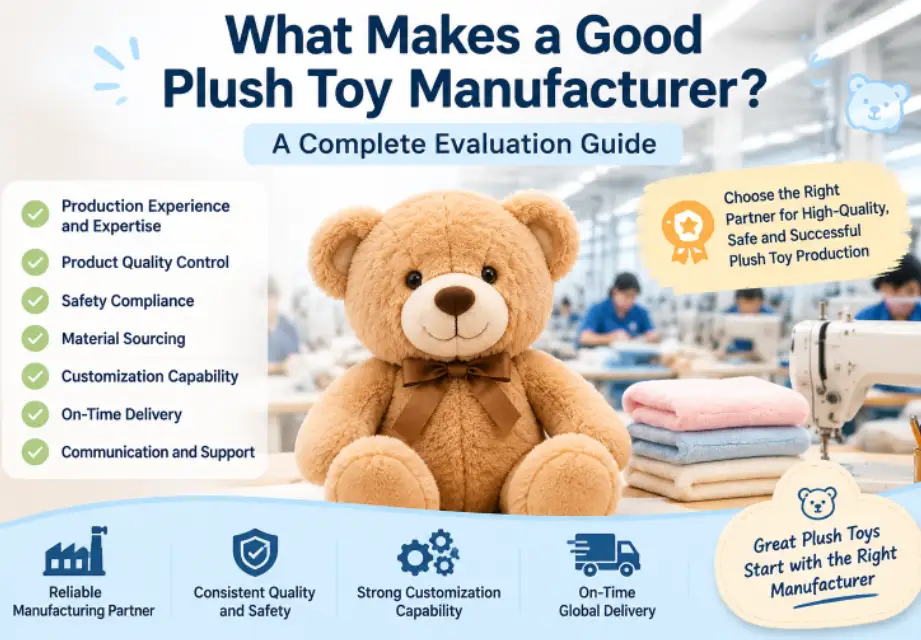
This guide breaks down what genuinely distinguishes a good plush toy manufacturer from an average or unreliable one, organized around the specific operational dimensions that buyers can actually observe and verify before committing to a production relationship — not vague reassurances, but concrete systems, documentation, and behaviors that predict how a manufacturer will actually perform once an order is underway.
What Does “Good” Actually Mean When Evaluating a Plush Toy Manufacturer?
The word “good” gets used loosely in supplier evaluation, and different buyers implicitly mean different things by it. A buyer focused on a tight retail launch window may define a good manufacturer primarily by delivery reliability. A buyer building a premium collectible line may define it primarily by craftsmanship and material quality. A buyer new to sourcing may define it primarily by how easy the factory is to communicate with. None of these definitions is wrong, but none of them alone is complete.
A good plush toy manufacturer performs consistently well across every dimension that affects a buyer’s ability to run a successful product business — not exceptional in one area while quietly weak in others. A factory that produces beautiful samples but cannot replicate that quality at bulk volume is not a good manufacturer for a buyer planning repeat production. A factory that ships reliably but uses materials that fail compliance testing in the buyer’s target market is not a good manufacturer regardless of its punctuality.
Core Dimensions of Plush Toy Manufacturer Quality
| Dimension | What It Covers | Why It Matters to Buyers |
|---|---|---|
| Production capability | Equipment, workforce skill, facility scale, specialization depth | Determines whether complex designs and volume can be executed consistently |
| Quality control systems | Incoming, in-process, and final inspection discipline | Determines whether bulk output matches the approved sample |
| Material sourcing standards | Supplier vetting, compliance documentation, batch consistency | Determines baseline quality and market compliance |
| Design and development support | Pattern making, sampling speed, technical problem-solving | Determines how efficiently a concept becomes a producible product |
| Communication quality | Responsiveness, transparency, proactive updates | Determines how well a buyer can manage their own business around production |
| Pricing and value | Cost structure transparency, fair margin, no hidden fees | Determines long-term commercial sustainability of the relationship |
Understanding these dimensions separately — rather than forming a single impressionistic judgment about a factory — allows a buyer to identify specifically where a candidate manufacturer is strong and where the relationship may need additional safeguards, rather than discovering the gap only after committing to a full production order.
Tip: Score each candidate manufacturer against these six dimensions separately, even informally, rather than forming a single overall impression. A factory that scores strongly on five dimensions and weakly on one is a very different sourcing decision than one that scores adequately across all six — and a single-impression evaluation tends to miss that distinction.
How Does Production Capability Reflect Manufacturer Quality?
Production capability is the foundation everything else is built on. A factory without the equipment, workforce skill, and organizational systems to execute a design consistently at scale cannot deliver good outcomes no matter how strong its intentions or how attractive its pricing.
Production capability reflects manufacturer quality through the combination of technical infrastructure, workforce experience, and process organization that determines whether a factory can deliver consistent results across every production run, not just a single well-managed order. Capability that depends on exceptional individual effort or unusually favorable conditions is fragile; capability built on documented processes and experienced, stable teams is durable.
Production Capability Elements and What They Indicate
| Capability Element | What to Ask About | What a Strong Answer Looks Like |
|---|---|---|
| Facility scale | Number of production lines, monthly output capacity | Specific figures matched to the buyer’s order volume needs |
| Workforce experience | Average operator tenure, task specialization | Stable, specialized teams rather than high turnover generalists |
| Equipment condition | Machine age, maintenance schedule, cutting/embroidery technology | Documented maintenance routine, modern equipment for complex work |
| Capacity utilization | Current utilization rate against maximum capacity | Moderate utilization (60%–80%) with room to absorb variability |
| Product specialization | Share of production dedicated to plush toys specifically | Plush-focused rather than plush as one category among many |
Facility Scale and Specialization Depth
Facility scale matters most in relation to the buyer’s actual order volume, not as an abstract measure of size. A very large factory built around massive minimum order quantities may treat a smaller buyer’s order as a low priority, delayed behind larger commitments whenever scheduling pressure arises. A very small workshop may lack the capacity or quality systems to scale reliably as a buyer’s order volume grows over time. The right scale match is one where the buyer’s typical order size represents a meaningful, well-prioritized part of the factory’s production schedule.
Specialization depth compounds this effect. A factory that produces plush toys as its primary or exclusive product category develops pattern-making expertise, material sourcing relationships, and quality management practices specific to soft goods that a generalist toy or textile factory does not accumulate to the same degree. Buyers evaluating manufacturers should ask directly what share of total production is dedicated to plush toys, since a factory splitting attention across rigid plastic products, textiles, and plush is less likely to have developed the same depth of category-specific capability.
Equipment and Technology Investment
The specific equipment a plush toy factory has invested in — computerized cutting systems, multi-head embroidery machines, metered stuffing equipment, calibrated testing tools for pull-force and material inspection — is a visible, verifiable signal of ongoing capability investment. Factories that have not upgraded core production equipment in many years are more likely to rely on manual workarounds that introduce inconsistency, particularly for complex, multi-panel, or highly detailed designs.
Tip: Ask specifically what percentage of a candidate factory’s production volume is plush toys versus other product categories. A factory that describes itself as a “toy manufacturer” broadly, without being able to answer this question precisely, is often less specialized in plush construction than its marketing materials suggest.
What Quality Control Systems Should a Good Manufacturer Maintain?
Quality control is the most direct operational expression of manufacturing discipline, and it is one of the easiest dimensions for buyers to verify concretely, since it produces documentation that a factory can be asked to share.

A good plush toy manufacturer operates a structured, multi-stage quality control system — commonly organized as incoming quality control (IQC), in-process quality control (IPQC), and final quality control (FQC) — staffed by personnel who can make independent quality decisions rather than personnel who report to and are evaluated by the same managers responsible for production output and speed.
Three-Stage Quality Control Framework for Plush Toy Production
| QC Stage | Timing | What Is Verified | Why It Matters |
|---|---|---|---|
| IQC — Incoming Quality Control | Before cutting begins | Fabric, filling, accessories, thread against specification | Prevents defects from entering production at the source |
| First-off inspection | First completed units | Full product against approved sample | Catches process setup errors before they scale |
| IPQC — In-Process Quality Control | At regular intervals during production | Random sample from the active line | Catches quality drift before it affects the full batch |
| FQC — Final Quality Control | Pre-shipment, on packed goods | AQL-sampled inspection of the completed batch | Confirms the batch meets the agreed acceptance standard |
Why Independence and Documentation Both Matter
The organizational independence of the QC function from production management is one of the clearest indicators of a factory’s genuine quality commitment. When quality inspectors report to the same supervisor whose performance is measured on daily output volume, there is a structural conflict of interest that consistently produces compromised quality decisions under schedule pressure. An independently reporting QC team can reject a batch or halt a line without needing approval from the person whose targets that decision affects.
Documentation is the second half of a credible QC system. A factory with mature quality management maintains organized, retrievable records for every production run — incoming inspection results, first-off findings, in-process logs, and final inspection reports. A factory that can produce these records on request, without significant delay, is demonstrating that quality documentation is a routine operational output rather than something assembled specifically to satisfy an external review.
Tip: Ask a candidate manufacturer directly who their QC team reports to. A factory where quality control reports independently to company management, separate from the production department, has a structurally different quality culture from one where QC sits inside the production chain of command — and this single question is one of the most revealing available in a factory evaluation conversation.
How Important Are Material Sourcing Standards and Compliance Certifications?
Material sourcing is where quality consistency either begins or breaks down, since every finished plush toy inherits the baseline characteristics of the fabric, filling, and accessories used to build it. A manufacturer that sources materials opportunistically — chasing the lowest price or fastest availability without consistent vetting — introduces variability at the very foundation of every production run, regardless of how well the downstream sewing and finishing stages are managed.
A good manufacturer maintains an approved supplier list for core materials, verifies incoming material batches against specification rather than assuming consistency, and requires current compliance documentation from every material supplier before that material is accepted into production. This discipline addresses both quality consistency and regulatory compliance simultaneously, since certified material suppliers generally maintain more mature production and quality systems than uncertified ones.
Key Certifications and Compliance Elements Relevant to Plush Toy Manufacturing
| Certification / Standard | What It Verifies | Relevant Market |
|---|---|---|
| ISO 9001 | Quality management system maturity | General — signals systematic process discipline |
| OEKO-TEX | Fabric chemical safety | General — strong material safety indicator |
| ASTM F963 | US toy safety compliance | United States |
| EN71 | EU toy safety compliance | European Union |
| BSCI / SEDEX-SMETA | Social compliance and labor standards | EU-facing buyers, ethical sourcing requirements |
| REACH documentation | Chemical substance compliance | European Union |
Certifications Establish a Baseline, Not a Guarantee
Certifications and test reports are valuable but limited evidence. They confirm that a factory or its materials met a defined standard at the time of assessment — which may have been months earlier — and they do not guarantee that the same standard applies to every subsequent material batch or every new product design. Treating certifications as a starting point for verification, rather than as sufficient evidence on their own, keeps buyers appropriately grounded: a factory with current, relevant certifications starts from a stronger baseline, but that baseline still benefits from direct confirmation through sample testing, incoming inspection review, and ongoing batch verification.
Tip: Request the actual compliance documentation — test reports, certificates, audit summaries — rather than accepting a general claim of compliance. A factory that supplies specific, dated, verifiable documentation quickly is demonstrating a materially different level of compliance maturity than one that offers only a general assurance without paperwork.

What Design and Development Support Should Buyers Expect from a Good Manufacturer?
For most buyers, a plush toy manufacturer is not simply executing a finished specification — it is a development partner that helps translate a concept, sketch, or reference image into a producible pattern, working sample, and eventually a manufacturable bulk production process. The quality of this development support has a substantial effect on both product quality and time to market.
A good manufacturer offers genuine design and development capability — pattern making expertise, iterative sample development, and technical problem-solving for challenging design elements — rather than a purely transactional production service that requires the buyer to arrive with a fully engineered specification. This support becomes especially valuable for buyers who are not themselves manufacturing experts and rely on the factory’s experience to identify issues before they become expensive production problems.
Design and Development Support Capability Comparison
| Support Element | Weaker Manufacturer | Good Manufacturer |
|---|---|---|
| Pattern development | Requires buyer to supply finished technical patterns | Develops patterns in-house from sketches or references |
| Sample iteration | Slow turnaround, limited revision rounds | Efficient turnaround with structured revision process |
| Technical problem-solving | Passes design challenges back to the buyer to resolve | Proposes manufacturable solutions for difficult design elements |
| Material guidance | Limited fabric/filling knowledge beyond standard options | Recommends materials suited to the design intent and budget |
| 3D prototyping/digital tools | Physical samples only, longer development cycles | Digital pattern grading and prototyping to reduce sample rounds |
Sample Development Speed Without Sacrificing Accuracy
Sample development speed is one of the most commonly cited factors in manufacturer evaluation, but speed alone is an incomplete measure. A fast sample that does not accurately represent what bulk production will actually produce creates a false sense of confidence that surfaces as a costly surprise once mass production begins. The more meaningful measure is how closely a factory’s approved sample predicts the eventual bulk output — which depends on whether the same materials, techniques, and quality standards used in sampling are genuinely replicated in production, not just how many days the sample took to arrive.
Tip: Evaluate sample turnaround together with sample-to-bulk accuracy, not turnaround alone. Ask a candidate manufacturer specifically how they ensure that materials and construction methods used for the approved sample are the same ones used in bulk production — a counter-sample check against bulk materials before mass production begins is a strong sign this consistency is taken seriously.
How Does Communication Quality Distinguish Good Manufacturers from Average Ones?
Communication quality is consistently underweighted in factory evaluation relative to its actual importance. Buyers tend to focus primarily on price and production capability during initial evaluation, treating communication as a secondary consideration — but how a manufacturer communicates during the sales and evaluation process is a highly reliable predictor of how it will communicate once an order is confirmed and the stakes of clear information rise.
A good manufacturer communicates proactively rather than only reactively — sharing production updates at meaningful milestones, flagging potential issues before they escalate into problems, and providing specific, accurate answers to technical questions rather than vague reassurance. This pattern reflects a genuine organizational commitment to transparency rather than a sales-stage performance that fades once the deposit is paid.
Communication Indicators That Predict Manufacturing Relationship Quality
| Indicator | Strong Signal | Weak Signal |
|---|---|---|
| Response time | Consistently prompt, within about a business day | Multiple days, inconsistent across inquiries |
| Technical specificity | Detailed, accurate, product-specific answers | Vague, generic, or evasive responses |
| Proactive updates | Shares production status without being asked | Provides information only when directly prompted |
| Handling of difficult questions | Honest acknowledgment of constraints or challenges | Unconditionally positive answers regardless of reality |
| Point of contact | Named, consistent contact throughout the relationship | Anonymous or rotating team responses |
A Simple Pre-Order Communication Check
Before placing a first order, a buyer can informally test communication quality by asking a specific technical question, a question about a realistic challenge such as a tight timeline, and a request for a piece of documentation such as a test report — then observing the specificity, honesty, and speed of the responses. A factory that answers the technical question precisely, responds honestly to the challenge question rather than with blanket reassurance, and produces documentation promptly is demonstrating communication habits that are likely to hold up once real production pressure appears.
Tip: Pay closer attention to how a factory responds to a difficult or constraint-revealing question than to how it responds to an easy one. Nearly every manufacturer communicates well when everything is going smoothly — genuine communication quality shows up in how honestly a factory discusses a real limitation, a tight deadline, or a past problem.
How Should Pricing and Value Be Evaluated When Choosing a Manufacturer?
Price is often the first and most heavily weighted factor in manufacturer selection, but price alone is a poor predictor of overall value, since it says nothing about the quality, consistency, or service that a given price actually buys. The most useful evaluation question is not simply which manufacturer quotes the lowest price, but which manufacturer offers the best combination of price, quality, and reliability for the specific product and volume in question.
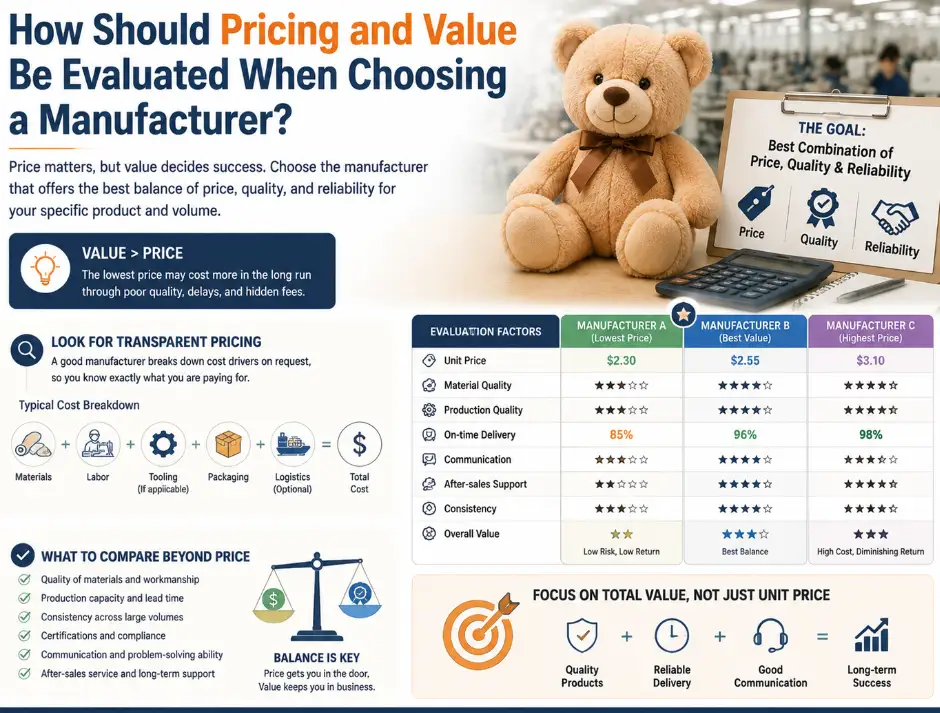
A good manufacturer prices transparently — breaking down cost drivers such as materials, labor, tooling, and packaging on request — rather than presenting only a single opaque unit price with no visibility into what it covers. Transparent pricing allows a buyer to understand what specifically differentiates a lower quote from a higher one, rather than assuming the lower price is simply a better deal.
Cost Drivers Behind Plush Toy Manufacturing Pricing
| Cost Driver | What Influences It | Buyer Consideration |
|---|---|---|
| Material cost | Fabric grade, filling type, accessory quality | Lower material cost often signals a corresponding quality reduction |
| Labor complexity | Number of panels, embroidery detail, hand-finishing requirements | Complex designs justify a labor cost premium over simple ones |
| Tooling and setup | Custom molds, dies, embroidery digitizing, sample development | One-time costs that should be clearly separated from per-unit pricing |
| Compliance and testing | Required certifications and third-party lab testing per market | A price that excludes compliance testing is not a complete cost comparison |
| Order volume | Economies of scale on both materials and labor | Very low minimum order quantities typically carry a per-unit premium |
Why the Lowest Quote Is Rarely the Best Value
An unusually low quote relative to other candidates is not automatically a bargain — it is a signal that deserves specific investigation. It may reflect a genuinely more efficient operation, but it may also reflect material substitution below the specified standard, reduced quality control investment, or a pricing strategy designed to win the order with the expectation of recovering margin through later changes or corner-cutting. Comparing quotes on a like-for-like basis — same material specification, same quality standard, same testing requirements — is essential before treating price differences as a meaningful comparison at all.
Tip: When comparing quotes from multiple manufacturers, request a line-item cost breakdown from each rather than comparing a single bottom-line number. A meaningful price comparison requires confirming that every quote assumes the same material grade, construction quality, and compliance testing scope — otherwise the comparison is not actually comparing the same product.
What Red Flags Signal a Manufacturer May Not Be a Good Fit?
Alongside the positive indicators described throughout this guide, certain recurring patterns reliably signal risk in a candidate manufacturer relationship. Recognizing these patterns early — during evaluation rather than after an order is placed — allows buyers to avoid the most common and costly sourcing mistakes.
Common Red Flags in Plush Toy Manufacturer Evaluation
| Red Flag | What It Often Signals |
|---|---|
| Reluctance to share QC documentation or records | Weak or inconsistent quality control practices |
| Vague or evasive answers to specific technical questions | Limited genuine manufacturing expertise or transparency |
| Claims of unlimited available capacity regardless of timing | Overstated capacity or willingness to overcommit at the buyer’s expense |
| Resistance to third-party inspection | Concern that independent verification would reveal quality gaps |
| Unusually low pricing with no clear explanation | Potential material substitution or reduced quality investment |
| No named, consistent point of contact | Weak account management and potential communication breakdown |
| Certifications that cannot be verified or documented | Possible misrepresentation of compliance status |
None of these red flags is automatically disqualifying in isolation, since context matters and every factory has occasional off days in communication or documentation availability. The pattern is what matters — a factory exhibiting several of these signals consistently across the evaluation process is meaningfully more likely to produce sourcing problems than one exhibiting none of them.
How Can Buyers Systematically Compare Multiple Plush Toy Manufacturers?
Given the number of dimensions involved in evaluating manufacturer quality, an unstructured, impressionistic comparison between candidate factories tends to overweight whichever factor made the strongest first impression — often price or the polish of the sales presentation — while underweighting factors that are harder to observe quickly, such as quality control discipline or communication consistency under pressure.
A structured comparison framework, applied consistently across every candidate manufacturer, produces a more reliable basis for selection than sequential, informal impressions formed during separate conversations that are difficult to compare directly against each other afterward.
Structured Manufacturer Comparison Checklist
| Evaluation Area | Verification Method | Ideal Timing |
|---|---|---|
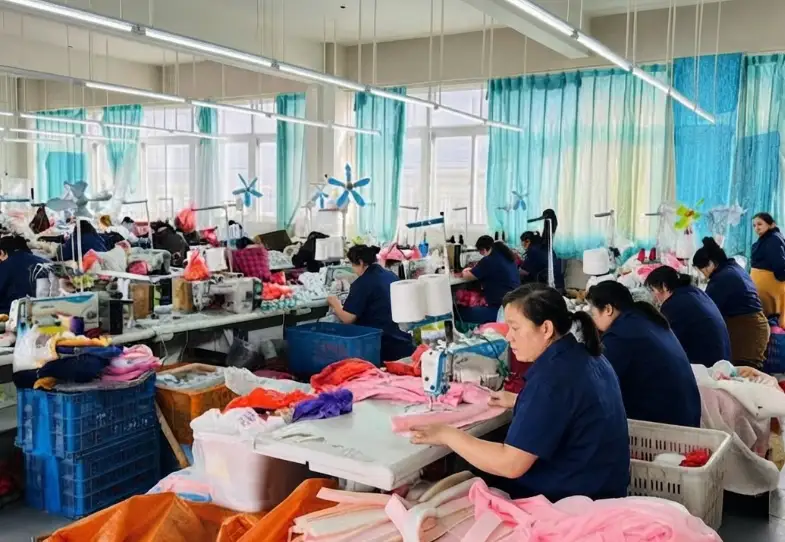
| Production capability | Video factory tour, capacity and specialization questions | Early evaluation stage |
| Quality control systems | Request sample QC records and documentation | Before sample order |
| Material sourcing and compliance | Request certifications and material test reports | Before sample order |
| Design and development support | Assess sample accuracy and revision process | During sample development |
| Communication quality | Structured pre-order communication test | Throughout evaluation |
| Pricing and value | Line-item cost comparison across candidates | After samples are evaluated |
| Reference verification | Speak with existing clients about real experience | Before bulk order commitment |
Applying this same checklist to every candidate manufacturer — rather than a different, ad hoc set of questions for each — makes the resulting comparison genuinely apples-to-apples, and it creates a documented record that is useful not only for the initial selection decision but for evaluating whether an established manufacturer relationship continues to perform to the standard it was originally selected for.
Frequently Asked Questions
What is the single most important factor in choosing a good plush toy manufacturer?
There is no single factor that outweighs all others, because manufacturer quality is genuinely multi-dimensional — a factory that excels at production capability but has weak quality control systems will still produce inconsistent results, and a factory with excellent quality control but poor communication will still create business planning difficulties for the buyer. That said, quality control systems are often the most revealing single area to investigate first, because they produce concrete, verifiable documentation — incoming inspection records, in-process logs, final inspection reports — that most other capability claims cannot be verified as directly or as quickly.
How can a buyer verify manufacturer quality before placing a first order?
Buyers can verify manufacturer quality before committing to a first bulk order through a combination of documentation review, a video factory audit, sample evaluation, and reference checks with existing clients. Requesting specific QC records and compliance certifications tests whether a factory’s systems are genuinely operational rather than only claimed. A video audit provides visibility into equipment, workforce organization, and facility conditions. Sample evaluation tests actual construction quality and material handling. Reference checks provide the most valuable evidence of all, since they reflect the real experience of buyers who have already lived through a full production cycle with that factory, including how it performed when conditions were not ideal.
Is a lower minimum order quantity always a sign of a more buyer-friendly manufacturer?
Not necessarily. A lower minimum order quantity can reflect genuine flexibility and efficient small-batch production capability, which is valuable for buyers testing new products or working with limited budgets. But it can also reflect a factory that lacks the volume relationships and negotiating leverage to secure competitive material pricing at scale, resulting in higher per-unit costs that are absorbed into a higher unit price rather than clearly disclosed. The more useful question is not simply what minimum order quantity a factory accepts, but how per-unit pricing and quality standards change as order volume increases, since that reveals whether the factory’s small-order accommodation comes with meaningful cost or quality tradeoffs.
How much should compliance certifications weigh in the decision versus other factors?
Compliance certifications should be treated as a near-mandatory baseline requirement rather than as one factor to be weighed against others, particularly for any product intended for children or for markets with strict toy safety regulation. A factory without the relevant certifications and test reports for a buyer’s target market should generally be excluded from consideration regardless of its strengths in other areas, since selling non-compliant products carries legal, platform, and reputational risk that no amount of production capability or attractive pricing can offset. Once the compliance baseline is met, the other dimensions — capability, quality systems, communication, pricing — become the basis for differentiating between qualified candidates.
What is a reasonable number of manufacturers to evaluate before making a final decision?
Most experienced buyers find that evaluating three to five candidate manufacturers in parallel provides enough comparative data to identify meaningful differences without creating excessive evaluation overhead. Evaluating only one or two candidates risks anchoring on whichever factory happens to communicate well initially, without a genuine point of comparison. Evaluating too many candidates simultaneously — beyond six or seven — tends to dilute the depth of evaluation possible for each one, since thorough verification of quality systems, sample evaluation, and reference checks takes meaningful time per candidate. Narrowing an initial broader list down to three to five serious candidates, then applying the full structured evaluation framework to each, tends to produce the most reliable final decision.
