Skip to content
A Complete Guide for B2B Buyers on What to Expect at Every Stage of Custom Plush Toy Development
One of the first questions any buyer asks when starting a custom plush toy project is a simple one: how long will this take? The answer matters enormously for planning purposes — it determines when a product launch can realistically be scheduled, when marketing and retail commitments can be made, and how much buffer needs to be built into a supply chain plan. Yet the answer is rarely as simple as the single number buyers are often given at the start of a sourcing conversation.
A custom plush toy production timeline is not one continuous block of manufacturing time. It is a sequence of distinct phases — design, sampling, revision, pre-production preparation, bulk manufacturing, quality control, and shipping — each with its own duration, its own dependencies, and its own potential for delay. Buyers who understand this phase-by-phase structure are far better equipped to plan realistic launch dates, identify where a timeline can legitimately be compressed, and recognize early when a project is falling behind schedule before it becomes a crisis.
This guide walks through the complete custom plush toy production timeline from initial concept to final delivery — explaining what happens in each phase, how long each phase typically takes, what factors extend or compress that duration, and how buyers can plan and manage the process to hit their target delivery dates reliably.
What Does the Custom Plush Toy Production Timeline Actually Include?
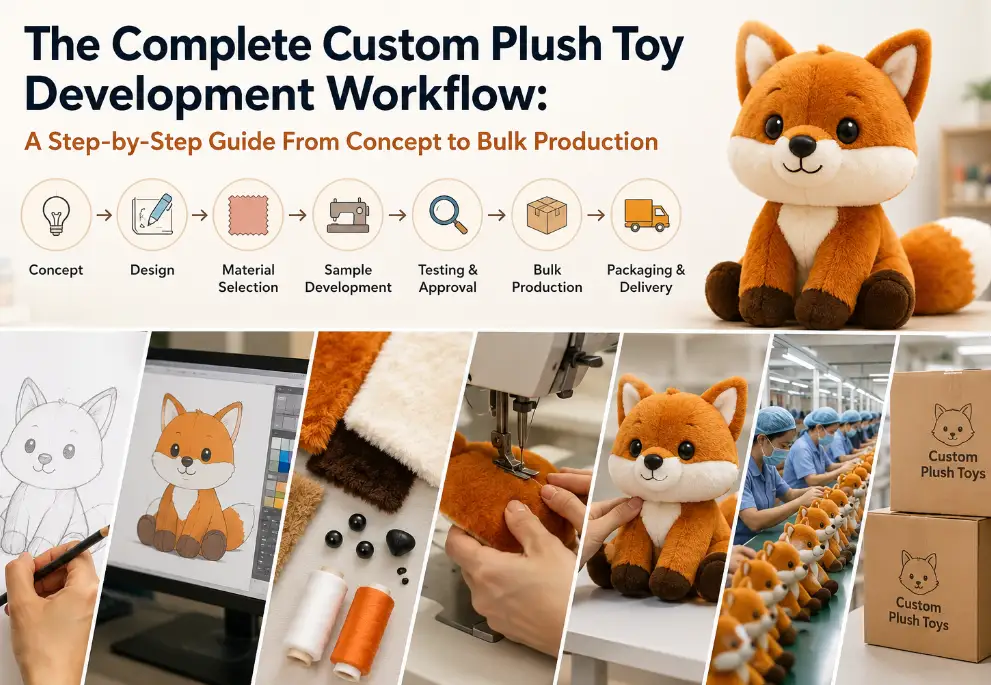
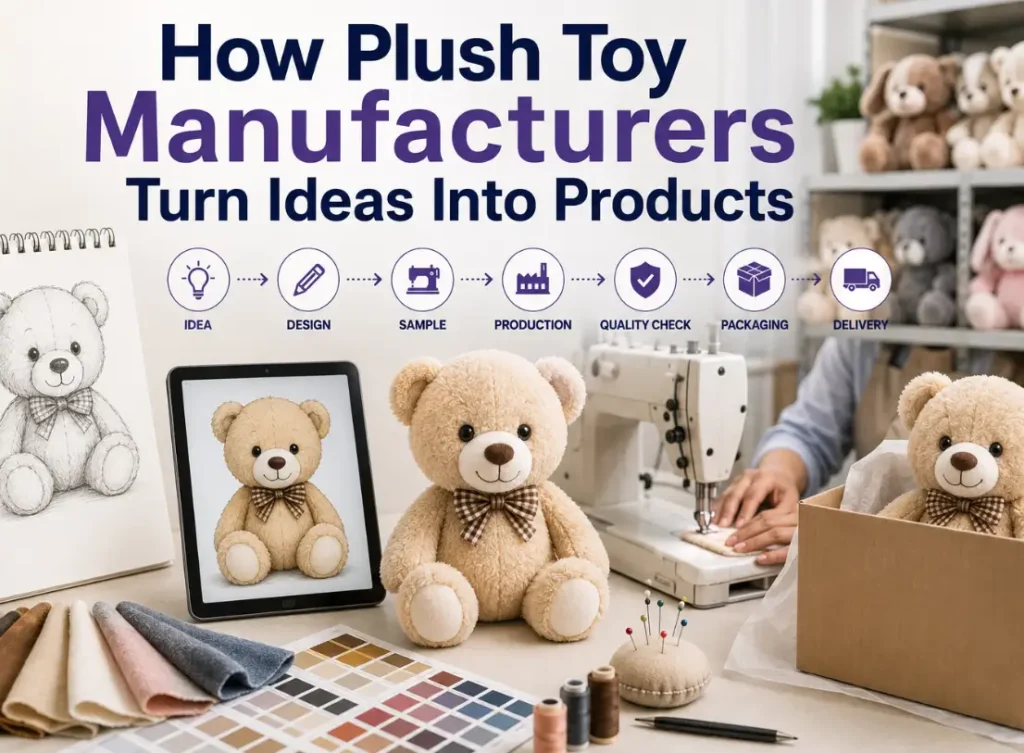
The full custom plush toy production timeline spans seven sequential phases, from the moment a design concept is finalized to the moment finished goods arrive at their destination. Each phase depends on the successful completion of the one before it, which means delays in an early phase compound through every phase that follows — a two-week delay in sampling approval does not simply shift the final delivery date by two weeks in isolation; it can also push production into a different, more congested slot in the factory’s schedule, adding further delay.
The seven phases are: design and development, sampling and revision, pre-production preparation, bulk production, quality control and inspection, packing, and shipping and logistics. Buyers new to custom plush sourcing often focus their planning attention almost entirely on the bulk production phase — reasonably, since it is the phase most closely associated with “manufacturing” in a general sense — but in practice, the phases before and after bulk production frequently account for as much, or more, of the total project timeline.
Custom Plush Toy Production Timeline — Phase Overview
| Phase | Typical Duration | Primary Activity | Key Dependency |
|---|---|---|---|
| Design and development | 1–3 weeks | Concept refinement, technical drawing, brief preparation | Buyer design input and stakeholder alignment |
| Sampling and revision | 3–6 weeks | First sample construction, evaluation, revision rounds | Timely, specific buyer feedback per round |
| Pre-production preparation | 1–2 weeks | Material bulk sourcing, tech pack finalization, line planning | Sample approval and material availability |
| Bulk production | 3–6 weeks | Cutting, sewing, stuffing, finishing at scale | Order quantity and factory production slot |
| Quality control and inspection | 2–5 days | In-line, final random, and pre-shipment inspection | Production completion and inspection scheduling |
| Packing | 2–4 days | Folding, bagging, cartoning, labeling | Passed inspection and packaging materials on hand |
| Shipping and logistics | 1–8 weeks | Transport from factory to destination | Shipping mode selected and customs clearance |
Adding these phases together, a realistic total timeline for a custom plush toy project — from the start of design work to goods arriving at a destination warehouse — typically falls between ten and twenty weeks, with the exact figure depending heavily on design complexity, order quantity, revision efficiency, and shipping mode. Buyers who are given a much shorter estimate at the outset of a sourcing relationship should ask specifically which phases that estimate covers, since a quoted “production time” of three to four weeks frequently refers only to the bulk production phase and excludes design, sampling, and shipping entirely.
How Long Does the Design and Development Phase Take?
The design and development phase is where a product concept — whether it originates as a hand-drawn sketch, a digital illustration, an existing character design, or a rough verbal description — is translated into a complete, technically actionable design brief that a factory can use to begin sampling. This phase is frequently underestimated in timeline planning because it involves relatively little visible manufacturing activity, but the decisions made here directly determine how efficiently every later phase proceeds.
The design and development phase typically takes one to three weeks and includes several distinct activities: initial concept review and feasibility discussion with the factory’s development team, technical drawing preparation showing front, back, and side views, dimensional specification, color specification using Pantone references, material and construction planning, and final brief compilation and internal buyer approval before submission to the factory for sampling.
Design and Development Phase — Activity Breakdown
| Activity | Typical Duration | Responsible Party | Common Bottleneck |
|---|---|---|---|
| Concept review and feasibility discussion | 2–4 days | Buyer and factory development team jointly | Unclear initial concept requiring multiple clarification rounds |
| Technical drawing preparation | 3–5 days | Factory design team or buyer’s design agency | Incomplete reference artwork from the buyer |
| Dimensional and color specification | 1–3 days | Buyer, with factory technical input | Colors described in words rather than Pantone codes |
| Material and construction planning | 2–4 days | Factory development and sourcing team | Buyer request for materials not in factory’s standard range |
| Internal buyer approval of final brief | 1–7 days | Buyer’s internal stakeholders | Multiple internal approvers not aligned before submission |
The single largest source of variability within this phase is internal buyer approval — the time it takes for all relevant stakeholders on the buyer’s side to review and sign off on the design brief before it is submitted to the factory. For buyers working independently or with a small, tightly aligned team, this step can be completed in a day or two. For buyers who need sign-off from a brand licensing partner, a retail buyer, or multiple internal departments, this step can extend the design phase by a week or more if it is not planned for and managed proactively from the start.
Tip: Begin internal stakeholder alignment before the design brief is finalized, not after. Share early concept sketches or reference artwork with every party who will need to approve the final brief as soon as a concept direction is chosen, rather than waiting until the complete technical brief is ready for a single final sign-off. This allows major concerns — a licensing restriction, a brand color requirement, a retail packaging constraint — to surface while the design is still flexible, instead of after the brief has been finalized and needs to be substantially reworked to accommodate late-stage feedback.
Why a Complete Brief Saves More Time Than It Costs
Buyers under time pressure sometimes consider submitting an incomplete brief to the factory in order to start sampling sooner, planning to fill in missing details — a Pantone reference, a precise dimension, a construction note — during the sampling process itself. This approach is nearly always counterproductive from a total-timeline perspective, even though it appears to save time at the outset.
An incomplete brief forces the factory to make assumptions in areas where information is missing, and those assumptions frequently do not match the buyer’s actual intent — generating a first sample that requires more extensive revision than it would have if the brief had been complete from the start. The one to three weeks invested in thorough design phase preparation is consistently recovered, and usually exceeded, in the sampling phase through fewer and faster revision rounds — making brief completeness one of the highest-leverage timeline investments available to a buyer.
How Long Does Sampling and Approval Take?
Sampling and approval are typically the longest and most variable phase of the entire production timeline, and it is the phase where buyer behavior has the greatest influence over total duration. It encompasses first sample construction, buyer evaluation, one or more revision rounds, and — for orders where it is included — counter sample confirmation before the design is approved for bulk production.
The sampling and approval phase typically takes three to six weeks for a design of moderate complexity requiring one to two revision rounds, though this can extend significantly for highly complex designs, designs requiring three or more revision rounds, or projects where buyer feedback turnaround is slow.
Sampling and Approval Phase — Timeline by Stage
| Sampling Stage | Typical Duration | What Determines the Duration |
|---|---|---|
| First sample construction | 7–14 days | Design complexity, material sourcing lead time, factory workload |
| Buyer evaluation of first sample | 2–7 days | How quickly the buyer can gather and consolidate stakeholder feedback |
| Revision round construction | 5–10 days per round | Scope of requested changes, whether new materials are needed |
| Buyer evaluation of each revision | 1–5 days | Specificity of the evaluation checklist used and reviewer availability |
| Counter sample construction (if included) | 7–12 days | Bulk material lead time, production line scheduling |
| Final approval and sign-off | 1–3 days | Internal buyer approval process for the production reference standard |
Shipping time between the factory and the buyer also adds meaningfully to this phase for buyers located outside the factory’s home region, since each physical sample — first sample, each revision, and any counter sample — typically needs to be shipped internationally for hands-on evaluation. Express international shipping for a sample package generally takes three to seven days each direction, meaning each full round of physical sample review can add a week or more to the phase beyond the factory’s internal construction time alone.
Tip: Where the shipping distance and time zone allow it, request a preview photo or short video of each sample before it is shipped, and review it immediately. This does not replace the need for physical, hands-on evaluation before final approval, but it allows the buyer to catch major, obvious deviations from the brief before an international shipment is spent on a sample that clearly misses the mark — potentially saving a full shipping cycle, which is often the single largest time cost within an individual revision round.
How Revision Round Efficiency Compounds Across the Timeline
Because the sampling phase is structured as a sequence of rounds, small inefficiencies in any single round compound across the full phase in a way that is easy to underestimate when planning a timeline. A revision round that takes an extra three days because feedback was vague and required a clarification exchange does not just cost three days once — if that same pattern of vague feedback repeats across two or three revision rounds, the cumulative delay can add two to three weeks to the total sampling phase.
This is why the practices covered in dedicated guidance on sample evaluation — systematic checklists, specific and measurable revision notes, consolidated stakeholder feedback, and change tracking across rounds — are not just quality practices. They are directly and measurably timeline practices, and buyers who apply them consistently complete the sampling phase in meaningfully fewer weeks than those who do not.
What Happens During Pre-Production Preparation?
Pre-production preparation is the bridge between an approved sample and the start of bulk manufacturing — a phase that is frequently invisible to buyers but essential to the smooth start and consistent output of bulk production. It typically takes one to two weeks and involves confirming bulk material availability, finalizing the complete tech pack, scheduling the order into the factory’s production line, and briefing the production team.
The pre-production preparation phase includes four core activities: bulk material sourcing and confirmation, in which the factory secures the actual production quantities of fabric, filling, thread, and accessories at the confirmed specification; tech pack finalization, in which all approved specifications are compiled into the complete technical document that will guide production; production scheduling, in which the order is assigned a specific slot in the factory’s production line calendar; and pre-production briefing, in which the production team is walked through the tech pack and the approved sample before cutting begins.
Pre-Production Preparation — Activities and Duration
| Activity | Typical Duration | Why It Matters |
|---|---|---|
| Bulk material sourcing | 5–10 days | Ensures materials are available in production quantities before cutting begins |
| Tech pack finalization | 2–4 days | Provides the single reference document every production department will use |
| Production line scheduling | Concurrent with above | Determines exactly when cutting and sewing will begin |
| Pre-production briefing | 1 day | Aligns the production team on quality expectations before work begins |
Bulk material sourcing is frequently the pacing activity within this phase, particularly for designs using specialty fabrics, custom-dyed colors, or accessories that require their own lead time to manufacture or import. A factory that has already confirmed material availability during the sampling phase — rather than waiting until sample approval to begin bulk sourcing — can compress this phase significantly, which is one of the reasons experienced factories often begin preliminary bulk material inquiries in parallel with later sampling rounds, once a design appears to be converging toward approval.
Tip: Ask the factory whether bulk material sourcing can begin before final sample approval, once the design has reached a stage where major changes are unlikely. For designs that have passed through most of their expected revision rounds and are converging on a stable specification, beginning preliminary bulk material sourcing in parallel with the final revision round — rather than waiting until formal approval — can compress the total timeline by several days to a week without meaningfully increasing the risk of wasted material investment.
How Long Does Bulk Production Take?
Bulk production is the phase during which the approved design is manufactured at the full order quantity — cutting fabric panels, sewing components together, stuffing and closing each unit, attaching accessories, and performing embroidery or other decoration. It typically takes three to six weeks, though this range varies substantially based on order quantity, design complexity, and the specific manufacturing techniques the design requires.
Bulk production duration is primarily a function of three variables: total order quantity, the number of production steps required per unit, and the factory’s available production capacity relative to other orders in its schedule at the time. A simple, single-fabric design with minimal accessories will move through cutting, sewing, and finishing considerably faster per unit than a complex design with multiple fabric types, several accessory attachment steps, and detailed embroidery.
Bulk Production Duration by Order Scale and Complexity
| Order Profile | Typical Production Duration | Primary Duration Driver |
|---|---|---|
| Small order (under 1,000 units), simple design | 2–3 weeks | Setup and changeover time relative to run length |
| Medium order (1,000–5,000 units), moderate complexity | 3–4 weeks | Sewing and finishing labor time per unit |
| Large order (5,000–20,000 units), moderate complexity | 4–6 weeks | Total labor hours required across the full run |
| Any order, high complexity design | Add 1–2 weeks to base estimate | Multiple accessory attachment and decoration steps per unit |
| Any order, during peak season | Add 1–3 weeks to base estimate | Factory capacity shared across multiple concurrent buyer orders |
Peak season capacity constraints deserve particular attention in timeline planning, since most plush toy factories experience significant order volume concentration in the months leading up to major retail seasons. A factory that can complete a given order in three weeks during a lower-demand period may require five or six weeks for the identical order during peak season, simply because production line capacity is being shared across a larger number of concurrent buyer orders. Buyers planning a launch tied to a seasonal retail window should factor this capacity variability into their timeline planning well in advance, ideally securing a confirmed production slot months before the peak period begins.
Tip: For orders intended to arrive ahead of a seasonal retail window, confirm the factory’s production slot in writing as early as possible — ideally as soon as the sample is approved, rather than waiting until the order is formally placed. Factories allocate production capacity on a rolling basis as orders are confirmed, and a buyer who delays formal order placement, even while sampling is complete, risks losing their intended production window to another buyer’s order that was confirmed first — a particularly costly outcome during peak season when rescheduling options are limited.
How Production Steps Break Down Within the Bulk Phase
Within the overall bulk production duration, the work itself proceeds through a consistent internal sequence: fabric cutting according to the confirmed patterns, sewing of body panels and construction seams, embroidery or other surface decoration, stuffing to the confirmed density, closing and hand-finishing, accessory attachment, and final assembly quality checks before the batch moves to formal inspection. For most plush toy designs, sewing and finishing represent the largest share of total labor time within this sequence, since they are the most labor-intensive, least automatable steps in plush toy construction.
This labor intensity is also why plush toy order quantities do not scale down in production time proportionally to the reduction in units — a run of 500 units does not take one-tenth the time of a run of 5,000 units, because setup, changeover, and minimum efficient batch sizes at each production station introduce a largely fixed time cost regardless of quantity. Buyers planning smaller orders should expect a proportionally longer per-unit production time than buyers of larger orders, reflecting this fixed-cost dynamic rather than any difference in factory efficiency.
How Long Does Quality Control and Inspection Take?
Quality control and inspection is a comparatively short phase in terms of raw duration — typically two to five days — but it is a critical checkpoint that, if compressed too aggressively, introduces meaningful risk to the reliability of the entire preceding timeline investment. This phase includes in-line inspection conducted throughout bulk production, final random inspection of the completed batch, and pre-shipment inspection immediately before the goods are released for shipping.
A comprehensive quality control program conducts inspection at multiple points during and after production rather than relying on a single inspection event at the very end. In-line inspection, performed by the factory’s own QC staff throughout the production run, catches and corrects issues while production is still ongoing — before they accumulate across the full batch. Final random inspection, often conducted by an independent third-party inspector using statistical sampling methods, provides an objective assessment of the completed batch against the approved sample and specification. Pre-shipment inspection confirms that packed, labeled goods are correctly prepared for shipping before they leave the factory.
Quality Control and Inspection Timeline
| Inspection Stage | Typical Duration | Who Conducts It | Timing Within Production |
|---|---|---|---|
| In-line inspection | Ongoing throughout production | Factory QC staff | Concurrent with bulk production |
| Final random inspection | 1–2 days | Independent third-party inspector (recommended) | After production reaches roughly 80–100% completion |
| Inspection report review and response | 1–2 days | Buyer, with factory rework as needed | Immediately following the inspection |
| Pre-shipment inspection | 1 day | Third-party inspector or factory QC | Immediately before goods are released for shipping |
The buyer’s response time to an inspection report — reviewing the findings and communicating whether identified defects require rework before shipping — is a variable within this phase that is entirely within the buyer’s control, and one that is frequently underestimated in planning. A buyer who takes several days to review and respond to an inspection report effectively adds that same number of days to the total timeline, since goods generally cannot be released for shipping until the buyer has confirmed how any identified issues should be handled.
Tip: Schedule the final random inspection to occur when production reaches approximately 80 to 90 percent completion rather than waiting until 100 percent completion. This timing allows any systemic issues identified during inspection to be corrected in the remaining production run while it is still in progress, rather than requiring a separate rework cycle after the full batch is already complete — a scheduling adjustment that can meaningfully shorten the total time between the end of production and final shipment approval.
How Long Does Shipping and Logistics Take?
Shipping and logistics is the most variable phase in the entire production timeline in terms of absolute duration, ranging from as little as a few days for air freight to as long as six to eight weeks for ocean freight to certain destinations, depending on the shipping mode selected, the origin and destination ports, and current global shipping conditions. It is also the phase where buyers have the most direct cost-versus-speed trade-off to manage.
Shipping mode selection is the primary determinant of this phase’s duration. Air freight offers the fastest transit time but at substantially higher cost per unit of weight or volume, making it best suited to smaller orders, urgent timelines, or high-value products where the cost premium is justified by the value of speed. Ocean freight offers dramatically lower per-unit shipping cost for larger orders but requires substantially more transit time and is subject to greater variability from port congestion, customs processing time, and seasonal capacity constraints.
Shipping Mode Comparison for Custom Plush Toy Orders
| Shipping Mode | Typical Transit Time | Relative Cost | Best Suited For |
|---|---|---|---|
| Air freight (express) | 3–7 days | Highest per unit | Small orders, urgent timelines, sample or top-up shipments |
| Air freight (standard) | 7–12 days | High per unit | Moderate orders needing faster-than-ocean delivery |
| Ocean freight (LCL) | 4–7 weeks | Moderate per unit | Smaller orders not requiring a full container |
| Ocean freight (FCL) | 3–6 weeks | Lowest per unit for large volumes | Large orders filling a full container |
| Rail freight (select regions) | 2–4 weeks | Moderate per unit | Orders to inland destinations with rail connectivity |
Beyond the transit time itself, customs clearance at the destination adds a further variable duration that depends on the destination country’s import processes, the completeness and accuracy of shipping documentation, and whether the specific product category is subject to any additional import inspection requirements. Toy products, including plush toys, are frequently subject to compliance documentation review at customs in major import markets, and incomplete or inaccurate documentation is one of the most common causes of unplanned customs delay.
Tip: Confirm all shipping documentation requirements — commercial invoice, packing list, certificate of origin, and any required product safety compliance certificates — well before goods are ready to ship, rather than preparing this documentation only once production is complete. Missing or incorrect documentation is one of the most common and most avoidable causes of customs delay, and the preparation of complete, accurate documentation can typically be finalized in parallel with the final stages of production rather than adding time after production is already finished.
What Factors Cause Timeline Delays and How Can Buyers Prevent Them?
Understanding the standard phase-by-phase timeline is necessary but not sufficient for reliable project planning — buyers also need to understand the specific factors that most commonly cause a project to run behind its planned schedule, since these factors are largely predictable and, in most cases, preventable with the right planning practices.
Timeline delays in custom plush toy production most commonly originate from four sources: slow or fragmented buyer feedback during sampling, late or incomplete design brief information, material sourcing complications for non-standard or specialty materials, and underestimating factory capacity constraints during peak production seasons. Each of these sources of delay is within the buyer’s ability to influence or plan around, even though only one — factory capacity — originates primarily on the factory’s side of the relationship.
Common Timeline Delay Sources and Prevention Strategies
| Delay Source | Typical Timeline Impact | Prevention Strategy |
|---|---|---|
| Slow or fragmented buyer feedback | 1–3 weeks across the sampling phase | Consolidate stakeholder feedback before submission; set internal review deadlines |
| Incomplete design brief | 1–2 additional revision rounds | Use a complete brief checklist before submission; include Pantone references and physical swatches |
| Specialty material sourcing complications | 1–3 weeks in pre-production | Confirm specialty material lead times during the design phase, before sampling begins |
| Peak season capacity constraints | 1–3 weeks in bulk production | Confirm production slot early; plan launch timelines with peak season buffer |
| Slow inspection report response | 2–5 days per inspection cycle | Establish a fixed internal response window for inspection report review |
| Incomplete shipping documentation | Days to weeks at customs | Prepare documentation in parallel with final production stages |
Of these delay sources, slow or fragmented buyer feedback during the sampling phase consistently proves to be the single largest controllable factor across the full range of custom plush toy projects. This is worth emphasizing because it runs counter to how many buyers instinctively think about timeline risk — the assumption is often that the greatest risk to the schedule lies on the factory’s side, in production or shipping delays outside the buyer’s control. In practice, a well-organized, responsive buyer working with an experienced factory such as Xing Wang Plushie frequently completes the full sampling-through-delivery timeline faster than a buyer with excellent factory support but slow, fragmented internal decision-making, because the phases most sensitive to buyer responsiveness — design brief approval and sampling revision — often account for a larger share of total project duration than bulk production itself.
Tip: Build a realistic internal response-time commitment into the project plan from the outset — for example, a firm 48-hour turnaround for reviewing and responding to any sample, inspection report, or factory question — and communicate this commitment to the factory so both sides are planning against the same expectations. Buyers who treat their own response time as a planned, managed part of the project timeline, rather than an open-ended variable, consistently achieve more predictable and more compressed total project durations than those who do not.
Building Buffer Into a Launch-Critical Timeline
For any project tied to a fixed external deadline — a retail launch date, a trade show, a contractual delivery commitment — buyers should build deliberate buffer time into their planning rather than working backward from the deadline using only the median expected duration for each phase. A reasonable approach is to add ten to fifteen percent buffer to the total estimated timeline for projects of moderate complexity, and a larger buffer for projects involving new factory relationships, highly complex designs, or shipping during peak logistics periods where delay risk is elevated.
This buffer should not be communicated to the factory as slack that can be freely consumed — doing so tends to erode the very buffer it was meant to preserve — but should instead function as a planning safety margin the buyer holds internally, used only if genuinely needed and otherwise banked as an early-delivery outcome that provides additional flexibility for marketing, logistics, or retail coordination ahead of the original target date.
Conclusion
The custom plush toy production timeline, from initial concept to final delivery, is a multi-phase process in which every stage — not just bulk manufacturing — contributes meaningfully to the total duration. Design and development, sampling and revision, pre-production preparation, bulk production, quality control, and shipping each carry their own typical duration and their own specific risks for delay, and a realistic total timeline accounts for all of them together rather than focusing narrowly on the manufacturing phase alone.
Buyers who plan with this full-phase view, who prepare complete and specific design briefs from the outset, who manage sampling feedback efficiently and consolidate stakeholder input before each round of communication, who confirm production slots and specialty material lead times early, and who build reasonable buffer into launch-critical schedules consistently achieve more predictable, more reliable delivery outcomes than those who plan around bulk production time alone and treat every other phase as an afterthought.
A production timeline is, at its core, a planning discipline as much as it is a manufacturing reality — and the buyers who master that discipline are the ones who bring products to market on schedule, launch after launch.
FAQ
Q1: What is a realistic minimum timeline for a custom plush toy project if every phase runs as efficiently as possible?
Under highly favorable conditions — a simple design requiring minimal revision, prompt buyer feedback at every stage, standard materials with no specialty sourcing needed, a factory with immediate production capacity available, and air freight shipping — a custom plush toy project can move from initial design brief to delivered goods in as little as eight to ten weeks. This represents a genuinely compressed but realistic best-case timeline rather than an aspirational figure, and buyers should treat it as the floor rather than the typical expectation, since even moderately complex designs or a single slow revision round can extend the timeline well beyond this range.
Q2: Can the sampling phase and pre-production material sourcing be run in parallel to save time?
Yes, to a meaningful degree, though with some risk that needs to be managed carefully. Once a design has progressed through its early sampling rounds and appears to be converging toward a stable final specification — with major structural and material decisions unlikely to change — many factories are willing to begin preliminary bulk material sourcing in parallel with the final one or two revision rounds, rather than waiting for formal sample approval to begin this work. The risk is that a late-stage revision could require a material substitution after sourcing has already begun, creating some wasted procurement effort — which is why this parallel approach works best when applied selectively, to elements of the design that have already been confirmed and approved, rather than to elements still under active revision.
Q3: How much additional time should buyers budget for a first-time order with a new factory compared to a repeat order?
First-time orders with a new factory typically take meaningfully longer than repeat orders with an established manufacturing relationship, primarily due to additional revision rounds during sampling as the factory builds an understanding of the buyer’s specific quality standards and communication preferences, and due to more conservative production scheduling as the factory calibrates its expectations for a new working relationship. Buyers should generally budget an additional two to four weeks for a first-time order compared to what an established relationship with the same design complexity would require, with this gap typically narrowing substantially — often to near zero — by the second or third order placed with the same factory.
Q4: Does adding a counter sample step to the sampling process meaningfully extend the total project timeline?
A counter sample typically adds one to two weeks to the sampling phase, since it requires building an additional prototype using actual bulk production materials and processes before final approval is granted. While this does extend the sampling phase in isolation, it frequently shortens the total project timeline when measured end to end, because a counter sample identifies and allows correction of any sample-to-bulk production gap before the full bulk order begins — preventing a much larger and more costly delay that would occur if the same gap were only discovered during or after bulk production, requiring partial rework of a much larger batch of finished goods.
Q5: How far in advance of a target delivery date should a buyer typically initiate a new custom plush toy project?
For most custom plush toy projects of moderate complexity and order size, initiating the project four to five months ahead of the target delivery date provides a reasonable margin that accommodates the full design-through-shipping timeline along with a sensible buffer for unforeseen delays. For projects with higher complexity, larger order volumes, first-time factory relationships, or delivery targets that fall during peak manufacturing or shipping seasons, extending this lead time to five to six months or more is a more prudent planning assumption, since each of these factors independently increases both the expected duration and the variability of one or more phases in the overall timeline.
Q6: What is the most effective single action a buyer can take to shorten the overall production timeline?
Among all the levers available to a buyer, consistently fast and specific feedback during the design and sampling phases has the largest measurable impact on total project duration, because these phases involve the most back-and-forth exchange between buyer and factory and are therefore the most sensitive to buyer response time. A buyer who commits to reviewing and responding to every design question, sample, and revision request within a fixed, short window — and who consolidates all internal stakeholder input before each response rather than sending feedback in multiple fragmented rounds — will typically see a greater overall timeline improvement from this single practice than from any comparable effort spent trying to compress the bulk production or shipping phases.
Q7: How should a buyer handle a situation where the factory notifies them of an unexpected delay mid-production?
The first step is to request a specific explanation of the cause of the delay and a revised, concrete timeline estimate — vague reassurances without a specific cause and a specific new date are not an adequate basis for downstream planning decisions. Once the cause and revised estimate are understood, the buyer should assess whether the delay affects a critical downstream commitment, such as a fixed retail launch date, and if so, evaluate whether shipping mode adjustments — such as upgrading a portion of the order to air freight to meet the critical date while the remainder ships by the originally planned mode — can offset some or all of the lost time. Maintaining open, factual communication with the factory throughout this process, rather than treating the delay purely as a dispute to be escalated, generally produces both a faster resolution and a stronger ongoing working relationship for future orders.