A cartoon character plush toy looks simple once it is finished — a soft, huggable figure with a recognizable face, a familiar color palette, and proportions that instantly signal which character it represents. That simplicity is deceptive. Turning a flat, two-dimensional illustration into a three-dimensional soft toy that fans, licensors, and quality inspectors all agree “looks right” is one of the more demanding disciplines in soft toy manufacturing, because the margin for error is razor-thin. A teddy bear with slightly asymmetrical ears is still a teddy bear.
A cartoon character plush toy with slightly asymmetrical ears, a proportion drift in the head-to-body ratio, or a color that is a shade off from the brand guide is instantly recognizable as “wrong” to anyone familiar with the source character.
This guide walks through the complete cartoon character plush toy manufacturing process from end to end — concept translation, pattern development, prototyping, material selection, cutting and sewing, facial feature production, stuffing and shaping, quality control, compliance testing, and packaging. Along the way, it explains why each stage exists, what typically goes wrong when it is rushed, and what buyers and brand teams should look for to confirm a production partner is handling character accuracy the way the project actually requires.
What Makes Cartoon Character Plush Toy Manufacturing Different From Standard Plush Production?
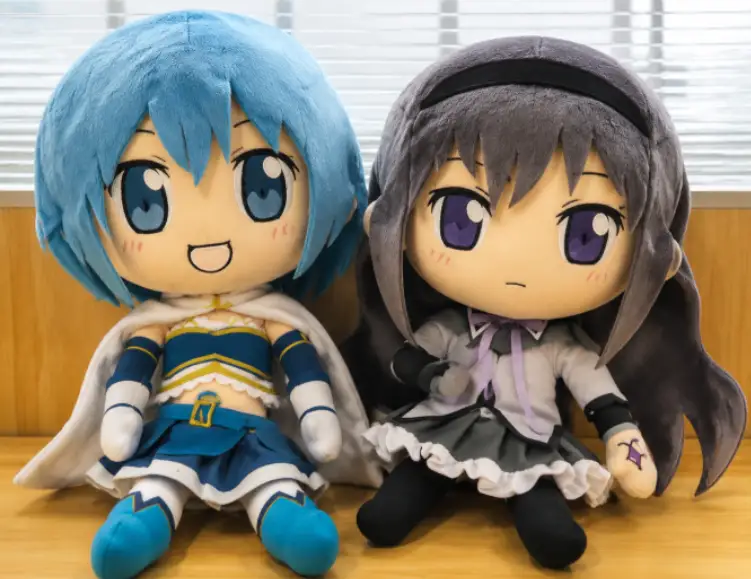
Standard plush toy manufacturing — a generic teddy bear, a plain animal shape, a decorative cushion — allows a reasonable amount of natural variation between units without any negative commercial consequence. Cartoon character plush toy manufacturing does not have that tolerance. Every unit is being measured against a reference the buyer already knows intimately: the character as it appears in animation, in a comic, in a game, or in branded packaging. Any deviation from that reference is not a minor cosmetic variance — it is a failure of the product’s core purpose, which is to be instantly identifiable.
Cartoon character plush toy manufacturing differs from standard plush production because it requires converting a flat, stylized 2D illustration into a 3D soft form while preserving proportion, silhouette, color accuracy, and facial expression — all under stricter tolerances than generic plush production, and frequently under licensor approval requirements that generic plush production never encounters.
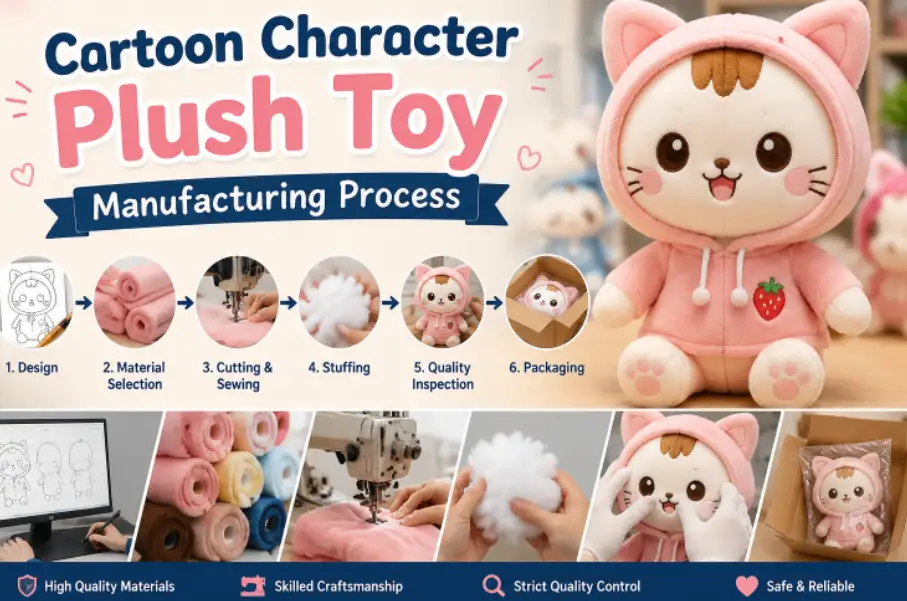
This shifts the entire workflow: pattern development becomes an iterative design discipline rather than a routine technical task, color matching becomes a Pantone-referenced process rather than a visual approximation, and quality control checkpoints multiply because a defect that would be invisible on a generic bear is glaringly obvious on a licensed character.
Standard Plush Manufacturing vs. Cartoon Character Plush Manufacturing
| Dimension | Standard Plush Toy | Cartoon Character Plush Toy |
|---|---|---|
| Design reference | General concept or moodboard | Exact character model sheet or 3D reference |
| Proportion tolerance | Moderate — natural variation acceptable | Tight — proportion drift is immediately visible |
| Color matching method | Visual approximation to swatch | Pantone or brand-specified color code matching |
| Facial feature production | Simple embroidery or basic appliqué | Multi-layer embroidery, appliqué, or printed detail work |
| Approval process | Buyer sign-off on sample | Buyer sign-off, frequently plus licensor or IP holder approval |
| Sampling rounds (typical) | 1–2 rounds | 2–4 rounds, sometimes more for complex characters |
| Pattern complexity | Standard shapes, reusable patterns | Custom pattern per character, rarely reusable |
Tip: Before requesting a quote, prepare a complete visual reference package — front, side, and back views if available, an official color code sheet, and any existing plush interpretations of the character. Factories quoting from a single front-facing image are guessing at proportions the pattern maker will eventually have to reconstruct anyway, and that guesswork shows up later as revision rounds.
How Does the Cartoon Character Plush Manufacturing Process Begin?
The process begins well before any fabric is cut. It starts with concept translation — the stage where a design team studies the character’s reference material and produces the technical documentation a pattern maker will actually use. This stage exists because a cartoon illustration and a soft toy pattern are fundamentally different mediums. An illustration can use exaggerated linework, flat color blocking, and perspective tricks that have no direct physical equivalent in stuffed fabric. Someone has to decide how those 2D design choices translate into 3D panels, seams, and proportions — and that decision-making is the single most consequential stage in the entire process, because every downstream stage inherits its accuracy or its errors.
The cartoon character plush manufacturing process begins with reference analysis and technical drawing development, in which the design team breaks the character down into its defining visual elements — head-to-body ratio, limb proportions, color zones, facial feature placement, and any signature accessories — and produces a construction sketch that a pattern maker can work from. This stage typically also includes an internal discussion of which elements are structurally feasible in soft toy form and which require creative adaptation, since some illustrated details simply cannot survive the transition to plush without becoming a choking hazard, a fragile component, or a shape that collapses under its own stuffing weight.
Concept Translation Deliverables Checklist
| Deliverable | Purpose | Typically Produced By |
|---|---|---|
| Construction sketch (front/side/back) | Establishes proportion and silhouette for pattern development | Design team |
| Color specification sheet | Locks exact color codes for every fabric zone | Design team, buyer-supplied brand guide |
| Feature adaptation notes | Flags illustrated details needing structural adjustment | Design and engineering team jointly |
| Size and scale specification | Confirms finished dimensions and proportion at scale | Buyer, confirmed by design team |
| Material recommendation draft | Suggests fabric and filling suited to the character’s texture | Design and sourcing team |
Why Proportion Decisions Happen Before Pattern Making, Not During It
Proportion decisions are locked at the concept stage rather than left to the pattern maker’s discretion because proportion is the single element buyers and licensors react to fastest during sample review. A character with a head that is even ten percent too small relative to the body reads as “off” to anyone who knows the character, even if they cannot immediately articulate why. Locking proportion ratios in the construction sketch — and getting buyer sign-off on that sketch before pattern development begins — prevents an entire pattern-making cycle from being built on a proportion assumption that gets rejected at first sample review.
How Is a Cartoon Character Plush Toy Pattern Made?
Pattern making is the stage where the approved construction sketch becomes a set of flat, cuttable fabric panels that, when sewn together and stuffed, produce the intended 3D form. This is a specialized skill distinct from general plush pattern making, because character patterns must solve a problem generic plush patterns rarely face: translating a stylized, often geometrically simplified illustration into panels that behave correctly once filled with soft material, which naturally rounds every edge and softens every angle.
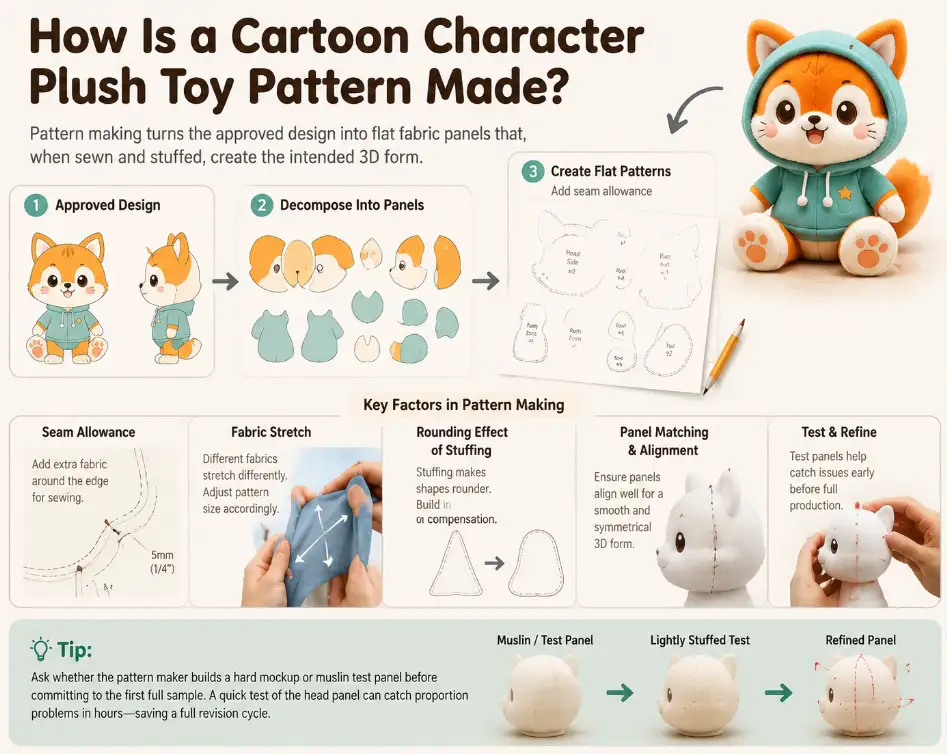
A cartoon character plush toy pattern is made by decomposing the approved design into individual fabric panels — head, body, limb, and feature panels — each cut to a shape that accounts for seam allowance, fabric stretch behavior, and the rounding effect of stuffing, so that the finished, filled form matches the intended silhouette rather than the flat outline of the illustration. Experienced pattern makers build in compensation for this rounding effect deliberately; a panel cut to the exact flat outline of an illustrated shape will produce a stuffed form that looks noticeably rounder and less angular than intended, because filling material pushes outward against every seam.
Tip: Ask whether the pattern maker builds a hard mockup or muslin test panel before committing to the first full sample. A quick unstuffed or lightly stuffed test of the head panel alone can catch a proportion problem in hours instead of after a full sample has already gone through cutting, sewing, and stuffing — saving a complete revision cycle.
How Many Pattern Revisions Does a Character Typically Require?
The number of pattern revisions a character requires depends heavily on design complexity. A character with simple, rounded, geometrically forgiving shapes — a basic round-bodied animal character, for example — may need only one or two pattern iterations before the silhouette reads correctly. A character with more complex features — angular limbs, an asymmetrical accessory, a distinctive multi-part head shape, or a pose-specific stance — routinely requires three or more pattern iterations, because each structural element interacts with the others in ways that are difficult to fully predict on paper.
Pattern Complexity and Typical Revision Count
| Character Design Type | Typical Pattern Revisions | Main Challenge |
|---|---|---|
| Simple rounded animal or creature | 1–2 | Basic proportion confirmation |
| Humanoid character with limbs | 2–3 | Limb-to-body proportion and pose stability |
| Character with distinctive accessories | 3–4 | Accessory attachment and structural integration |
| Character with asymmetrical or angular features | 3–5 | Translating hard angles into soft-form panels |
| Multi-piece or articulated character | 4+ | Joint construction and pose functionality |
What Happens During Prototyping and Sampling for Cartoon Character Plush Toys?
Prototyping and sampling is the stage where the pattern is actually cut, sewn, stuffed, and finished into a physical first sample — the first point in the entire process where the character exists as a tangible, three-dimensional object rather than a technical drawing. This stage carries outsized importance because a physical sample reveals problems that no sketch or pattern review can predict: how the fabric drapes under stuffing, how light interacts with the fabric pile to affect perceived color, how the proportions read from angles a flat drawing never showed, and how the character “feels” as an object someone would actually pick up and hold.
Prototyping and sampling for cartoon character plush toys involves producing a first physical sample from the approved pattern, followed by a structured review process — typically involving the buyer and, for licensed characters, the IP holder — that evaluates proportion accuracy, color accuracy, facial expression, fabric texture, and overall character likeness against the reference material, with revision rounds continuing until every reviewing party confirms the sample is an accurate representation. This is also the stage where safety-relevant construction decisions get their first real-world test — seam strength, stuffing density, and small-part attachment security — even though formal compliance testing happens later in the process.
Typical Sampling Round Timeline and Focus
| Sampling Round | Primary Focus | Typical Duration |
|---|---|---|
| Round 1 — First sample | Overall proportion, silhouette, basic color | 10–15 days |
| Round 2 — Revised sample | Proportion correction, precise color matching | 7–10 days |
| Round 3 — Refinement sample | Facial detail, texture, finishing quality | 7–10 days |
| Round 4 — Confirmation sample | Final sign-off, pre-production reference lock | 5–7 days |
Why Licensor Approval Adds a Layer Most Plush Sampling Does Not Have
When a cartoon character is a licensed property rather than an original in-house design, the sampling process typically adds a licensor approval checkpoint that generic plush sampling never requires. IP holders generally maintain strict brand guidelines covering acceptable proportion ranges, approved color codes, and expression rules for how the character can and cannot be depicted, and a sample that satisfies the buyer’s own quality expectations can still be rejected if it falls outside the licensor’s brand standards. Building in time for this additional review — and confirming upfront whether licensor sign-off is required and what its typical turnaround time is — prevents a production schedule from being built around an approval step that was never actually accounted for.
How Are Materials Selected for Cartoon Character Plush Toys?
Material selection for a cartoon character plush toy is driven by a different priority order than material selection for a generic plush toy. Generic plush material selection typically optimizes primarily for softness, durability, and cost. Character plush material selection has to optimize for those same factors while also treating color accuracy and surface texture as non-negotiable requirements, because the wrong fabric choice can make an otherwise well-patterned character look wrong even when every proportion is correct.
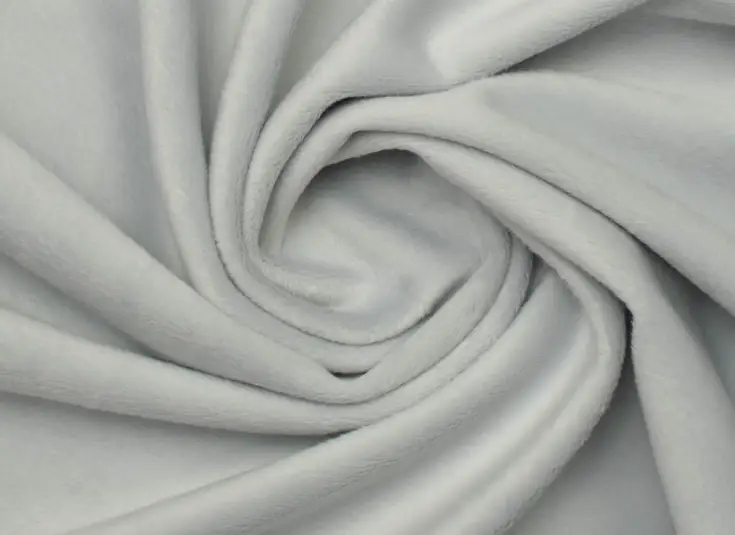
Materials for cartoon character plush toys are selected by matching fabric type, pile height, and surface finish to the character’s illustrated texture — smooth, short-pile fabric for characters with a flat, clean illustrated surface, longer-pile or textured fabric for characters with a furry or shaggy illustrated appearance — while simultaneously confirming that the fabric supplier can produce or dye the material to the exact color codes specified in the brand guide. Color accuracy in particular requires a dedicated matching process, because standard dye lots vary between batches and a color that matches perfectly in one production run can drift in the next unless the factory maintains a locked color standard and retains a physical reference swatch for every future reorder.
Fabric Selection by Character Surface Type
| Illustrated Character Surface | Recommended Fabric Type | Typical Pile Height |
|---|---|---|
| Flat, smooth, cartoon-clean surface | Short-pile plush or Minky-type fabric | 2–5mm |
| Soft, slightly textured surface | Medium-pile plush | 6–12mm |
| Furry or shaggy illustrated texture | Long-pile or faux fur fabric | 15–30mm |
| Scaled, smooth, or hard-surface character | Velboa or smooth-finish fabric | 1–3mm |
| Mixed-texture character (fur plus smooth zones) | Combination of two or more fabric types | Varies by zone |
Tip: Request a dedicated color-matched fabric swatch card before bulk fabric is dyed or ordered, and keep a physical copy on file after approval. A retained swatch is the only reliable way to confirm that a reorder six months later still matches the original approved color, since digital color references shift depending on the screen or lighting they are viewed under.
How Is Character Accuracy Maintained During Cutting and Sewing?
Cutting and sewing is where pattern accuracy either survives contact with production reality or begins to erode. In generic plush production, minor cutting or sewing variation between units is invisible to the end customer. In cartoon character plush production, the same degree of variation is frequently visible, because customers who know the character are comparing what they receive against a mental reference of exactly how that character should look.
Character accuracy is maintained during cutting and sewing through precision die-cutting or laser-cutting of fabric panels to the approved pattern, consistent seam allowances across every unit, and sewing operators who are specifically briefed on which seams and details are character-critical and require closer tolerance than standard construction seams. Factories producing character plush at scale typically use cutting dies or digital cutting systems rather than manual scissor-cutting for character panels specifically, because die-based cutting produces far more consistent panel shapes across a production run than manual cutting can reliably achieve, and that consistency compounds directly into consistency of the finished character’s proportions across every unit in the order.
Why Seam Placement Is a Design Decision, Not Just a Construction Decision
On a generic plush toy, seam placement is largely a construction convenience — seams go where they are easiest to sew and least likely to show. On a cartoon character plush toy, seam placement is a design decision that affects how accurately the character reads, because a seam that crosses through a facial feature, disrupts a color transition line, or interrupts a signature silhouette element can undermine character accuracy even when every other element of the toy is correct. Experienced pattern makers deliberately route seams along natural color-block boundaries or areas the illustration itself treats as a visual break, so the seam becomes invisible to the character’s overall read rather than an obvious interruption.
Tip: During sample review, check seam placement specifically against the character’s color transition lines and facial boundaries — not just overall shape. A silhouette can look correct in a photo while a seam still crosses awkwardly through a feature that becomes obvious the moment the toy is handled in person.
How Are Facial Features and Details Produced for Cartoon Character Accuracy?
Facial features are the single element buyers, licensors, and end customers scrutinize most closely, because a character’s face carries the majority of its recognizable identity. A body proportion error might go unnoticed by a casual observer; a facial expression that reads as slightly wrong is noticed almost universally, even by people who could not explain exactly what looks off. This makes facial feature production one of the highest-scrutiny stages in the entire manufacturing process.
Facial features and details for cartoon character plush toys are produced using embroidery, appliqué, printing, or a combination of these methods, chosen based on the complexity and style of the character’s original illustrated expression, with embroidery generally preferred for line-based features requiring durability and dimensional texture, appliqué preferred for larger flat color-block features, and printing used selectively for fine detail or gradient effects that embroidery and appliqué cannot reproduce precisely. The choice of method has direct implications for both accuracy and durability, and factories with genuine character-plush experience typically use a combination of methods on a single face rather than defaulting to one technique for the entire design.

Facial Feature Production Methods Compared
| Method | Best For | Durability | Detail Capability |
|---|---|---|---|
| Embroidery | Outlines, simple line-based expressions | High | Moderate — limited fine gradient detail |
| Appliqué | Large flat color-block features (eyes, cheeks) | High | Low-moderate — clean shapes, limited fine lines |
| Screen or digital printing | Fine detail, gradients, complex color blends | Moderate — depends on ink and fabric bond quality | High |
| Safety eyes/noses (molded) | Dimensional features requiring 3D form | High — subject to pull-test requirements | Moderate — limited to available molds or custom tooling |
| Combination approach | Complex characters with mixed feature types | Varies by component | Highest — matches method to each feature |
Why Expression Consistency Across a Production Run Is Harder Than It Sounds
A single well-executed sample face does not guarantee that every unit in a five-thousand-piece production run will carry an identical expression. Embroidery machines can drift slightly in tension or placement over long runs, appliqué placement can vary by a few millimeters between operators, and printed details can shift in registration if the printing setup is not locked and periodically checked against a reference standard. Maintaining expression consistency across a full production run requires periodic in-line comparison of finished faces against the approved sample — not just a final inspection at the end of the run, by which point an entire batch of drifted units may already exist.
This is also why many experienced factories set up a dedicated reference station on the production line specifically for facial feature work — a fixed physical copy of the approved sample face that operators can check against at regular intervals, rather than relying on memory or a printed photo that does not capture texture and dimensional depth the way a physical reference does. For characters with particularly nuanced expressions — a specific eyebrow angle that conveys personality, a mouth shape that reads as friendly rather than neutral — this kind of in-line physical reference is often the difference between a production run that stays consistent from unit one to unit five thousand and one that drifts noticeably by the middle of the run.
What Does the Stuffing and Shaping Process Involve?
Stuffing and shaping is the process that gives a sewn but empty fabric shell its final dimensional form — and it is a stage where character accuracy can be won or lost independently of everything that came before it. Two units sewn from identical, perfectly cut panels can look meaningfully different once stuffed, if the stuffing density, distribution, and technique are not controlled consistently.
The stuffing and shaping process for cartoon character plush toys involves filling the sewn shell with an appropriate density and distribution of filling material — typically polyester fiberfill, sometimes combined with PP cotton or weighted pellets for specific zones — using a technique that fills character-defining areas (the head, in particular) to the density needed to hold the correct silhouette without over-filling seams to the point of visible strain or under-filling areas so the shape collapses or looks deflated. For characters with distinctive silhouettes — a large round head, a particular limb shape, a signature accessory — stuffing technicians typically receive specific density guidance for each panel zone rather than a single uniform fill instruction, because uniform filling density across a character with non-uniform proportions consistently produces a form that drifts from the approved sample.
Tip: Ask for zone-specific stuffing density documentation as part of the approved sample package, not just a general fill weight. A character with a signature oversized head or a specific limb shape needs different fill density in different zones, and without written zone guidance, that nuance is easily lost between the sample maker and the production floor.
How Is Quality Control Different for Licensed Cartoon Character Plush Toys?
Quality control for licensed cartoon character plush toys operates on top of standard plush toy QC — checking seam strength, stuffing security, stitching quality, and general construction integrity — but adds a dedicated layer specifically focused on character likeness, which standard plush QC checklists do not typically include at all. This additional layer exists because a unit can pass every conventional construction quality check and still fail the product’s core commercial purpose if it does not look sufficiently like the character it is meant to represent.
Quality control for licensed cartoon character plush toys is different because inspectors check each unit — or a statistically representative sample of each production batch — against an approved physical reference sample specifically for proportion consistency, color accuracy, facial feature placement, and any brand-specific details, in addition to the standard construction and safety checks applied to all plush toys. Some production runs for licensed characters include a dedicated character-accuracy inspector role separate from the general QC inspector, precisely because likeness assessment is a distinct skill from structural quality assessment and benefits from focused attention rather than being folded into a general inspection checklist.
The sampling methodology used for character-accuracy inspection also tends to differ from standard construction QC sampling. Standard construction defects — a loose seam, an underfilled limb — tend to appear somewhat randomly across a production run and are reasonably well caught by standard statistical sampling plans such as AQL-based inspection. Character-accuracy drift, by contrast, is often systematic rather than random — a color shift that begins at a specific point in a dye lot, or a facial feature placement error introduced when an operator shift changes — which means inspectors benefit from checking units spread across the full production timeline rather than a single random batch pulled from one point in the run. A thorough inspection plan for licensed character plush typically pulls comparison units from the beginning, middle, and end of a production run specifically to catch this kind of drift pattern, which a single-point sample would miss entirely.

Cartoon Character Plush QC Checkpoints
| QC Checkpoint | What Is Verified | Standard Plush QC Includes This? |
|---|---|---|
| Seam strength and stitch density | Construction durability | Yes |
| Stuffing security and fill weight | Shape retention, safety | Yes |
| Small-part pull test | Choking hazard prevention | Yes |
| Color match against approved swatch | Brand and character color accuracy | Not typically |
| Proportion measurement against sample | Silhouette and likeness accuracy | Not typically |
| Facial feature placement and symmetry | Expression accuracy | Not typically |
| Batch-to-batch consistency check | Uniformity across production run | Sometimes |
What Safety and Compliance Standards Apply to Cartoon Character Plush Toys?
Cartoon character plush toys are subject to exactly the same safety and compliance framework that applies to all plush toys sold in a given market — character licensing does not change or reduce any regulatory requirement. For products destined for the United States, this means compliance with ASTM F963 and CPSIA requirements, including lead content limits, small-parts testing, and flammability standards. For products destined for the European Union, EN71 compliance, covering mechanical, physical, and chemical safety requirements, applies in the same way it would to any other plush toy.
Safety and compliance standards for cartoon character plush toys apply in full regardless of licensing status, requiring the same material safety verification, mechanical strength testing, and chemical compliance documentation as any other plush product, with the added consideration that decorative or character-specific elements — small accessories, appliqué pieces, printed ink coverage — must independently meet the same small-parts and chemical safety requirements as the rest of the toy. A character-specific accessory that looks purely decorative, such as a small removable prop or a clip-on accent piece, still has to pass the same pull-test and choking-hazard evaluation as any other small component, and factories with less rigorous compliance discipline sometimes treat character accessories as exempt from this scrutiny simply because they were not part of the original safety checklist template.
Tip: Confirm explicitly that every character-specific accessory, appliqué piece, or decorative attachment has been included in the small-parts pull-test documentation — not just the toy’s primary body components. Accessories added late in development are the most common gap in an otherwise complete compliance file.
How Are Cartoon Character Plush Toys Packaged and Prepared for Shipping?
Packaging for cartoon character plush toys carries a marketing function that packaging for generic plush toys often does not, because character packaging is frequently the first point of visual contact a retail customer has with the product, and it needs to reinforce character recognition instantly on a shelf or in an online product listing. This adds design and production considerations beyond the functional packaging requirements — protecting the toy in transit, fitting carton dimensions efficiently, and meeting any retailer-specific packaging standards — that apply to plush toys generally.
Cartoon character plush toys are packaged and prepared for shipping using methods that balance protective function with brand presentation, typically including individually shaped or printed packaging that reflects the character’s visual identity, protective poly bagging beneath any printed outer packaging, and carton configurations calculated to maximize container efficiency without compressing the plush toy in a way that distorts its shape during transit — a particular risk for character toys with distinctive silhouettes that need to arrive at retail looking exactly as designed. Vacuum-compression packaging, common for generic plush toys shipped in bulk, is generally avoided or used cautiously for character plush toys with defined silhouettes, since repeated compression can affect the fiberfill’s ability to fully recover its shape.
Tip: Request a packaging pre-production sample alongside the toy sample itself, particularly for characters with a distinctive silhouette. A packaging design that looks correct as a flat print file can still compress or misshape the toy once it is actually boxed, and that is far easier to catch and correct before a full production run than after.
How Long Does the Full Cartoon Character Plush Toy Manufacturing Process Take?
Timeline expectations for cartoon character plush toys should generally be set longer than timeline expectations for generic plush toys, primarily because of the additional sampling rounds, approval checkpoints, and character-specific QC steps built into the process. Buyers who plan a character plush launch against a generic plush timeline consistently find themselves compressing the sampling and approval stages under deadline pressure — which is precisely where character accuracy problems are most likely to slip through uncaught.
Typical Cartoon Character Plush Toy Production Timeline
| Stage | Typical Duration | Notes |
|---|---|---|
| Concept translation and technical drawing | 5–10 days | Longer for complex or multi-character projects |
| Pattern development | 7–14 days | Depends on design complexity and revision count |
| Sampling and revision rounds | 3–6 weeks | Includes licensor approval turnaround if applicable |
| Material sourcing and color matching | 2–3 weeks (can run in parallel with sampling) | Longer for custom-dyed fabric colors |
| Bulk production | 4–8 weeks | Depends on order volume and factory capacity |
| Final QC and packaging | 1–2 weeks | Includes character-specific inspection layer |
| Total estimated timeline | 12–20 weeks | From concept approval to shipment-ready goods |
Why Building Buffer Time Into the Approval Stages Matters More Than Buffer Time Elsewhere
Of all the stages in the timeline, the sampling and approval stage is the one most prone to unpredictable delay, because it depends on external response time — buyer review turnaround, and for licensed characters, licensor review turnaround — that the factory does not control. Buyers planning a character plush launch against a fixed retail or campaign date should build the largest timeline buffer around this stage specifically, rather than distributing buffer evenly across every stage, since a delay in bulk production is usually recoverable with expedited shipping, while a delay in getting licensor sign-off on a sample has no equivalent shortcut.
Conclusion
Manufacturing an accurate cartoon character plush toy is a fundamentally different discipline from manufacturing plush toys in general, even though the two processes share the same underlying construction steps — cutting, sewing, stuffing, and finishing. The difference lies in the precision, documentation, and additional checkpoints layered onto every stage: proportion accuracy locked before pattern development begins, color matching against exact brand codes rather than visual approximation, facial feature production chosen deliberately for each character’s specific style, quality control that evaluates likeness as rigorously as it evaluates construction, and timelines that account for approval cycles a generic plush project never has to navigate.
None of these additional requirements make the process prohibitively complex — they simply require a production partner who treats character accuracy as a defined technical discipline rather than an aesthetic afterthought, and a buyer who understands which stages of the process most directly determine whether the finished toy will actually look like the character it is meant to represent. Buyers who understand this process end to end are consistently better positioned to evaluate a factory’s proposal, ask the right questions during sampling, and catch accuracy problems early — while they are still inexpensive to correct.
FAQ
Q1: How much does it typically cost to develop a custom cartoon character plush toy sample, compared to a generic plush design?
Sample development for a cartoon character plush toy generally costs more than a comparable generic plush design because of the additional pattern revision rounds, more detailed facial feature work, and precise color matching involved. Where a simple generic plush sample might be developed and approved within one or two rounds, a character sample commonly requires two to four rounds, each with its own sampling fee. Buyers should expect total sample development costs for a character plush toy to run meaningfully higher than for an equivalent generic design, and should request a per-round fee structure upfront rather than assuming a flat sampling cost will cover the full development cycle.
Q2: Can an existing generic plush pattern be adapted for a cartoon character, or does every character need a pattern built from scratch?
It depends on how closely the character’s silhouette matches an existing generic shape. A character with a simple, rounded animal body that closely resembles a standard plush shape may be adaptable from an existing base pattern, with modifications concentrated on color, facial features, and minor proportion adjustments. A character with a distinctive silhouette, unusual proportions, or design elements that do not correspond to any standard plush shape needs a pattern built from scratch. Attempting to force a character with a genuinely unique silhouette onto an existing base pattern to save development time is one of the more common causes of proportion-related sample rejections, because the underlying pattern structure constrains what the finished shape can actually look like.
Q3: What happens if the fabric color drifts slightly on a reorder months after the original production run?
Color drift on reorders is a known risk in plush manufacturing generally, and it applies to character plush toys with particular consequence given how closely customers scrutinize color accuracy. The most reliable prevention method is maintaining a physical, retained fabric swatch from the original approved production run — not just a digital color code — since physical swatches do not shift with screen calibration or lighting and provide fabric suppliers with an exact physical target to dye against. If drift is discovered before bulk dyeing on a reorder, requesting a pre-production swatch check against the retained original sample catches the issue before an entire batch of off-color fabric is produced.
Q4: Do all cartoon character plush toys require licensor approval, or only officially licensed properties?
Licensor approval is only required when the character is an officially licensed third-party property — meaning the buyer has secured rights to reproduce the character from the IP holder, and that licensing agreement typically includes brand guideline compliance and approval checkpoints as a condition of the license. Original characters developed in-house by the buyer, or characters the buyer has full creative ownership of, do not require this external approval step, though the buyer’s own internal design and brand team commonly serves a similar function, reviewing samples against internal brand standards before production is authorized.
Q5: How do factories handle small, intricate character details that are difficult to reproduce accurately in plush form?
Intricate details that do not translate well into soft toy form are typically handled through creative adaptation rather than being omitted entirely, since removing a signature detail can undermine character recognition as much as getting it wrong. Common adaptation approaches include simplifying an intricate illustrated pattern into a cleaner embroidered or printed version that reads correctly at plush scale, substituting a rigid illustrated element with a soft-sculpted equivalent that preserves the visual impression without the structural fragility, or using printing techniques for fine detail that would be impractical to embroider at the required scale. These adaptation decisions are generally made collaboratively between the design team and the buyer during the concept translation stage, before pattern development locks in a specific construction approach.
Q6: Is it more expensive to manufacture a cartoon character plush toy with multiple fabric textures on a single unit, compared to a single-texture design?
Yes, multi-texture characters generally cost more to produce than single-texture designs, primarily because of the additional cutting, sourcing, and sewing complexity involved in working with more than one fabric type on a single unit. Sourcing and inventory management become more complex when a factory has to maintain multiple color-matched fabric types for a single character rather than one; sewing operations take longer because seams between different fabric types often require different handling than seams within a single fabric type, and quality control has to verify consistency across every fabric zone rather than just one. This cost difference should be factored into budget planning during the material selection stage, particularly for characters whose illustrated design combines a furry texture with smooth accent zones.
Q7: How can a buyer verify a factory’s character-plush capability before committing to a full development project?
The most reliable verification method is reviewing a factory’s actual character plush portfolio — completed projects for other licensed or original characters — rather than relying on general plush production photos, since character accuracy capability is a distinct skill from general plush construction quality. Buyers should also ask specific process questions during evaluation: how the factory handles proportion translation from 2D reference, what facial feature production methods they use and why, how many sampling rounds their character projects typically require, and whether they have direct experience working within licensor approval workflows. A factory that can answer these questions with specific, concrete detail rather than general reassurance is demonstrating the kind of process maturity that character plush production actually requires.