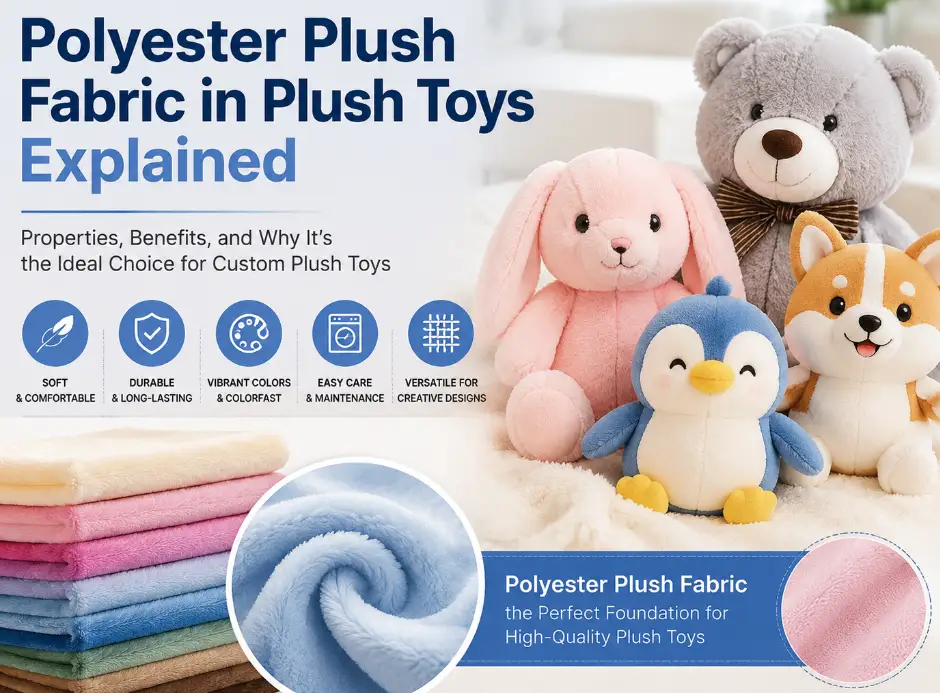
Polyester Plush Fabric in Plush Toys is one of the most popular material choices in modern plush toy manufacturing, offering excellent softness, durability, colour retention, easy maintenance, and versatility for creating high-quality custom stuffed toys. Almost every plush toy a buyer will ever source is built on the same foundational material decision, even though that decision rarely gets discussed explicitly during early product conversations: the outer fabric is overwhelmingly polyester.
Not cotton, not wool, not a natural fiber blend — polyester, in one of its many plush-specific constructions. This is not a coincidence or a cost-cutting default that buyers should be suspicious of. It reflects genuine material properties that make polyester the practical standard for soft toy manufacturing worldwide, and understanding why — along with understanding the meaningful quality differences that exist within the broad category of “polyester plush fabric” — is one of the most useful things a buyer can learn before sourcing a plush product.
This guide explains what polyester plush fabric actually is, how it is manufactured, the different fabric constructions and pile types used across the plush toy industry, what separates a high-quality polyester plush fabric from a low-quality one, how dyeing and color matching work, what compliance standards apply, how polyester compares to alternative fibers, and how buyers should think about selecting the right fabric for a specific product. The goal is to leave a buyer able to look at a fabric specification sheet and understand exactly what they are being offered — rather than relying entirely on a supplier’s assurance that a fabric is “good quality.”
What Is Polyester Plush Fabric, and Why Does It Dominate Plush Toy Manufacturing?
Polyester plush fabric is a knitted or woven textile made from polyester fiber — a synthetic polymer, most commonly polyethylene terephthalate (PET) — constructed with a raised pile surface that gives it the characteristic soft, dense, touchable texture associated with stuffed toys. The pile is created by knitting or weaving fine polyester fibers into a base fabric and then brushing, shearing, or otherwise finishing the surface so the fibers stand up rather than lying flat, producing the plush hand-feel that distinguishes this fabric category from ordinary flat textiles.
Polyester plush fabric dominates plush toy manufacturing because polyester fiber offers a combination of properties that no commonly available natural fiber matches at a comparable cost: it is durable under repeated washing and handling, resistant to moisture absorption and mildew growth, colorfast under a wide range of dyeing methods, resistant to shrinking and stretching out of shape, and inexpensive to produce at the volumes plush toy manufacturing requires. Cotton and other natural fibers can be processed into a plush-like pile fabric, but they generally cost more, absorb moisture more readily, are more prone to shrinkage, and do not hold color as consistently across large production runs — all of which make them a niche choice in plush manufacturing rather than a mainstream one.
Polyester vs. Common Alternative Fibers for Plush Fabric
| Property | Polyester | Cotton | Acrylic | Wool |
|---|---|---|---|---|
| Durability under repeated washing | High | Moderate | Moderate-High | Low-Moderate |
| Moisture resistance | High | Low | Moderate | Low |
| Colorfastness | High | Moderate | Moderate | Moderate |
| Shrink resistance | High | Low-Moderate | Moderate | Low |
| Relative cost at scale | Low | High | Moderate | High |
| Hypoallergenic profile | Generally good | Good | Can trigger sensitivity in some users | Common allergen |
Tip: Do not treat “polyester plush fabric” as a single, uniform specification when reviewing a quote. The category covers an enormous quality range, from thin, low-density fabric that pills within weeks to dense, long-lasting fabric that holds its texture for years. Always request the specific fabric name, GSM (grams per square meter), and pile height rather than accepting a generic “polyester plush” line item.
How Is Polyester Plush Fabric Made?
Polyester plush fabric manufacturing begins with polyester fiber production, either from virgin polyester chips or from recycled PET material, which is melted and extruded into continuous filament fiber. That fiber is then processed into yarn suitable for knitting, and the yarn is knitted on specialized circular or warp-knitting machines configured to produce a pile structure rather than a flat fabric — meaning the machine deliberately creates loops or tufts of fiber on the fabric surface during the knitting process itself, rather than adding pile as a separate step afterward.
Polyester plush fabric is made through a sequence of fiber production, pile knitting, and finishing processes: after the base pile fabric is knitted, it goes through brushing to raise and separate the pile fibers, shearing to cut the pile to a consistent, specified height, and finishing treatments that can include anti-pilling treatment, softening treatment, and sometimes a backing coating to stabilize the knit structure and prevent pile fibers from pulling loose during use. Each of these finishing steps has a measurable effect on the fabric’s final hand-feel and durability, which is part of why two fabrics with an identical raw fiber content and pile height can still feel noticeably different once finished.
Polyester Plush Fabric Manufacturing Stages
| Stage | What Happens | Effect on Final Fabric |
|---|---|---|
| Fiber production | Polyester chips or recycled PET extruded into filament fiber | Determines base fiber quality and sustainability profile |
| Yarn preparation | Fiber processed into yarn suitable for pile knitting | Affects fiber fineness and pile softness potential |
| Pile knitting | Base fabric knitted with pile loops built into the structure | Establishes fabric density and pile distribution |
| Brushing | Pile fibers raised and separated mechanically | Creates the visible, touchable pile texture |
| Shearing | Pile trimmed to a consistent target height | Determines final pile height and surface uniformity |
| Finishing treatment | Anti-pilling, softening, and stabilizing treatments applied | Affects long-term durability and hand-feel |
| Dyeing or printing | Fabric colored via piece dyeing, yarn dyeing, or printing | Determines color accuracy and colorfastness |
Why Backing Treatment Is a Detail Worth Asking About
Backing treatment — a coating or lamination applied to the reverse side of the knitted fabric — is one of the least visible but most consequential finishing steps in polyester plush fabric production. An untreated knit backing can allow pile fibers to gradually work loose from the base structure over repeated handling, particularly at cut edges and seams where the knit structure is disrupted.
A properly applied backing treatment locks the pile fibers into the base knit more securely, meaningfully reducing pile shedding and fiber loss at seams over the toy’s usable life. Buyers sourcing plush toys intended for heavy handling — children’s toys in particular — should specifically ask whether the fabric being quoted includes backing treatment, since this detail is frequently omitted from basic fabric descriptions despite its direct effect on product longevity.
What Types of Polyester Plush Fabric Are Used in Plush Toy Manufacturing?
“Polyester plush fabric” functions as an umbrella term covering several distinct fabric constructions, each suited to different plush toy applications based on their texture, pile height, and visual character. Selecting the correct fabric type for a given design is a foundational decision that affects not just the toy’s appearance but its cost, its manufacturability, and how accurately it can represent a specific design intent.
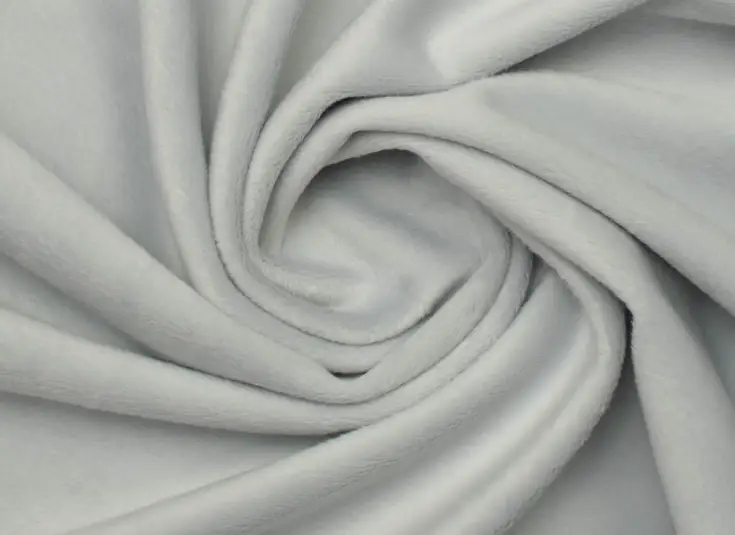
The types of polyester plush fabric used in plush toy manufacturing include short-pile plush (sometimes called velboa or velour-style fabric) for smooth, close-textured surfaces; standard or medium-pile plush for the classic soft toy texture most commonly associated with teddy bears and generic stuffed animals; long-pile or shaggy plush for a furrier, more textured appearance; Minky-type fabric, a very soft, dense short-pile variant popular for baby products and blankets as well as toys; and sherpa-style fabric, which mimics the texture of sheepskin with a looped rather than sheared pile. Each of these categories comes in a range of quality grades and weight specifications within itself.
Common Polyester Plush Fabric Types Compared
| Fabric Type | Typical Pile Height | Texture | Common Applications |
|---|---|---|---|
| Velboa / short-pile plush | 1–3mm | Smooth, velvet-like, low nap | Smooth-surfaced characters, animal noses, accent panels |
| Standard/medium plush | 4–10mm | Classic soft, slightly textured | Teddy bears, generic stuffed animals |
| Long-pile / shaggy plush | 15–40mm | Furry, shaggy, high-volume texture | Furry animal characters, high-end collectibles |
| Minky-type fabric | 2–5mm | Extremely soft, dense, smooth | Baby plush, blankets, premium-feel toys |
| Sherpa-style plush | Loop pile, 3–8mm | Curly, sheepskin-like texture | Sheep and farm-animal characters, cozy-texture products |
Tip: When a design brief calls for “soft and fluffy,” ask the factory to send physical swatches of at least two or three candidate fabric types rather than relying on a written description or a photo. Pile texture is difficult to judge accurately from images, and a fabric that photographs well can feel noticeably different — coarser, thinner, or less dense — once it is in hand.
Why Mixing Fabric Types on a Single Product Is Increasingly Common
Many plush toy designs, particularly character-based products and higher-complexity animal designs, use more than one fabric type on a single finished unit — a short-pile Minky-type fabric for a smooth face panel combined with a longer-pile body fabric, for example, to mirror the visual contrast present in the original design reference. This approach adds manufacturing complexity, since sourcing, cutting, and sewing operations all have to accommodate multiple fabric types rather than a single uniform material, and seams between different fabric types require more careful handling to avoid an uneven, unfinished appearance where the two fabrics meet.
Despite the added complexity, mixed-fabric construction has become increasingly standard for designs where a single fabric type cannot accurately represent every textural element of the intended design, and buyers should expect a modest cost and lead-time premium for designs specifying more than one fabric type rather than treating it as a cost-neutral design choice.
How Does Pile Height Affect the Look, Feel, and Cost of Polyester Plush Fabric?
Pile height — the length of the raised fiber on the fabric surface, typically measured in millimeters — is one of the most influential single variables in how a plush fabric looks and feels, and it has direct cost implications that buyers should understand before finalizing a fabric choice. Longer pile requires more raw fiber per square meter of fabric, more processing time during brushing and shearing, and more careful handling during cutting and sewing, since longer pile fibers are more prone to getting caught in seams if cutting and sewing are not managed carefully.
Pile height affects the look, feel, and cost of polyester plush fabric because longer pile produces a visually fuller, furrier appearance and a softer initial hand-feel, but also increases material cost, complicates precise pattern-edge definition since long pile can obscure fine design details, and requires more careful construction to prevent pile from being trapped in seams during sewing. Shorter pile, by contrast, is more cost-efficient, allows for cleaner, more precise pattern edges and fine detail work, but produces a less dramatically soft first impression and can feel thinner or less luxurious to some buyers evaluating fabric by hand-feel alone.

Pile Height Selection Guide
| Pile Height Range | Visual Effect | Best Suited For | Cost Impact |
|---|---|---|---|
| 1–3mm (short) | Smooth, clean, precise detail | Facial features, fine character detail, licensed accuracy work | Lowest |
| 4–10mm (medium) | Classic plush softness | General stuffed animals, most mainstream plush toys | Moderate |
| 11–20mm (long) | Noticeably furry, plush volume | Premium or cuddly-positioned products | Higher |
| 21mm+ (extra-long/shaggy) | Dramatic fur volume, luxury feel | High-end collectibles, statement products | Highest |
What Determines the Quality of Polyester Plush Fabric?
Not all polyester plush fabric of the same general type and pile height is equal in quality, and this is one of the areas where buyers with less fabric experience are most vulnerable to receiving a lower-quality product than they expected. Fabric quality within the polyester plush category is determined by a combination of factors that are not always visible in a photograph or even in a brief hands-on inspection, which is why understanding the underlying specification metrics matters.
The quality of polyester plush fabric is determined primarily by fabric weight (measured in GSM, or grams per square meter), pile density (how many fiber loops or tufts exist per unit of surface area), fiber fineness (thinner fibers generally produce a softer hand-feel), backing treatment quality, and finishing process quality, including how evenly the pile is sheared and how effectively anti-pilling treatments have been applied. A fabric with low GSM and low pile density will feel thin and insubstantial even if it has an acceptable pile height, because pile height alone does not determine how much material is actually present in the fabric — it is possible to achieve a specified pile height with a much lower fiber density than a higher-quality equivalent, producing a fabric that looks similar in a photo but performs very differently once stuffed, sewn, and handled.
Polyester Plush Fabric Quality Indicators
| Quality Indicator | What It Measures | Why It Matters |
|---|---|---|
| GSM (grams per square meter) | Overall fabric weight and density | Higher GSM generally indicates more substantial, durable fabric |
| Pile density | Number of fiber tufts per unit area | Higher density resists matting and looks fuller longer |
| Fiber fineness (denier) | Thickness of individual polyester fibers | Finer fiber generally feels softer to the touch |
| Pile height consistency | Uniformity of pile length across the fabric roll | Inconsistent pile height creates visible texture variation |
| Anti-pilling performance | Resistance to fiber balling from friction over time | Directly affects long-term appearance after use |
| Colorfastness rating | Resistance to fading from light, washing, and rubbing | Determines whether color holds up over the product’s life |
Tip: Ask for the fabric’s GSM specification in writing on every quotation, not just the fabric name. Two suppliers can offer fabric under the same generic name — “standard plush” — at meaningfully different GSM weights, and GSM is one of the fastest, most objective ways to compare fabric substance across quotes without needing to physically test every sample.
Why Pilling Resistance Matters More Than It Initially Seems
Pilling — the small balls of tangled fiber that form on a fabric surface after repeated friction, such as a plush toy being hugged, rubbed, or washed repeatedly — is one of the most common quality complaints in plush products, and it is directly tied to fiber quality and finishing treatment rather than being an unavoidable feature of polyester fabric in general. Lower-quality polyester fiber, combined with inadequate anti-pilling finishing treatment, produces fabric that develops a visibly worn, fuzzy, balled-up surface texture within weeks of normal use. Higher-quality fiber and proper anti-pilling treatment can maintain a clean surface appearance for years of regular handling. Because pilling is a use-over-time defect rather than something visible on a brand-new sample, it is one of the easiest quality gaps to miss during sample approval — a new sample will look identical whether the fabric is pilling-resistant or not, and the difference only becomes apparent after the product has been in a customer’s hands for weeks or months.
One practical way to surface this risk before committing to bulk production is requesting an accelerated wear or abrasion test on the specific fabric batch being quoted, rather than relying solely on the fabric’s general specification sheet. Standardized abrasion testing methods can simulate the friction a plush toy experiences over months of normal handling within a matter of hours in a lab setting, producing a pilling and surface-wear result that a visual inspection of a fresh sample simply cannot reveal. Buyers sourcing for retail channels with return policies, or for markets with a strong customer expectation of long-term product durability, should treat this kind of test result as a standard part of fabric due diligence rather than an optional extra step reserved for large orders.
How Is Polyester Plush Fabric Dyed and Color-Matched?
Color accuracy is one of the most commercially important properties of plush fabric, particularly for branded or character-based products where a specific color code has to be matched precisely and consistently reproduced across every production run, potentially over a period of years. Polyester’s dyeing behavior is different from natural fibers, which has practical implications for how color matching is approached in plush fabric sourcing.
Polyester plush fabric is dyed using disperse dyes, a dye class specifically formulated to bond with polyester’s synthetic fiber structure, applied either through yarn dyeing — where the fiber is colored before it is knitted into fabric — or piece dyeing, where the finished fabric is dyed after knitting. Yarn dyeing generally produces more consistent, deeply saturated color and is preferred for solid-color plush fabric used at scale, while piece dyeing offers more flexibility for smaller production runs or fabrics requiring color matching against a very specific reference sample after the fact. Because disperse dyes bond specifically with polyester fiber, color consistency and colorfastness performance are generally strong and predictable when the dyeing process is executed correctly, which is part of why polyester plush fabric is well suited to licensed and brand-color-critical plush products.
Tip: For any color that must match an exact brand or licensor color code, request that the factory dye against a physical Pantone reference or an approved lab dip sample rather than a digital color code alone. Screens and printed color charts render color differently depending on calibration, and a digital reference is not a reliable standard for matching physical dye output.
Why Dye Lot Variation Is a Real Risk on Reorders
Even with a well-controlled dyeing process, some degree of dye lot variation between production runs is a normal characteristic of textile dyeing generally, including polyester plush fabric. Small differences in dye bath temperature, timing, or raw material batch can produce a color that is technically within an acceptable tolerance range but still perceptibly different from a previous batch when the two are placed side by side.
This risk is particularly relevant for buyers placing reorders months after an initial production run, or for buyers combining fabric from more than one production run into a single retail assortment. Requesting a physical retained swatch from the original approved production run, and asking the factory to dye new batches against that physical retained standard rather than a general color code, is the most reliable safeguard against this kind of drift.
Is Polyester Plush Fabric Safe? What Compliance Standards Apply?
Polyester plush fabric intended for children’s toys is subject to the same safety and chemical compliance framework that applies to plush toys generally, and polyester as a fiber category does not present any inherent safety obstacle to meeting these standards when it is produced and finished correctly. Compliance risk in polyester plush fabric typically comes not from the base polyester fiber itself but from the chemicals used in dyeing, finishing treatments, and any flame-retardant or anti-pilling additives applied during processing.
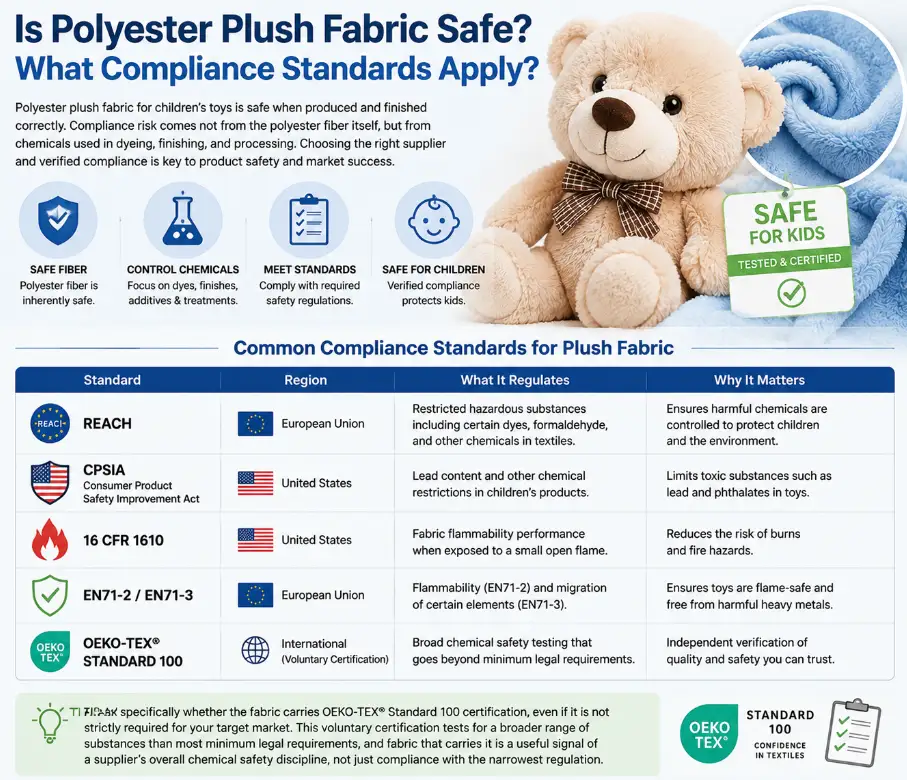
Compliance standards that apply to polyester plush fabric include REACH regulation in the European Union, which restricts a defined list of hazardous substances in textiles including certain dyes, formaldehyde, and heavy metals; CPSIA requirements in the United States, which govern lead content and other chemical restrictions for children’s products; and flammability standards such as 16 CFR 1610 in the US or equivalent regional standards, which regulate how quickly a fabric burns when exposed to a flame source. Fabric intended for children’s plush toys should carry documented test reports confirming compliance with the specific standards required in the toy’s target market, and buyers should request these reports as part of their fabric sourcing evaluation rather than assuming compliance based on the fabric appearing visually unremarkable.
Common Compliance Standards for Plush Fabric
| Standard | Region | What It Regulates |
|---|---|---|
| REACH | European Union | Restricted hazardous substances including certain dyes and formaldehyde |
| CPSIA | United States | Lead content and other chemical restrictions in children’s products |
| 16 CFR 1610 | United States | Fabric flammability performance |
| EN71-2 / EN71-3 | European Union | Flammability and migration of certain elements |
| OEKO-TEX Standard 100 | International (voluntary certification) | Broad chemical safety testing beyond minimum legal requirements |
Tip: Ask specifically whether the fabric carries OEKO-TEX Standard 100 certification, even if it is not strictly required for your target market. This voluntary certification tests for a broader range of substances than most minimum legal requirements, and fabric that carries it is a useful signal of a supplier’s overall chemical safety discipline, not just compliance with the narrowest applicable regulation.
How Does Polyester Plush Fabric Compare to Cotton, Acrylic, and Other Alternatives?
Buyers occasionally ask whether a natural or alternative-fiber fabric might be a better choice for a specific plush product, usually driven by a marketing angle around natural materials or a specific texture requirement that polyester does not easily replicate. Understanding where polyester’s advantages hold and where alternative fibers genuinely offer something different helps buyers make this decision based on the product’s actual requirements rather than general assumptions about natural fibers being inherently superior.
Polyester plush fabric compares favorably to cotton and acrylic alternatives on durability, cost, colorfastness, and consistency at production scale, while natural fiber alternatives such as organic cotton plush can offer a specific market positioning advantage for buyers targeting environmentally conscious or natural-materials-focused customer segments, and acrylic can offer a slightly different, sometimes considered warmer, hand-feel in certain fabric constructions. The practical tradeoff is that cotton and other natural fiber plush fabrics generally cost meaningfully more, are more prone to shrinkage and color variation across batches, and require more careful care instructions to maintain their appearance over the product’s life — tradeoffs that are commercially justified only when the natural-fiber positioning itself is central to the product’s value proposition.
Polyester vs. Alternative Fibers — Practical Tradeoffs
| Consideration | Polyester Plush | Organic Cotton Plush | Acrylic Plush |
|---|---|---|---|
| Relative unit cost | Lowest | Highest | Moderate |
| Production scale consistency | High | Moderate | Moderate-High |
| Marketing positioning value | Neutral | Strong for eco-conscious segments | Neutral |
| Care and washing durability | High | Moderate — more shrink-prone | Moderate-High |
| Typical use case | Mainstream plush production | Premium natural-materials products | Warmth-oriented or textured niche products |
Tip: If a product’s marketing depends on a natural-materials or eco-conscious positioning, confirm that the fabric choice actually supports that claim with verifiable certification — such as GOTS certification for organic cotton — rather than relying on a general “natural fiber” description. Unsubstantiated material claims create regulatory and reputational risk that is far more costly than the fabric cost difference itself.
Blended Fabrics as a Middle-Ground Option
Beyond the pure-fiber comparison, some plush fabric is produced as a blend — most commonly a polyester-cotton blend — combining a percentage of natural fiber with a polyester base to capture some of the softness or marketing appeal associated with natural materials while retaining more of polyester’s cost and durability advantage than a pure natural-fiber fabric would offer. Blended fabrics generally sit at a price point between pure polyester and pure natural fiber options, and their performance characteristics — shrink resistance, colorfastness, durability — also fall somewhere between the two pure-fiber alternatives, generally scaling with the blend ratio. Buyers considering a blended fabric should request the exact blend percentage in writing, since a “cotton-blend” fabric that is ninety percent polyester behaves very differently in practice from one that is fifty percent cotton, despite both being technically accurate to describe using the same blended terminology.
What Are the Sustainability Considerations for Polyester Plush Fabric?
Polyester’s environmental profile is a genuinely mixed picture that buyers increasingly need to understand and communicate accurately, since it involves both real advantages and real tradeoffs compared to alternative materials. Polyester is a petroleum-derived synthetic fiber, and virgin polyester production draws on non-renewable resources, which is the primary sustainability criticism leveled against the material. At the same time, polyester’s durability — meaning products made from it last longer before needing replacement — and its compatibility with recycling processes offer genuine sustainability advantages that are sometimes overlooked in a simplified “natural versus synthetic” framing.
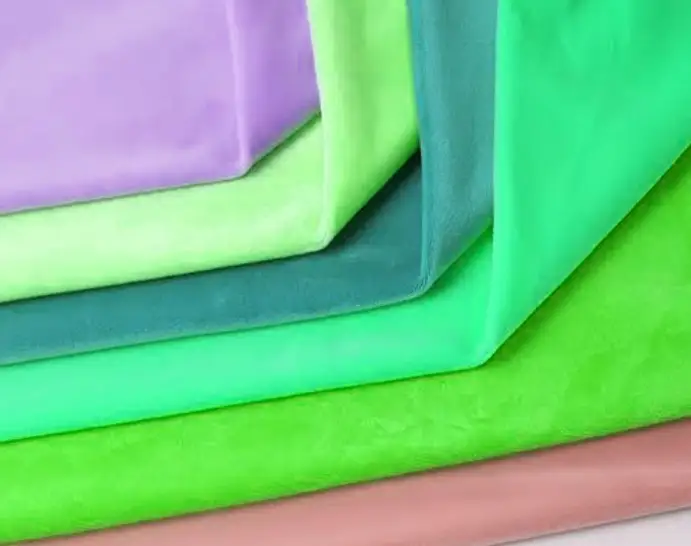
Sustainability considerations for polyester plush fabric center primarily on the growing availability of recycled polyester, commonly referred to as rPET, which is produced from recycled plastic material, most often post-consumer PET bottles, processed back into polyester fiber suitable for plush fabric knitting. Recycled polyester plush fabric offers a meaningfully reduced environmental footprint compared to virgin polyester production, while maintaining essentially the same performance characteristics — durability, colorfastness, and cost profile — that make polyester the practical standard for plush manufacturing in the first place. This combination of reduced environmental impact without a corresponding performance tradeoff has made recycled polyester an increasingly common and increasingly requested specification among buyers building sustainability-conscious product lines.
The recycled PET supply chain feeding into plush fabric production varies in traceability and quality depending on the source material and processing method used. Post-consumer bottle-derived rPET is the most common and generally most consistent source, since bottle-grade PET has a relatively uniform starting material composition compared to mixed post-industrial or post-consumer textile waste streams, which can introduce more variability into the resulting fiber quality. Buyers evaluating recycled polyester fabric closely should ask specifically about the source of the recycled material — bottle-derived versus textile-derived — since this affects both the consistency of the resulting fabric and the strength of the sustainability narrative the buyer can accurately communicate to their own customers.
Tip: When sourcing recycled polyester plush fabric, request documentation of the recycled content percentage and, where available, third-party certification such as the Global Recycled Standard (GRS). “Recycled” claims without supporting documentation are increasingly scrutinized by retailers, marketplaces, and regulators, and unverified claims carry real commercial risk.
How Should Buyers Select the Right Polyester Plush Fabric for Their Product?
Selecting the right polyester plush fabric for a specific product is a matter of matching fabric properties to the product’s actual requirements — its price positioning, its target user, its design intent, and its expected use conditions — rather than defaulting to whatever fabric a factory proposes first. A well-matched fabric choice supports the product’s commercial goals; a poorly matched one can undermine an otherwise well-executed design, either by adding unnecessary cost through over-specification or by disappointing customers through under-specification.
Buyers should select polyester plush fabric by working through the product’s design requirements systematically: confirming the intended texture and pile height based on the design’s visual reference, setting a minimum acceptable GSM and pile density based on the product’s price positioning and expected use intensity, confirming color-matching requirements and dyeing method suited to the order volume, verifying that the fabric carries documentation for the compliance standards required in the target market, and deciding whether a recycled-content specification is required based on brand positioning. This structured approach replaces a purely price-driven fabric decision with one grounded in the product’s actual functional and commercial requirements.
Fabric Selection Framework by Product Positioning
| Product Positioning | Recommended GSM Range | Pile Height Guidance | Additional Considerations |
|---|---|---|---|
| Budget / mass-market plush | Lower-moderate | Short to medium pile | Prioritize cost efficiency, standard compliance documentation |
| Mainstream retail plush | Moderate | Medium pile | Balance of cost, durability, and hand-feel |
| Premium / gift-positioned plush | Higher | Medium to long pile | Emphasize hand-feel, colorfastness, and finishing quality |
| Licensed character plush | Moderate-high | Matched to character’s illustrated texture | Precise color matching against brand reference is essential |
| Eco-positioned plush | Moderate-high | Product-dependent | Recycled content documentation and certification required |
Conclusion
Polyester plush fabric earns its dominant position in plush toy manufacturing through a genuine combination of durability, cost efficiency, and color performance that alternative fibers struggle to match at comparable scale — but “polyester plush fabric” is not a single, interchangeable specification, and treating it as one is where buyers most commonly end up disappointed by a fabric quality gap they did not anticipate. GSM, pile density, fiber fineness, backing treatment, and finishing quality all vary significantly within the broad polyester plush category, and each of these variables has a measurable effect on how a finished plush toy looks, feels, and holds up over its usable life.
Buyers who understand these underlying fabric specifications are far better equipped to evaluate a factory’s fabric proposal critically, ask for the specific documentation that reveals real quality differences between quotes, and select a fabric that actually matches their product’s design intent and commercial positioning — rather than accepting a generic “polyester plush” description and discovering the quality gap only after the product is already in production or already in a customer’s hands.
FAQ
Q1: Is polyester plush fabric safe for babies and young children?
Yes, polyester plush fabric is generally safe for babies and young children when it is produced and finished in compliance with the chemical safety standards that apply to children’s products in the target market, such as REACH in the European Union and CPSIA in the United States. Polyester fiber itself is not an inherent safety concern; the relevant safety considerations relate to the dyes, finishing chemicals, and any flame-retardant treatments used during processing, which is why requesting documented compliance test reports for the specific fabric being used — rather than relying on general assumptions about polyester as a fiber category — is the appropriate way to confirm safety for a specific product.
Q2: How can a buyer tell the difference between high-quality and low-quality polyester plush fabric just by feeling a sample?
A hands-on evaluation can reveal several useful signals, even without lab equipment. Higher-quality fabric generally feels denser and more substantial when gently pinched, with pile that springs back into place after being pressed down rather than staying flattened. Lower-quality fabric often feels thin, with visible gaps in the pile where the base knit shows through, and pile that mats down and stays flattened rather than recovering its shape. Gently rubbing the fabric surface repeatedly can also give an early indication of pilling tendency, though this hands-on test is not a substitute for requesting formal GSM and pilling-resistance specifications, which provide a more objective and comparable basis for evaluating fabric across multiple supplier quotes.
Q3: Does higher GSM always mean better quality fabric?
Generally, higher GSM correlates with a more substantial, durable fabric, but it is not the only variable that determines overall quality, and an extremely high GSM is not automatically the right choice for every product. Fiber fineness, pile density, finishing treatment quality, and how well-suited the GSM is to the specific pile height and construction all interact with GSM to determine final fabric performance. A very high GSM fabric with poor finishing treatment can still pill or shed more than a moderate GSM fabric that has been properly treated. GSM is best used as one significant data point in fabric comparison, alongside pile density, fiber fineness, and documented pilling-resistance performance, rather than as the single deciding factor.
Q4: What is the typical cost difference between recycled polyester (rPET) plush fabric and virgin polyester plush fabric?
Recycled polyester plush fabric typically carries a modest cost premium over equivalent virgin polyester fabric, though the exact premium varies depending on the recycled content percentage, the supplier’s sourcing relationships for recycled raw material, and broader market conditions affecting recycled PET availability. This premium has generally narrowed over time as recycled polyester production has scaled and become more commercially established within the textile industry. Buyers evaluating recycled polyester should request pricing at the same GSM and pile specification as their virgin polyester comparison quote, since comparing recycled fabric pricing against a different specification produces a misleading cost comparison.
Q5: Can polyester plush fabric be recycled at the end of a plush toy’s life?
Technically, polyester fiber itself is recyclable, but a finished plush toy is a composite product — combining fabric, filling material, safety components such as plastic eyes or joints, and thread — that is not straightforward to separate into individual recyclable material streams through typical consumer recycling channels. In practice, most plush toys are not recycled at end of life through standard municipal recycling systems, regardless of whether the outer fabric is made from recycled or virgin polyester. Buyers focused on end-of-life sustainability should treat the recycled content of the input material as a separate consideration from end-of-life recyclability of the finished product, since the two questions are not the same and conflating them can lead to inaccurate sustainability claims.
Q6: Why do some polyester plush fabrics feel noticeably softer than others even at the same pile height?
Fiber fineness, measured in denier, is usually the primary driver of this difference. Finer polyester fibers — a lower denier per filament — generally produce a softer, silkier hand-feel than coarser fibers at the same pile height, because thinner individual fibers bend and compress more readily against the skin. Finishing treatments, including softening agents applied during the fabric’s finishing stage, also contribute meaningfully to perceived softness independent of pile height. This is why requesting a physical sample swatch rather than relying on pile height specification alone is important when softness is a key product requirement — pile height describes length, not fiber fineness or finishing quality, and two fabrics can share an identical pile height while feeling very different to the touch.
Q7: How much does fabric selection typically influence the overall cost of a finished plush toy?
Fabric is consistently one of the largest single cost components in plush toy production, commonly representing a substantial share of total material cost alongside filling material, safety components, and labor. Because of this weighting, fabric choice has an outsized effect on the finished product’s overall unit cost compared to most other individual sourcing decisions. This is precisely why fabric specification deserves detailed scrutiny during quote comparison rather than being treated as a minor line item — a seemingly small difference in GSM, pile height, or fiber quality between two quoted fabrics can represent a meaningful percentage of the total unit price difference between competing supplier quotations.