Skip to content

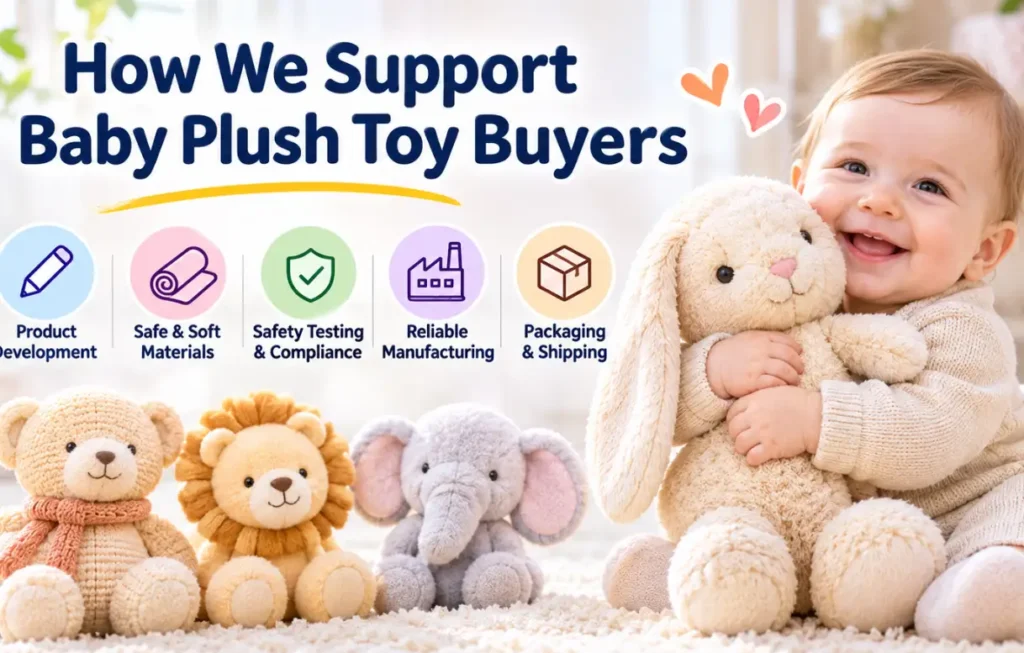
How We Support Baby Plush Toy Buyers is at the heart of our manufacturing services, from custom design and safe material selection to professional sampling, strict quality control, and reliable mass production, helping global baby brands create soft, comfortable, and high-quality plush toys that meet international safety standards and market expectations.
Finding a professional manufacturer for infant soft toys is rarely a single event. For most baby plush toy buyers, it is a chain of decisions: which age grade to design for, which fabrics and fills to accept, which tests to run, which sample to approve, and which version of the file the factory is actually building from. Each decision looks small on its own. Together they determine whether a first order ships on time, passes testing in the target market, and matches what the buyer approved.
Our role is to make that chain visible. At every stage, we, Xing Wang Plushie, make four things explicit: the decision that needs to be made, the evidence required to make it, the risk created by delay or ambiguity, and the record that remains once the buyer approves. A buyer who can see those four things can compare suppliers on facts rather than promises, and can tell early whether a project is on the critical path or drifting away from it.
This article is written for first-time importers sourcing infant and toddler plush, for brand owners moving from a trading company or another factory, and for buyers who need to judge whether a supplier is capable of children’s product work. It is not legal advice. Compliance for the target market stays with the buyer or importer; we support it with materials, records, samples, and laboratory coordination.
The eight sections that follow match the order of a real project. We start with the written brief, then move through design review, the approved sample, compliance documents, materials and traceability, production control, inspection, and the landed cost records that shape the next order. Each section ends with a table that can be used as a checklist, and a short FAQ at the end answers the questions buyers most often search.
Turn Baby Plush Toys Buyers’ Requirements into a Written Brief
A written brief is a single document that fixes who the toy is for, what it must look like, how it must be built, and which market rules it must meet before any pattern is cut.
In practice, we ask for five items before design starts. The first is the age grade, such as 0 to 12 months or 0 to 36 months, because it drives every later choice about small parts, attachments, and fill. The second is the target market, which sets the applicable standards, for example EN 71 for Europe or ASTM F963 and CPSIA for the United States. The third is the reference artwork or physical sample, with finished size in centimetres and a stated tolerance, such as plus or minus 5 percent on height. The fourth is the fabric and fill preference, including whether the toy must be machine washable. The fifth is the target quantity per design and the trade term the buyer expects the price to reflect.
The trade-off is speed. A buyer who wants a quote within a day will often send a photograph and a quantity, and we can respond with an estimate, but that estimate carries a wide price range because fabric, embroidery detail, and trims are still open decisions. Completing a brief takes a few days, and a buyer who cannot yet name the age grade should expect the quote to stay provisional. The goal is not a faster first quote. It is a first quote that survives sampling without a price revision of 15 to 25 percent once the real construction is understood.
Buyers can verify the brief by asking for it back in writing with a version number and a date. It should list every open decision, assign an owner and a due date to each, and name the document that will be updated when the answer arrives. If the brief cannot be traced to a version, the factory and the buyer can later claim different starting points. We keep the brief under version control, so each change shows who requested it and when it was accepted into the project.
A common example shows why this matters. A buyer asks for a 25 cm bunny rattle for newborns and sends one photograph. During the brief, we learn that the toy will be sold in two markets, that the buyer expects a machine-washable finish, and that the ears must be softer than the reference photo suggests. Each of those answers changes the fabric, the fill, and the test scope. Capturing them in the brief takes an afternoon; discovering them after the first sample takes weeks.
The buyer’s benefit is a quote and a schedule built on one agreed scope, which removes the most common source of price revisions after sampling begins.
Brief items and measurable targets for baby plush projects
| Item | What We Confirm/Provide | Why It Matters/Buyer Benefit |
|---|---|---|
| Age grade | Record the age band, the intended use setting, and the small-parts category before design | The design review starts from one agreed safety scope |
| Size tolerance | Fix finished height and width in centimetres with a plus or minus 5 percent band | Measurement disputes are settled against a number instead of an opinion |
| Quantity and price basis | State the order quantity per design, such as 500 to 3,000 pieces, and the trade term | The quote reflects real fabric yardage and the chosen packing method |
| Open decisions list | List each unresolved item with an owner and a due date | No question is lost between the buyer and the factory |
| Brief version record | Date each revision and log the person who requested it | Both sides work from the same document throughout sampling |
Review Age Grading, Materials, and Construction Risks Before Design
A design review is a structured check that compares the toy’s intended age grade against its materials, attachments, and construction before pattern making begins.
We go through five areas with the buyer. Facial features come first: embroidered eyes and noses are the usual choice for infant toys, while plastic safety eyes need a secure lock washer and a tension test appropriate to the age grade. Seams come second, including double stitching at stress points such as ears, limbs, and neck joins, a stitch density of roughly 10 to 12 stitches per inch, and a defined seam allowance. Fabric comes third, covering pile length, fibre content, and how much the surface sheds. Fill comes fourth, meaning new polyester fibre with a target weight per piece. Trims come last, including ribbon loops, tags, and attached accessories, each checked against the age grade.

The safest construction often costs something in appearance. Embroidered features look flatter than moulded eyes, a long-pile fabric that looks soft in a photograph may shed more, and removing a ribbon or a hanging accessory can weaken the character’s personality. We state these costs in the review so the buyer decides with the whole picture. We also cannot promise that a design will pass testing, because the result depends on the physical sample. A strong supplier raises these conflicts during design review; a weak supplier agrees to everything and lets the laboratory raise them later.
Buyers can verify the review by asking for the written review record. It should list each risk that was raised, the option chosen, the person who approved it, and any open decisions that remain. A construction sheet with photographs of seam details and attachment methods is a useful second document, because it shows what the pattern maker will actually build and gives the inspector something to compare against at the end of production.
Consider a plush elephant designed with a trunk that curls forward and a loop of ribbon at the neck. In review, we flag the ribbon as a strangulation concern for an infant, propose a sewn fabric tag instead, and show how a shorter trunk reduces stress on the seam where the trunk joins the head. The buyer keeps the character’s silhouette and loses nothing that mattered. Without the review, these points would surface as a failed test or a rejected sample.
The buyer’s benefit is that construction risks are closed on paper, when a change costs a conversation, instead of on a finished sample, when a change costs a new round.
Design review decisions by risk area
| Item | What We Confirm/Provide | Why It Matters/Buyer Benefit |
|---|---|---|
| Facial features | Compare embroidered, appliqué, and secured safety-eye options against the age grade | The buyer picks the look knowing what each option adds to testing risk |
| Seam construction | Specify double stitching, seam allowance, and reinforcement at limbs and ears | Seam failure risk is addressed before the first pattern is cut |
| Fabric selection | Match pile length, fibre content, and shedding behaviour to the infant use case | Loose fibres are not discovered after the sample is already approved |
| Trims and accessories | Review ribbon length, tags, and attached items against the age grade | Strangulation and detachment risks are closed before design |
Build the Approved Sample Around Written Tolerances
An approved sample is the single physical reference, signed by the buyer, against which every production unit will later be judged.
We build samples in rounds, and each round has a defined purpose. The first prototype checks shape and proportion, usually within 7 to 15 working days. A revision round applies the buyer’s logged comments. The pre-production sample is made from bulk fabric and trims, because only that sample shows how the real materials behave. For each round, we record height, width, and weight, check fill weight against a written tolerance such as plus or minus 5 percent, compare colour to an agreed swatch under a stated light source, confirm label placement, and photograph the toy from six angles. Written tolerances turn “looks about right” into a measurable decision.
Every extra round adds days and cost. Two rounds are common for a clear brief, and three are not unusual for a new character with embroidery and several fabrics. Skipping a round to protect a launch date does not remove the risk; it moves the risk into production, where a change is far more expensive. A sample room also tends to produce neater work than a production line, so we tell the buyer which details were hand-finished. The goal is not a perfect sample. It is a sample that production can repeat.
Buyers can verify the stage by asking for the sample record sheet. It should show measurements, weight, photographs, the date, and the buyer’s signature, and it should name the version of the brief it was made against. We also seal and tag a duplicate, called a twin sample, and keep it at the factory with the signed record, so that an inspector has one agreed reference when production ends. The buyer should keep a matching sample.
One practical habit helps here. When the buyer comments on a sample, we convert each comment into a numbered line in the revision log, with the requested change, the person who asked for it, and the result in the next round. A comment such as “make it softer” is rewritten into a measurable instruction, for example, a change of fabric weight or a reduction in fill by a stated number of grams, before it is accepted.
The buyer’s benefit is that disagreements about what was agreed are settled by a signed record and a physical reference, not by memory.

Sampling rounds, tolerances, and approval evidence
| Item | What We Confirm/Provide | Why It Matters/Buyer Benefit |
|---|---|---|
| Prototype round | Produce a first sample in 7 to 15 working days and measure height, width, and weight | Major shape and proportion issues surface at the lowest cost |
| Revision round | Correct logged comments, remeasure against the brief, and photograph six angles | Each change can be traced to a buyer instruction |
| Pre-production sample | Build from bulk fabric and trims and check fill weight within plus or minus 5 percent | The buyer approves what the production line will actually make |
| Sealed twin sample | Tag, date, and seal a duplicate and store it with the signed sample record | The final inspection has one agreed physical reference |
Prepare Compliance Documents and Lab Test Coordination
Compliance preparation is the coordination of materials, records, samples, and laboratory testing that lets an importer demonstrate that a baby plush toy meets the rules of its destination market.
We handle five practical tasks. We collect material declarations and any earlier test reports from fabric, fill, and thread suppliers. We submit the approved sample to an accredited third-party laboratory chosen with the buyer. We help set the test scope, which commonly includes EN 71-1 for mechanical and physical properties, EN 71-2 for flammability, and EN 71-3 for migration of certain elements for Europe, or ASTM F963 and CPSIA requirements such as lead and phthalate limits for the United States. We prepare draft labels covering age warnings, care instructions, and tracking information. We relay the laboratory’s results to the buyer promptly so any retest fits the schedule.
Testing costs money and time. A full panel typically takes one to two weeks, and the fees vary by market and test scope. A passing report on the pre-production sample also does not guarantee that bulk goods will pass, because a change of fabric lot, fill, or trim can invalidate the tested construction. The boundary of responsibility matters here: the buyer or importer is responsible for compliance in the target market, and the factory supports that work with materials, records, samples, and laboratory coordination. The goal is not to hand the buyer a certificate. It is to give the importer the records needed to stand behind one.
Buyers can verify this stage by reading each test report closely. The report should name the sample tested, the laboratory, the date, and the version of each standard applied. The description of the tested sample should match the approved sample, and the buyer can confirm authenticity by contacting the laboratory with the report number. Material records should show which fabric, fill, and trim lots were used, which gives the importer’s compliance file a clear link to what was tested.
Timing is where most compliance problems start. If testing is booked only after bulk production, a failure leaves finished goods without a path forward. If the approved sample is tested first, the failure is a sample issue, a revision of the design, and a week of delay. We therefore place laboratory submission directly after sample approval on the critical path, so that results arrive before the fabric order is final.
The buyer’s benefit is a compliance file assembled during the project, not after the goods are already on the water.
Compliance responsibilities and supporting records
| Item | What We Confirm/Provide | Why It Matters/Buyer Benefit |
|---|---|---|
| Target market rules | Confirm the destination and list the standards the importer should verify | The importer owns the legal interpretation and starts with the right inputs |
| Material records | Collect fabric, fill, and thread declarations and earlier test reports | The laboratory and importer can match tested materials to bulk materials |
| Laboratory coordination | Submit the approved sample, book the test scope, and relay results to the buyer | Test timing is planned inside the critical path rather than added afterwards |
| Labelling files | Prepare drafts of age warning, care, and tracking labels for importer review | Labels match the market requirements the importer has confirmed |
Control Materials, Trims, and Traceability
Material control is the practice of tying each fabric, fill, thread, and trim to a named source and a batch record, so that the toy that is built can be traced back to what was approved.
We apply five controls. Each fabric lot is checked against the approved swatch for colour and recorded by lot number. Incoming rolls are inspected for width, weight in grams per square metre, and visible defects, with a working tolerance of about plus or minus 5 percent on weight. Filling is confirmed as new polyester fibre and weighed per piece. Needle detection is run on finished goods, and metal detection is added where the market or buyer requires it. Trims such as eyes, noses, ribbons, and labels are logged by supplier, purchase date, and quantity, and each production batch receives a batch code that is linked to the material lots used.
Locking sources reduces flexibility. If a fabric mill runs short, a substitution may be needed, and a substitution can require a new sample and a new test. Buying a full fabric lot early protects colour consistency but ties up cash and can raise the unit price. Traceability records also cannot prove that an unknown contaminant is absent; they can only show where to look. A strong supplier tells the buyer before a material changes; a weak supplier substitutes quietly and reports it after shipment.

Buyers can verify material control by asking to see the lot record that connects fabric lots, trim purchases, and production batch codes. Swatch cards tagged by lot, incoming inspection forms, and photographs of roll labels are all reasonable requests. A buyer can also ask the factory to retain a small piece of each fabric lot with the batch record, which gives a physical reference if a question comes up months after delivery.
The value of these records is clearest when something goes wrong. Suppose a buyer reports a colour difference between two cartons. With batch codes and lot records, we can see that the cartons came from different fabric lots, compare each lot against the approved swatch, and tell the buyer whether the issue lies within tolerance or outside it. Without the records, the same complaint becomes a long exchange of photographs and opinions.
The buyer’s benefit is that a complaint can be traced to a specific material and batch, which shortens root cause work and limits the number of units in question.
Incoming material checks and traceability records
| Item | What We Confirm/Provide | Why It Matters/Buyer Benefit |
|---|---|---|
| Fabric rolls | Check width, weight within plus or minus 5 percent, and visible defects on each roll | Off-specification fabric is rejected before it is cut |
| Colour lots | Match each lot to the approved swatch and record the lot number | Shade differences between batches are caught early |
| Filling material | Confirm new fibre, weigh fill per piece, and pass needle detection | Fill weight and cleanliness match the approved sample |
| Trims and labels | Log supplier, purchase date, and quantity for each eye, nose, ribbon, and label | A trim problem can be linked to a single purchase |
| Batch codes | Mark cartons with a production batch code tied to the material lots | A complaint can be traced back to specific materials |
Manage Production with Version Control and Containment
Production management is the discipline of building every unit from the same approved sample and the current version of the specification, and of stopping a defect before it spreads through the order.
We hold a pre-production meeting where the critical path is fixed with dates for cutting, embroidery, sewing, stuffing, finishing, and packing. Bulk production commonly takes 30 to 45 days after the approved sample and deposit, depending on quantity and complexity. During production, we run in-line checks at each stage, covering pattern version, embroidery file version, stitch quality, and fill weight. We keep the pattern, embroidery files, and packing specification under version control, with a dated change log. We send milestone updates with photographs. When a defect appears, we record its root cause, the affected quantity, and the corrective action.
Strict version control slows late changes. A change after cutting can create waste and may carry a charge, and some changes require a new sample before they can be adopted. Containment has a cost as well. Holding and sorting a suspect lot can delay shipment by several days and may cost a booked shipping slot. Even good controls cannot remove every defect; they reduce the number that reach final packing. The goal is not zero reported defects. It is defects found, contained, and explained while they are still inexpensive.
Buyers can verify this stage with documents. In-line check records should be dated and signed by stage. The change log should show each revision with a date and an approver. A defect report should state the root cause and the corrective action, and a containment record should show how many units were held, how they were sorted or reworked, and how many were released. If these records do not exist, the buyer is relying on assurances.
A short example shows containment at work. During a sewing check, an auditor finds that one line has been stitching ear seams with a seam allowance narrower than the pattern specifies. We stop that line, tag the bundles already sewn, measure a sample from each, and rework those outside the tolerance. The root cause is a worn sewing guide that was not replaced, and the corrective action is a guide check at the start of every shift.
The buyer’s benefit is a production schedule that reports problems early, so the decision to rework, delay, or ship is made with facts.
Production checkpoints, root cause review, and containment steps
| Item | What We Confirm/Provide | Why It Matters/Buyer Benefit |
|---|---|---|
| Pre-production meeting | Fix critical path dates, confirm the approved sample, and close open decisions | Production starts from an agreed schedule and a single reference |
| Cutting and embroidery check | Check pattern version, embroidery file version, and piece counts per bundle | Wrong-version parts are stopped before sewing begins |
| Sewing and stuffing check | Audit stitch density of 10 to 12 per inch, seam strength, and fill weight against tolerance | Construction faults are found while rework is still inexpensive |
| Defect investigation | Record the root cause, the affected quantity, and the corrective action | The same defect does not repeat in the next batch |
| Containment hold | Tag affected lots, sort or rework them, and log the released quantity | Suspect units do not reach final packing |
Coordinate Inspection and Pre-Shipment Approval
Pre-shipment approval is the formal decision, made by the buyer or the buyer’s inspector against the approved sample, that finished goods may leave the factory.
We prepare the lot so that inspection is efficient: cartons are packed, marked, and accessible, and the approved sample, the sealed twin, and the written tolerances are on the table. Inspections usually follow a sampling plan under ISO 2859-1, commonly general level II, with zero tolerance for critical defects and acceptance limits of 2.5 for major and 4.0 for minor defects. The inspector measures units against the tolerances, checks workmanship, labels, and carton marking, runs tension checks on attachments, confirms needle detection, and performs a carton drop test. We provide a place and the people to open cartons and correct findings the same day.
Sampling inspection checks a sample, not every unit. An acceptable result means the lot met a defined statistical standard, not that no defect exists. Inspection also compresses the schedule, and a failed inspection means rework and re-inspection, which commonly adds three to seven days. A buyer who books shipping before inspection takes on that risk. A strong supplier offers the buyer a plan for a failed inspection before the inspection takes place; a weak supplier arranges inspection after cartons are sealed and shipping is booked.

Buyers can verify approval through the inspection report. It should state the sampling plan, the sample size, how defects were classified, and the count in each class, with dated photographs and the inspector’s signature. The report should compare the goods to the approved sample and the sealed twin, and it should confirm that carton markings and batch codes match the purchase order. The release record is the buyer’s approval evidence for the shipment.
Buyers who cannot visit the factory often ask whether a remote inspection is enough. It can be, if the inspector is independent, the sampling plan is stated, and the buyer receives photographs and measurements taken against the approved sample. What it cannot do is replace a decision the buyer has not made. We ask the buyer to name, in advance, which findings would stop a shipment and which would allow it with rework.
The buyer’s benefit is a documented release decision made before freight is committed, which reduces the cost of discovering problems at the destination.
Inspection stages, sample sizes, and release criteria
| Item | What We Confirm/Provide | Why It Matters/Buyer Benefit |
|---|---|---|
| Final random inspection | Draw samples under ISO 2859-1 general level II and classify defects as critical, major, or minor | The release decision rests on a published sampling plan |
| Measurement check | Measure a set of units against the written tolerances of plus or minus 5 percent | Size drift is quantified instead of judged by eye |
| Attachment and detection checks | Run tension checks on eyes and trims and pass cartons through needle detection | Small-part and broken-needle risks are verified before shipment |
| Carton drop test | Check carton marking, inner packing, and drop performance | Transit damage and mislabelled cartons are caught at the factory |
| Release record | Sign the report, the AQL result, and the comparison to the approved sample | Shipping begins on written approval evidence |
Use Landed Cost and Shipping Records to Plan the Next Order
Landed cost is the full price of a baby plush toy delivered to the buyer’s door, including the factory price, testing, inspection, freight, duty, insurance, and local handling.
We work on five items. At the quote stage, we itemise fabric, fill, labour, trims, and packaging so the buyer can see which line moves when a specification changes. We list testing and inspection fees separately from the unit price. We compare air, sea, and consolidated shipment options by transit time and carton volume, and we pack to reduce cubic metres per order. We provide material composition, product description, and carton data so the buyer’s customs broker can estimate duty. We also assemble the shipping documents, including the commercial invoice, packing list, and the carton-by-carton details the broker needs.
A lower unit price can raise landed cost. A cheaper fabric may produce more rejects, and a thinner carton may increase transit damage. Sea freight costs less than air but adds weeks, which matters for seasonal launches. We can supply data for duty estimates, but the importer’s broker confirms the rate, and freight quotes only hold for a limited time. The goal is not the lowest quote. It is the lowest landed cost at the quality the buyer approved.
Buyers can verify this stage by asking for an itemised quote and comparing it to the final invoice and packing list. Quantities, carton counts, and weights should reconcile with the purchase order. The buyer should also request a reorder file at shipment: the signed approved sample record, test reports, the inspection report, the batch codes, and the final specification versions. That file is what lets the next order start from documented facts, not from memory.
Reorders show whether the earlier project was documented properly. When a buyer returns with a second colour, the reorder file lets us start from the signed sample record, the pattern and embroidery versions, and the supplier lots that passed testing. Only the elements that change need a new sample or a new test. That saves the buyer from repeating the full development cycle for a change that affects one component.
The buyer’s benefit is a reorder that begins with traceability and known costs, which shortens the next project’s schedule and reduces repeat sampling.

Landed cost components and reorder records
| Item | What We Confirm/Provide | Why It Matters/Buyer Benefit |
|---|---|---|
| Unit price breakdown | Itemise fabric, fill, labour, trims, and packaging in the quote | The buyer can see which line moves when the specification changes |
| Freight options | Compare air, sea, and consolidated shipments by transit time and carton volume | The shipping choice matches the launch date and the budget |
| Duty and tax inputs | Provide material composition, product description, and carton data to the broker | The importer’s broker calculates duty from accurate information |
| Reorder file | Archive the approved sample record, test reports, inspection report, and batch codes | The next order starts from documented approval evidence |
Conclusion
Supporting baby plush toys buyers comes down to making a long chain of decisions visible while they can still be changed. A clear brief avoided price revisions after sampling; design review avoided construction choices that conflict with the age grade; the approved sample avoided disputes about what was agreed; compliance preparation avoided testing without the right records; material control avoided silent substitutions; production management avoided defects spreading through the order; inspection avoided unverified goods leaving the factory; and landed cost records avoided starting the next order blind.
This does not eliminate every risk. Sampling inspections accept some defects by design, a test report covers only the sample that was tested, and freight and duty can change after a quote. Compliance in the target market also remains the responsibility of the buyer or importer, supported by the materials, records, samples, and laboratory coordination the factory provides.
A buyer who wants to test these steps with any supplier can start with four documents: the age grade and target market, a reference sample with written tolerances, a list of open decisions, and a request for the supplier’s record of approvals from a comparable project. The answers show quickly how a supplier works.
Frequently Asked Questions
How do I find a professional baby plush toy manufacturer?
Look for a factory that asks for the age grade and target market before it quotes, and that can show test reports and sample records from comparable infant products. A supplier that asks only for quantity and price is quoting without enough information. Also confirm that the factory runs in-line checks and keeps a separate sample room.
What documents should a baby plush toy supplier provide before production?
Expect material declarations, earlier test reports for similar fabrics and fills, a signed approved sample record, and draft label files. These support the importer’s compliance file but do not replace it. The exact list depends on the target market, so confirm it with the importer’s testing laboratory.
Who is responsible for compliance with children’s product rules in my market?
The buyer or importer is responsible for compliance in the target market. The factory supports that work through materials, records, samples, and laboratory coordination. If you act as the importer of record, confirm certificate and labelling duties with your own adviser or laboratory.
How many samples do I need before approving a baby plush toy?
Two to three rounds are common: a prototype, a revision, and a pre-production sample. A simple design with a clear brief may need only two, while a new character with embroidery and several fabrics may need more. Approve the pre-production sample made with bulk materials, not from an earlier round.
What is a realistic MOQ for custom baby plush toys?
For custom baby plush, MOQs commonly fall between 500 and 1,000 pieces per design, although some factories accept less at a higher unit price. The number depends on fabric minimums, embroidery set-up, and the number of colours. Ask which cost lines change if the quantity is reduced.
How long does it take to produce baby plush toys from approved sample to shipment?
Bulk production often takes 30 to 45 days after the approved sample and deposit, followed by inspection and shipping time. Larger quantities, complex embroidery, and peak season can extend this. Ask for a dated critical path rather than a single promised delivery date.
What should I check if I am switching baby plush suppliers mid-project?
Check who owns the pattern and embroidery files, and collect the approved sample, test reports, and open decisions list. Existing test reports may not apply if the new factory uses different materials or construction. Plan for a new pre-production sample and a retest before committing to the order.
How do I confirm that a baby plush toy shipment matches the approved sample?
Compare the inspection report’s measurements, weights, and photographs with the approved sample record and the sealed twin. Check carton markings and batch codes against the purchase order. Where possible, use an independent inspector so the comparison does not depend on the factory’s own report.