Skip to content

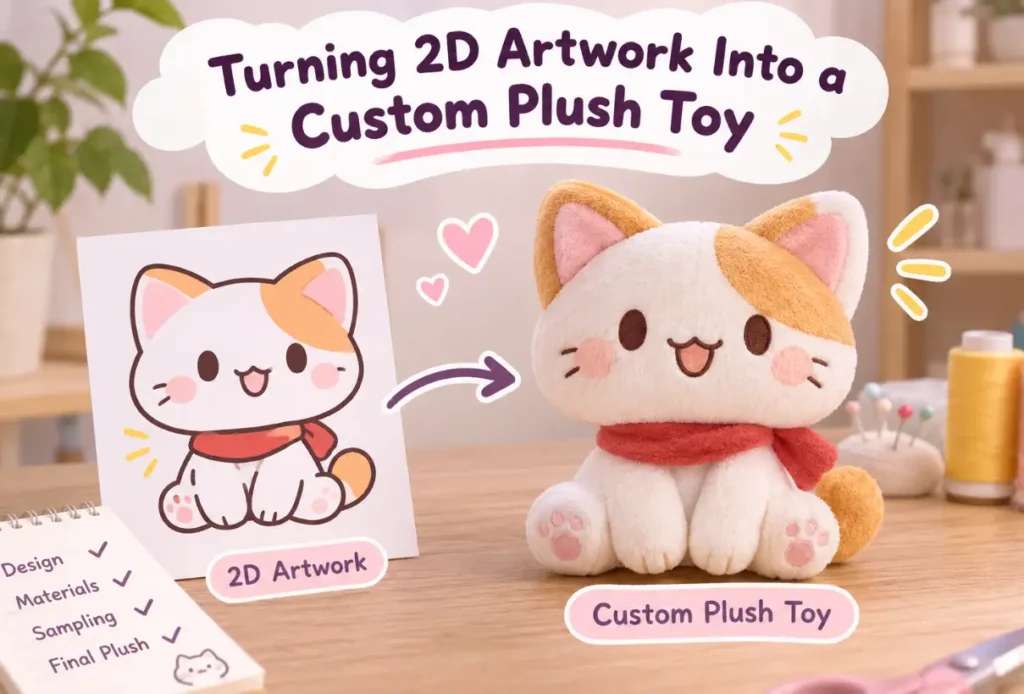
Turning 2D artwork into a custom plush toy is rarely a single event. A drawing shows one view, in flat colour, with no weight, no seams, and no stuffing. A plush toy has volume, a fabric surface, stitched details, and a body that has to sit, stand, or be held by a child. Moving from one to the other is a chain of decisions: which views to trust, which details to keep, which techniques to use, which colours to match, and which sample to approve.
Our role is to make that chain visible. At every stage, we make four things explicit: the decision that needs to be made, the evidence required to make it, the risk created by delay or ambiguity, and the record that remains once the buyer approves. A buyer who can see those four things can judge a supplier by what it documents rather than by what it promises, and can tell early whether a project is staying on the critical path.
This article is written for brand owners and illustrators bringing a character to life for the first time, for importers who receive artwork from a client and must brief a factory, and for buyers who are unhappy with an earlier sample and are considering a change of supplier. It is not legal advice. Compliance for the target market stays with the buyer or importer; we support it with materials, records, samples, and laboratory coordination.
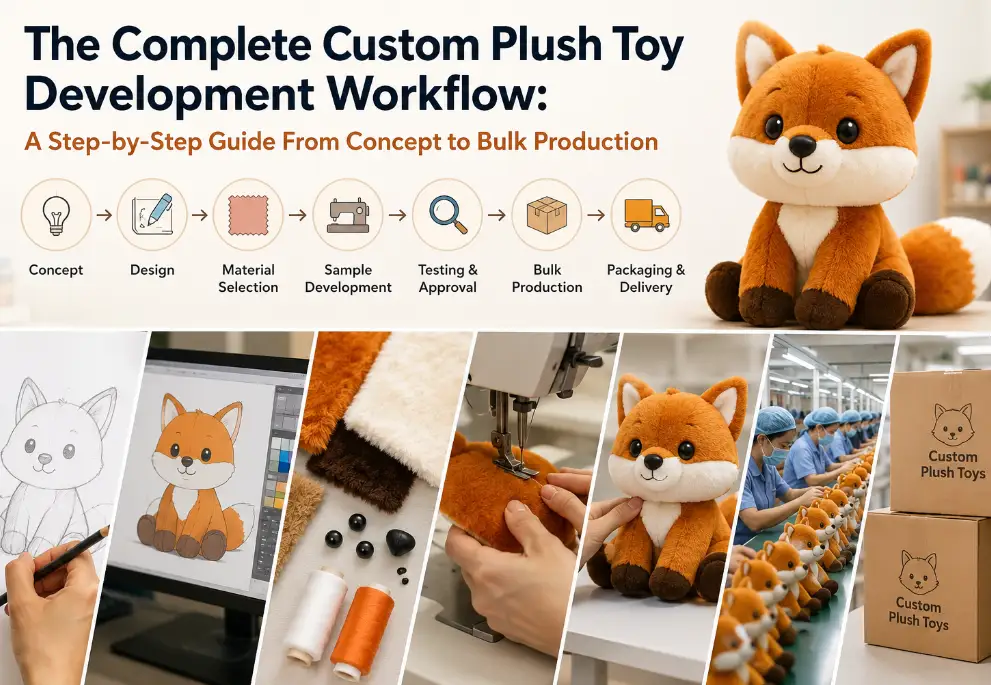
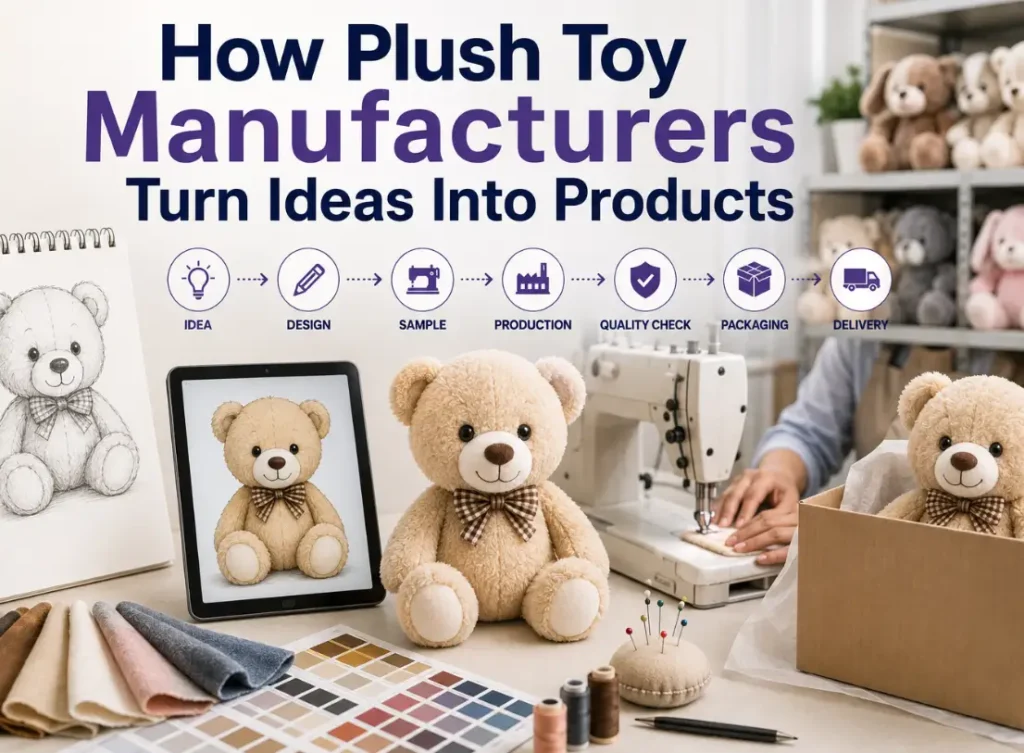
The eight sections that follow match the order of a real project. We begin with the written brief, then review the artwork, build the pattern, choose fabric and embroidery techniques, approve colour, manage sample rounds, coordinate safety testing, and finally hand the approved sample over to production and landed cost planning. Each section ends with a table that works as a checklist, and an FAQ at the end answers the questions buyers most often search.
Turn 2D Artwork Into a Custom Plush Toy Brief
A plush brief is a single document that converts an illustration into a specification: which views exist, how large the toy should be, who it is for, and who has authority to approve changes.
We ask for five inputs before any pattern work begins. The first is the artwork itself, preferably as vector or layered files together with a turnaround sheet showing front, side, back, and top views. The second is the finished size in centimetres, including height, width, and depth, with a stated tolerance such as plus or minus 5 percent. The third is the age grade and target market, because they decide which constructions are acceptable. The fourth is the fabric and finish direction, for example, short-pile velboa or a smoother minky, and whether the toy should be washable. The fifth is the order quantity per design, often 500 to 2,000 pieces, with the trade term the price should reflect.
The trade-off is how much the factory has to guess. Many buyers send one front-facing illustration, and we can give an estimate from it, but the side, back, and top are then our interpretation and not the buyer’s design. Each additional view costs the illustrator a few days, and each guessed view costs a sample round if the guess is wrong. The goal is not to copy the drawing. It is to translate it into a form that can be sewn, stuffed, and stood up. A buyer who cannot supply extra views should expect the first sample to carry more open decisions.
Buyers can verify the brief by asking for it in writing with a version number and a date. It should name the artwork files by version, state the size and tolerance, list every open decision with an owner and a due date, and record who owns the artwork and who may approve changes. If the artwork belongs to a client, the brief should say so, because the person who signs off the sample must be the person authorised to do so. We keep the brief under version control, so a later change shows who requested it.
A typical case shows why this matters. A buyer sends a flat mascot illustration with a tail that curls behind the character. The front view gives no clue about the tail’s length, its thickness, or whether it should touch the ground. By asking in the brief, we learn that the tail is a decorative curl, that it must not exceed 8 cm, and that the buyer is happy to have it stitched to the body. That takes ten minutes to record and prevents a redesign at the second sample.
The buyer’s benefit is a quote and a schedule built on one agreed set of artwork, size, and approval rights, which removes the most common source of rework after sampling begins.
Artwork inputs and measurable targets for a plush brief
| Item | What We Confirm/Provide | Why It Matters/Buyer Benefit |
|---|---|---|
| Artwork files | Collect vector or layered files, a turnaround sheet, and colour references | The pattern maker works from source files instead of screenshots |
| Finished size | Fix height, width, and depth in centimetres with a plus or minus 5 percent band | Size disputes are settled against a number instead of an opinion |
| View coverage | Confirm front, side, back, and top views, or mark missing ones as open decisions | Unseen angles are not guessed during pattern making |
| Order quantity | State the quantity per design, such as 500 to 2,000 pieces, and the trade term | The quote reflects realistic fabric yardage and packing |
| Rights declaration | Record who owns the artwork and who may approve changes | Approvals come from the person authorised to give them |
Review Artwork for Shape, Colour, and Construction Constraints
An artwork review is a structured check of every element in the illustration against what fabric, stitching, and stuffing can reliably reproduce.
We go through the drawing element by element and mark each as keep, simplify, or replace. Thin or pointed shapes, such as spikes, long ears, and slim limbs, are checked for whether they can hold their form once stuffed. Fine lines and small text are compared with the narrowest line that embroidery can hold cleanly, which is usually well above what a vector drawing allows. Shading and gradients are matched to printed patches, two-tone fabric, or embroidery blends. Proportions, such as a head that is as wide as the body, are tested against how the toy will sit and stand. Accessories and attachments are checked against the age grade.
Simplification changes the look, and that is a real cost. A character with sharp triangular ears may need rounded ears to avoid flopping, and a gradient eye may become a two-colour appliqué. We cannot promise that every cartoon will survive translation unchanged, and we would rather say so in the review than in the sample. A strong supplier tells the buyer which details will not survive translation; a weak supplier promises an exact copy and delivers a different toy.
Buyers can verify the review by asking for the annotated artwork. It should show each flagged element, the option chosen, the person who approved it, and any open decisions still waiting for an answer. A buyer can also ask for a short written summary of what will look different from the drawing. That list is the benchmark for every later sample, because it states in advance which differences were agreed and which were not.
Consider a character with a spiky crest of hair made of eight thin points. In the review, we show three options: eight sewn points stuffed lightly, four wider points, or a single scalloped edge. The buyer picks four wider points, and the decision is recorded on the artwork. The first sample then matches the agreed look, and nobody has to argue later about why the toy has fewer spikes than the drawing.

The buyer’s benefit is that the gap between the drawing and the toy is agreed on paper, where it costs a conversation, instead of on a sample, where it costs a new round.
Artwork review decisions by element
| Item | What We Confirm/Provide | Why It Matters/Buyer Benefit |
|---|---|---|
| Thin or pointed shapes | Mark spikes, long ears, and slim limbs, then propose a wider base or a firmer fill | Parts that would collapse or bend are resolved before pattern work |
| Fine line details | Check line widths and spacing against what embroidery can hold cleanly | Details that would blur on fabric are simplified deliberately |
| Shading and gradients | Compare printed patches, two-tone fabric, and embroidery blends for each area | The buyer chooses how a gradient is expressed on fabric |
| Proportion changes | Test head-to-body ratio and limb length against a standing and sitting form | The toy sits or stands the way the buyer intended |
Build the Pattern and 3D Form from Front, Side, and Back Views
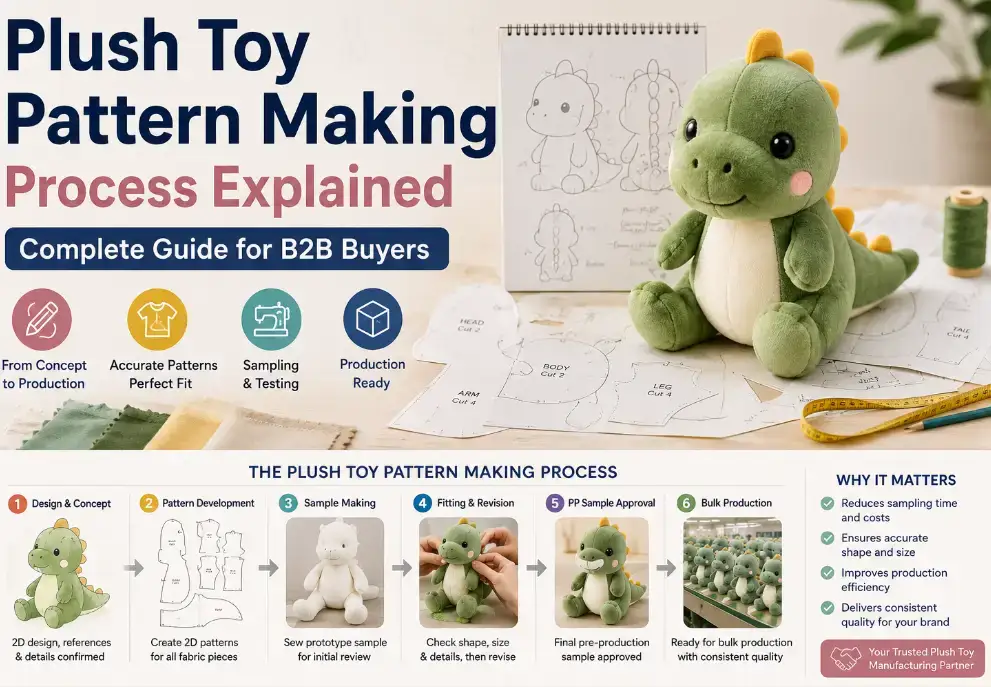
Pattern making is the process of converting flat views into a set of cut fabric pieces that, once sewn and stuffed, produce the three-dimensional form of the character.
We build the pattern in five steps. First, we trace the silhouette from each view and compare front, side, and back for consistency. Second, we divide the form into pieces, usually between 12 and 30 for a character toy, placing seam lines where they follow natural contours and where they will be least visible. Third, we define the stuffing openings and the direction of the fabric grain. Fourth, we cut and sew a plain mock-up in neutral fabric, which typically takes 5 to 10 working days. Fifth, we measure the mock-up for height, width, depth, and weight and photograph it from four sides.
A mock-up does not show colour or texture, so it cannot answer every question. It also adds days to the schedule, and buyers who want to skip it to save time often end up paying for it later in a real-fabric sample. Some forms cannot be reproduced faithfully at all: a character whose head is wider than its shoulders will lean forward unless the neck is reinforced or the fill is adjusted. A strong supplier builds a plain mock-up and measures it; a weak supplier cuts final fabric straight away and corrects the shape by adding more stuffing.
Buyers can verify this stage by asking for the pattern sheet with its version number, the list of pieces with quantities, and the dimension record from the mock-up. The record should compare measured height, width, and depth with the brief and state the difference in centimetres and in percent. Photographs of the mock-up from front, side, back, and top let the buyer compare the form with the artwork before any real fabric is committed.
One example is a round character whose body is a sphere in the drawing. A single sphere made of two circles would flatten at the seam, so we divide the body into six petal-shaped pieces. The mock-up shows that six pieces give a rounder form at the cost of more seams, and the buyer chooses four pieces as a compromise. The decision and the final pattern version are recorded together.
The buyer’s benefit is that the shape is confirmed on inexpensive material, which protects the more costly fabric and embroidery work that follows.
Pattern checkpoints, dimensions, and written tolerances
| Item | What We Confirm/Provide | Why It Matters/Buyer Benefit |
|---|---|---|
| Pattern piece count | List each piece, its grain direction, and its quantity for one toy, typically 12 to 30 pieces | A missing or mirrored piece is spotted at the first count |
| Plain mock-up | Sew a neutral mock-up in 5 to 10 working days and photograph four views | Shape problems are found before costly fabric is cut |
| Dimension record | Measure height, width, depth, and weight against the brief tolerance of plus or minus 5 percent | Differences from the artwork are measured instead of estimated |
| Seam placement | Mark seam lines and stuffing openings with a seam allowance of roughly 5 mm | Visible seams fall where the buyer expects them |
Prepare Fabric, Embroidery, and Print Choices for Each Artwork Detail
Detail translation is the decision, made one element at a time, about whether each part of the illustration becomes a cut fabric panel, an embroidered area, a printed patch, or an attached component.
We work through four categories. Facial features can be embroidered, made as appliqué, printed on a patch, or fitted as safety eyes where the age grade allows. Large colour areas are usually separate fabric panels, because stitched fill over a large area can pucker the fabric. Small details, such as emblems and short text, are checked for minimum line width and stitch count before the embroidery file is made. Surface texture is matched to the character, using pile length and fabric weight, commonly in the range of 180 to 300 grams per square metre, to produce the intended feel.
Each technique has a limit. Embroidery gives a durable, soft finish but cannot reproduce very fine detail, and dense stitching adds cost and can stiffen the area. Printing handles gradients and tiny artwork but can fade with washing or rubbing, and a printed patch may peel at the edge if the bonding is weak. Appliqué is a sound compromise but adds sewing time. The goal is not to match every pixel. It is to choose the technique that holds each detail up in use.
Buyers can verify the choices through a detail translation sheet. It should list each element, the technique chosen, the reason, and the person who approved it. For embroidery, the factory should provide a stitch preview or a digitised file with a version number, and for printed patches, a small test piece that shows how the print behaves after rubbing. Open decisions, such as an emblem that might be removed, should remain on the sheet until closed.
For example, a character has a gradient belly that fades from white to pale blue. The options are a printed patch, a two-tone panel with a pieced curve, or an embroidery blend. The printed patch looks closest to the drawing but has the least wash durability, while the two-tone panel is the most durable. The buyer chooses the panel for an infant toy, and the choice is recorded with the reasons so that a later sample does not reopen it.
The buyer’s benefit is a toy where each detail uses the technique that suits its size and use, which reduces rejects and warranty complaints.
Detail translation options for fabric, embroidery, and print
| Item | What We Confirm/Provide | Why It Matters/Buyer Benefit |
|---|---|---|
| Facial features | Compare embroidery, appliqué, printed patches, and safety eyes against the age grade | The look is chosen with its testing risk visible |
| Colour blocks | Decide between cut fabric panels, embroidery fill, and printed fabric for each area | Large areas stay flat and durable |
| Small details | Check stitch counts, minimum line width, and patch size for emblems and text | Tiny logos remain legible after stitching |
| Surface texture | Match pile length, fabric weight, and hand feel to the character’s personality | The toy feels like the character as well as looking like it |
Control Colour Matching and Material Approval
Colour approval is the process of matching each colour in the artwork to a physical swatch, under a stated light, that the buyer signs and the factory uses as its reference.
We use five controls. Each colour is assigned a textile colour code or a physical reference from the buyer, because colour values on a screen cannot be reproduced exactly in dyed fabric. Swatch rounds are run, usually two to three, each taking about 5 to 7 days. Each swatch is viewed under a stated light source and, where possible, measured with an instrument so the difference from the reference is recorded as a number. The fabric lot is logged by dye lot number and weight, with a working tolerance of about plus or minus 5 percent on fabric weight. Retained swatches are kept with the record.
The limits are physical. Screens emit light and fabric reflects it, so a bright colour on a monitor may not be reachable with a dye. Neon and very saturated tones are especially difficult, and a colour that matches under daylight can shift under shop lighting. Dye lots also vary slightly between batches, so a repeat order may differ even when the code is the same. The goal is not an identical colour in every light. It is a colour difference small enough that the buyer has agreed in advance to accept it.

Buyers can verify this stage with a signed swatch card. It should list each colour code, the dye lot, the light source used, the measured colour difference where available, and the date. Buyers should also ask where the retained swatches are kept and whether the fabric ordered for production uses the same lot as the approved sample. If the lot changes, the factory should say so and offer a fresh comparison before cutting begins.
Consider a brand teal that appears slightly blue on screen. The first swatch comes back greener than expected, so the buyer shows the brand guideline and a printed reference. We run a second swatch with an adjusted formula, measure both under the same lamp, and record that the second falls within the agreed difference. The buyer signs that swatch, and both samples are tagged so the evidence stays with the project.
The buyer’s benefit is that colour disputes are settled with numbers and signed swatches, which prevents rejected batches caused by shade drift.
Colour and material checks against the approved swatch
| Item | What We Confirm/Provide | Why It Matters/Buyer Benefit |
|---|---|---|
| Colour references | Record a textile colour code for each colour and attach a physical swatch | The factory and the buyer name the same colour |
| Swatch rounds | Run two to three swatch rounds of about 5 to 7 days each | The colour is settled before bulk fabric is dyed |
| Instrument readings | Measure each swatch under a stated light source and log the colour difference value | The tolerance is a number instead of a visual impression |
| Fabric lot record | Log fabric weight within plus or minus 5 percent and the dye lot number | Later batches can be matched back to the approved fabric |
Manage Sample Rounds with Version Control and Approval Evidence
Sample management is the controlled sequence of prototype, revision, and pre-production samples that ends in an approved sample, signed by the buyer, that production must repeat.
We run samples in defined rounds. The prototype checks shape and proportion and normally takes 7 to 15 working days. Revision rounds apply the buyer’s comments, each of which is turned into a numbered line in a change log with the requested change, the requester, and the date. Artwork, pattern, and embroidery files carry version numbers, so any sample can be linked to its source. The pre-production sample uses bulk fabric and trims. For each round, we record height, width, depth, and weight, and photograph the toy from six angles. After approval, we seal and tag a twin sample.
More rounds mean more days and cost, and feedback sent in pieces makes this worse. When a buyer sends comments one at a time, each sample answers only part of the question, and the rounds multiply. Two rounds are common for a clear brief, and three or four are normal for a new character with several techniques. A buyer who wants to approve quickly may approve a sample made from substitute fabric, which then does not represent bulk. The goal is not to approve quickly. It is to approve once.
Buyers can verify this stage by asking for three records: the change log with each comment and its outcome, the version record that matches each sample to its files, and the approved sample record that carries measurements, weight, photographs, date, and signature. The approved sample record should state which version of the brief and artwork it was made against. A buyer should also keep a matching sample, so there are two physical references.
For example, a buyer sends the comment “make the face friendlier”. In the log we rewrite it into measurable terms: move the eyes 6 mm lower, widen the mouth by 8 mm, and keep the same fabric. The change is applied once, and the next sample is measured against these figures. Without that rewrite, the comment could produce three different interpretations in three rounds and no way to say which one was wrong.
The buyer’s benefit is that each round closes specific open decisions, so the project reaches an approved sample in fewer rounds and with a clear record.
Sample rounds, change logs, and approved sample records
| Item | What We Confirm/Provide | Why It Matters/Buyer Benefit |
|---|---|---|
| Prototype round | Produce the first sample in 7 to 15 working days and measure it against the brief | Proportion errors are caught at the lowest cost |
| Revision change log | Number each comment, state the change, and record the requester and the date | Every change can be traced to an instruction |
| File version record | Tag artwork, pattern, and embroidery files with version numbers | Each sample can be matched to its source files |
| Pre-production sample | Build from bulk fabric and trims and check fill weight within plus or minus 5 percent | The approved sample represents what the line will make |
| Sealed twin sample | Tag, date, and store a duplicate with the signed record | Inspectors have a physical reference at final check |
Coordinate Safety Testing and Compliance Records
Compliance coordination is the work of assembling materials, records, samples, and laboratory testing so that an importer can demonstrate that a custom plush toy meets the rules of its destination market.
We handle five tasks. We confirm the age grade and target market, because they set the scope. We collect declarations and earlier test reports for fabric, fill, thread, and trims. We submit the approved sample to an accredited third-party laboratory chosen with the buyer. The test scope commonly includes EN 71-1, EN 71-2, and EN 71-3 for Europe, or ASTM F963 and CPSIA requirements for the United States. We also prepare draft age warning, care, and tracking labels for the importer’s review, and we relay results so any retest fits the schedule.
Testing takes time and money. A full panel often takes one to two weeks, and fees depend on the market and the number of materials. Added components, such as beads, glitter, hard plastic parts, or loose accessories, can raise the testing risk and the cost. A pass on the approved sample also does not cover bulk goods if a fabric lot, fill, or trim changes afterwards. A strong supplier states these limits at the start; a weak supplier hands over a report without saying what it covers.
The boundary of responsibility must be clear. The buyer or importer is responsible for compliance in the target market, and the factory supports that work with materials, records, samples, and laboratory coordination. Buyers can verify the stage by reading each test report for the sample tested, the laboratory, the date, and the version of the standard applied, and by comparing the sample description with the approved sample. The laboratory can confirm the report’s authenticity from its report number.

Timing is where most problems start. If the artwork includes a detachable accessory, such as a small removable hat, we flag it in the review and test the approved sample with the hat included. If the buyer decides to sew the hat to the body, the construction changes and the test is repeated on the revised sample. Doing it in that order costs a week; discovering it after bulk fabric is cut can cost the shipping window.
The buyer’s benefit is a compliance file built during development, which protects the importer from finding gaps once the goods are packed.
Compliance responsibilities and supporting records
| Item | What We Confirm/Provide | Why It Matters/Buyer Benefit |
|---|---|---|
| Target market rules | Confirm the destination and list the standards for the importer to verify | The importer holds the legal interpretation with the right inputs |
| Material records | Collect fabric, fill, thread, and trim declarations and earlier reports | Tested materials can be matched to bulk materials |
| Laboratory coordination | Submit the approved sample, book the test scope, and relay results to the buyer | Testing fits inside the critical path instead of delaying it |
| Label drafts | Prepare age warning, care, and tracking label drafts for importer review | Labels reflect what the importer has confirmed |
Use the Approved Sample to Plan Production and Landed Cost
Production handover is the point at which the approved sample, its records, and its source files become the single reference for bulk manufacturing, pricing, inspection, and shipping.
We hand over five items to production. The approved sample and its sealed twin go with the signed record. The pattern, embroidery files, and packing specification go under version control with a dated change log. The fabric and trim orders use the approved lots. A critical path fixes dates for cutting, embroidery, sewing, stuffing, finishing, and packing, commonly 30 to 45 days after the deposit. Quoted prices include fabric, fill, labour, trims, and packaging, with price breaks for different quantities, so the buyer can see how landed cost changes with volume.
A larger quantity reduces unit price but increases stock and cash tied up, and a buyer testing a new character may prefer a smaller run at a higher cost per piece. Sea freight costs less than air but takes weeks longer, which affects launch dates. We can supply the information a customs broker needs for duty estimates, but the importer’s broker confirms the rate, and freight quotes hold only for a limited time. A strong supplier shows the buyer how landed cost changes with quantity and freight; a weak supplier quotes only the factory price.
Buyers can verify the stage by asking for an itemised quote, a dated production schedule, and an inspection report. Final inspection normally follows ISO 2859-1 general level II, with zero tolerance for critical defects, and the report should state the sampling plan, defect counts by class, photographs, and a comparison with the approved sample and sealed twin. At shipment, the buyer should also ask for a reorder file with the signed sample record, pattern and embroidery versions, test reports, and batch codes.
The reorder file proves its value on the second order. A buyer returns six months later and asks for the same character in a new colour. Because the pattern and embroidery versions, the approved sample, and the tested materials are on file, only the colour swatch and one revised sample need to be done again. The project starts from approval evidence instead of from the first conversation, which saves weeks.
The buyer’s benefit is a production plan and a landed cost view built on documented facts, which shortens the next order and reduces repeat sampling.

Production handover items and landed cost components
| Item | What We Confirm/Provide | Why It Matters/Buyer Benefit |
|---|---|---|
| Production lead time | Fix cutting, embroidery, sewing, and packing dates within about 30 to 45 days of the deposit | The buyer plans the launch from a dated critical path |
| Price breaks | Quote at several quantity tiers, such as 500, 1,000, and 2,000 pieces | The buyer sees what extra volume actually saves |
| Final inspection | Sample under ISO 2859-1 general level II and report defects by class | Release rests on a stated sampling plan |
| Freight options | Compare air and sea shipments by transit time and carton volume | Shipping matches the launch date and the budget |
| Reorder file | Archive the approved sample record, pattern and embroidery versions, test reports, and batch codes | A repeat order restarts from documented approval evidence |
Conclusion
Turning 2D artwork into a custom plush toy comes down to making a long chain of decisions visible while they can still be changed. A clear brief avoided guesses about unseen views; artwork review avoided promises the fabric could not keep; pattern making avoided shape errors on costly material; detail translation avoided techniques that fail in use; colour approval avoided disputes about shade; sample management avoided endless rounds of vague comments; safety testing coordination avoided late compliance surprises; and production handover avoided starting bulk goods without a single reference or a landed cost view.
This does not eliminate every risk. A signed sample can still differ slightly from bulk goods, a test report covers only the sample that was tested, dye lots vary, and freight and duty can change after a quote. Compliance in the target market also remains the responsibility of the buyer or importer, supported by the materials, records, samples, and laboratory coordination the factory provides.
A buyer who wants to test these steps with any supplier can begin with four items: the artwork files with every available view, a target size with written tolerances, a list of open decisions, and a request to see the approval records from a comparable character project. The answers show quickly how a supplier works.
Frequently Asked Questions
How do I turn a 2D drawing into a custom plush toy?
Start with a written brief that includes the artwork, a target size, the age grade, and the target market, then let the factory review the artwork and build a pattern and sample. Expect two to four sample rounds before approval. The more views you can supply, the fewer rounds you will need.
What file formats and details should I send to a plush toy manufacturer?
Send vector or layered files if you have them, together with a turnaround sheet showing front, side, back, and top views. Add colour references, the target size in centimetres, and the age grade. A flat image can still be used, but it leaves more open decisions for the factory to interpret.
How many sample rounds does a custom plush toy usually need?
Two to three rounds are common: a prototype, one or more revisions, and a pre-production sample. A simple character with a clear brief may need only two, while a design with several fabrics and embroidery details may need four. Send comments together and in measurable terms to keep the count down.
Can every cartoon or logo design be made as a plush toy?
Most designs can be made, but not every detail survives translation unchanged. Thin shapes, very small text, and complex gradients usually need to be simplified or replaced. Ask for an artwork review that lists what will look different from the drawing before the first sample is made.
How do I match the colours of my artwork on a plush toy?
Give the factory textile colour codes or physical swatches, because screen colours cannot be reproduced exactly in dyed fabric. Approve a signed swatch under a stated light source before bulk fabric is ordered. Very bright or neon tones are harder to match and may require a compromise.
How long does it take to develop a custom plush toy from artwork to approved sample?
Development commonly takes several weeks, depending on how many rounds are needed. A mock-up takes about 5 to 10 working days, and each sample round takes 7 to 15 working days. Colour approval, buyer response time, and added safety testing can lengthen the schedule.
Who owns the pattern and embroidery files after sampling?
Ownership should be agreed in writing before sampling begins, because it is not decided by default. Many buyers ask that pattern and embroidery files be released or held exclusively for their project. If you plan to move production later, confirm this point before paying for development.
Who is responsible for safety compliance on a custom plush toy?
The buyer or importer is responsible for compliance in the target market. The factory supports that work through materials, records, samples, and laboratory coordination. If you are the importer of record, confirm certificate and labelling duties with your own adviser or laboratory.