Skip to content
A complete technical and buyer-facing breakdown of plush toy filling materials — how each type behaves, which compliance standards apply, and how to match filling choice to product type, age group, and market requirements.
Filling material is the part of a plush toy that almost nobody talks about — and the part that determines almost everything about how the finished product actually feels, holds its shape, and performs over years of handling. Buyers spend enormous energy evaluating outer fabric, embroidery quality, and character accuracy, then treat the filling as an interchangeable commodity that gets specified in a single line item: “PP cotton, standard.” That shortcut is where a surprising share of plush toy quality problems, compliance failures, and customer complaints originate.
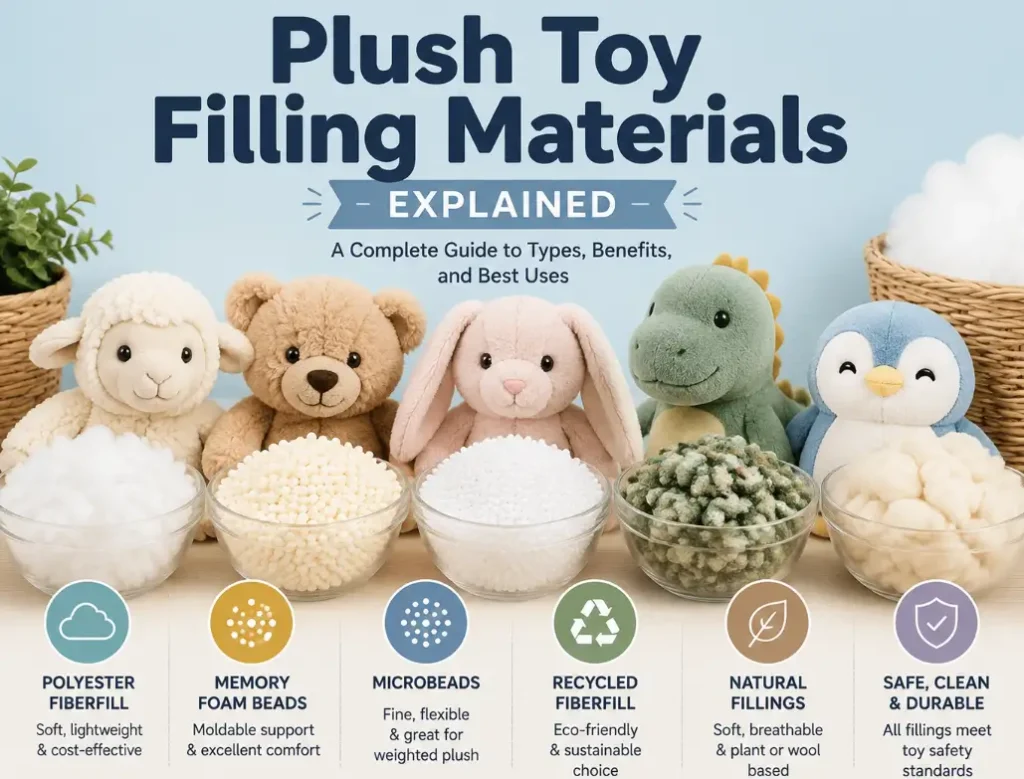
The filling is not one material. It is a category that spans a dozen distinct materials with meaningfully different densities, safety profiles, compliance requirements, tactile properties, and cost structures — from ordinary polyester fiberfill to weighted glass and plastic pellets, memory foam microbeads, natural fibers, and recycled polyester alternatives. Choosing between them is not a cosmetic decision. It changes how the toy feels in a child’s hands, how it holds its shape after a wash cycle, what compliance testing it requires, and what liability exposure the finished product carries.
This guide explains exactly what plush toy filling materials are available, how each one behaves in real production and real use, which compliance standards govern filling safety in major markets, and how to build a filling selection framework that matches material choice to product type, target age group, and destination market — rather than defaulting to whatever a factory quotes first.
Why Does Filling Material Choice Matter More Than Most Buyers Assume?
Filling material choice matters more than most buyers assume because it simultaneously determines three separate outcomes that buyers usually evaluate independently — tactile quality, shape retention over the product lifecycle, and regulatory compliance status — and a filling decision made to optimize one of these frequently compromises the other two without the buyer realizing it until the product is already in production or already in a customer’s hands.
Filling represents 15 to 30 percent of the total material cost of a plush toy depending on size and filling type, which is a modest enough share of the bill of materials that buyers routinely under-invest attention in it relative to fabric and trim decisions. But filling’s influence on the finished product is disproportionate to its cost share. It is the single largest determinant of how a plush toy feels when a customer first picks it up — the property that drives the overwhelming majority of purchase-moment emotional response in a toy category defined by tactile appeal.
Filling is also the material most directly implicated in safety compliance testing. Small parts requirements, choking hazard assessment, flammability testing, and chemical safety screening under ASTM F963, EN71, and CPSIA all evaluate filling material directly — not just the outer fabric shell. A filling material that has not been sourced, tested, and documented correctly can fail a product at the compliance stage regardless of how well the outer construction has been executed, and the cost of discovering that failure after a production run is complete is dramatically higher than the cost of specifying the correct filling before production begins.
What Filling Material Choice Actually Controls in a Finished Plush Toy
| Outcome Dimension | How Filling Drives It | Consequence of Poor Filling Choice |
|---|---|---|
| Tactile feel/softness | Fiber type, denier, and hollow structure determine hand-feel and compressibility | Product feels cheap or stiff despite good fabric |
| Shape retention | Fiber resilience and fill density determine how well the toy recovers after squeezing | Toy flattens permanently after weeks of handling |
| Weight and drape | Fiberfill vs. bead vs. pellet fill changes how the toy sits, hangs, or drapes | Wrong weight for the intended play pattern |
| Washability | Fiber type and clumping resistance determine post-wash performance | Filling clumps or shifts after a single wash cycle |
| Compliance status | Fiber source, chemical treatment, and pellet material determine test outcomes | Product fails safety testing or cannot be sold in target market |
| Cost per unit | Fiber grade and fill weight are direct cost inputs | Margin erosion or a race-to-the-bottom fill weight reduction |
The Filling Decision Is Made Earlier Than Most Buyers Realize
In most sourcing relationships, the filling specification is finalized during the sampling stage — often as a default assumption the factory makes rather than an explicit decision the buyer makes. A brief that specifies fabric, size, and design detail but leaves filling as “standard PP cotton” is handing the factory a decision that has real downstream consequences for both product quality and compliance exposure. Buyers who specify filling type, density grade, and compliance requirement explicitly in the design brief consistently receive a more consistent, more compliant, and more accurately priced product than those who leave the decision to default assumptions.
Tip: Always request the filling specification as a named line item in the quotation — fiber type, denier, hollow or solid structure, and density grade in grams per unit — rather than accepting “standard filling” as a description. A supplier who cannot name the specific filling material they are quoting is not able to guarantee consistency across production batches.
Filling Is Also a Direct Cost Lever, Not Just a Quality Lever
Because filling weight is one of the few production inputs that can be adjusted incrementally without changing pattern, fabric, or trim, it is also one of the first places factories reach for when a buyer pushes hard on unit price during negotiation. A five-gram reduction in fill weight across a mid-sized plush toy is nearly invisible to a casual inspection at the sample stage, but it produces a measurable cost saving across a large production run — and a measurable softness and shape-retention difference once the product reaches the end customer. This is precisely why fill weight needs to be locked into the written specification before final price negotiation, rather than left as a variable the factory can quietly adjust to hit a target unit price after the sample has already been approved.
What Are the Main Types of Plush Toy Filling Materials?
Plush toy filling materials fall into several distinct categories, each with a different fiber structure, cost position, and best-fit application. Understanding what separates them is the foundation for every downstream decision about density, compliance, and product matching covered later in this guide.
Polyester Fiberfill (PP Cotton) — The Industry Standard
Polyester fiberfill, universally referred to in the plush toy industry as “PP cotton” even though it is polypropylene- or polyester-based rather than cotton, is the dominant filling material across the plush toy category. It is manufactured from either virgin or recycled polyester fiber, processed into a hollow or solid fiber structure, and carded into a loose, springy fill that can be machine-stuffed or hand-stuffed depending on production volume and product complexity.
PP cotton is the default filling choice for the overwhelming majority of plush toys because it offers the best balance of cost, softness, washability, and shape retention of any filling material at scale. Hollow-fiber variants trap air within each fiber strand, producing a lighter, loftier fill with better resilience after compression than solid fiber. Solid fiber variants are denser, heavier, and less expensive, typically used in lower-cost products or in combination with hollow fiber to balance cost and feel.
Memory Foam and Microbead Filling
Memory foam filling — shredded polyurethane foam pieces — and microbead filling — small expanded polystyrene or polypropylene beads — are used in plush products where a moldable, weighted, or slow-recovery feel is the design intent rather than the springy resilience of standard fiberfill. Memory foam shred is common in novelty pillows, huggable body pillows, and plush products marketed specifically for their squishable, moldable texture. Microbeads are used in weighted plush categories and in products designed to conform closely to a body or surface.

Glass and Plastic Weighted Pellets
Weighted plush toys — beanie-style animals, weighted sensory plush, and character plush designed to sit or pose — use small glass or plastic pellets, typically concentrated in the base or paws of the toy and combined with standard fiberfill in the body. Pellet weight and material are subject to specific compliance scrutiny because they present a higher choking and ingestion risk profile than fiberfill if a seam fails, which is covered in detail later in this guide.
Natural and Alternative Fiber Fillings
Cotton fiber, kapok, wool, and bamboo-derived fiber fillings appear in premium and eco-positioned plush products where natural material sourcing is part of the product’s market positioning. These fillings generally cost more than polyester fiberfill, offer different tactile and breathability properties, and require different compliance and flammability testing profiles than synthetic fill.
Blended and Hybrid Filling Combinations
A meaningful share of plush toys, particularly larger or more structurally complex designs, do not use a single filling material throughout the product but instead combine two or more filling types in different zones of the same toy. A common combination pairs standard hollow fiberfill in the main body with a denser solid fiber or light pellet fill concentrated in the base, feet, or seated position of the toy, giving the product a soft huggable body while still allowing it to sit upright or hold a pose on a shelf.
Blended filling strategies are also used to manage cost without sacrificing perceived quality — using a higher-grade hollow fiber in the head and outer-facing panels where hand contact is most concentrated, and a lower-cost solid fiber or blended recycled content in the interior body panels that are compressed less frequently and matter less to the customer’s tactile first impression. This approach requires more precise construction instructions and typically a slightly longer stuffing process, since workers need to fill different cavities or zones with different materials rather than a single uniform fill, but it can meaningfully improve the cost-to-perceived-quality ratio on a product line where budget constraints are real.
If a supplier proposes a blended or zone-filled approach to manage cost, it is worth requesting a cutaway diagram or sample cross-section showing exactly where each filling grade is used. Blended filling only delivers its cost-to-quality advantage when the placement is precise — a poorly executed blend can create visible density inconsistencies that are more noticeable than a uniform lower-grade fill would have been.
Comparison of Major Plush Toy Filling Material Types
| Filling Type | Typical Feel | Relative Cost | Best Application | Key Consideration |
|---|---|---|---|---|
| Hollow polyester fiberfill | Light, springy, resilient | Low to moderate | Most stuffed animals, general plush | Best all-round balance of cost and performance |
| Solid polyester fiberfill | Denser, heavier, less lofty | Lowest | Budget plush, blended fill | Flattens faster under repeated compression |
| Memory foam shred | Moldable, slow-recovery | Moderate to high | Novelty pillows, huggable plush | Heavier; requires reinforced seams |
| Microbeads (EPS/PP) | Fine, conforming, weighted | Moderate | Weighted sensory plush, body pillows | Small-part choking risk if seam fails |
| Glass/plastic pellets | Dense, positionable weight | Moderate | Beanie-style plush, posable characters | Highest scrutiny in compliance testing |
| Cotton/kapok/natural fiber | Dense, breathable, natural | High | Premium and eco-positioned plush | Different flammability and moisture profile |
| Recycled PET fiberfill | Comparable to virgin polyester | Moderate | Sustainability-positioned plush lines | Consistency depends on recycling source quality |
Tip: When a supplier quotes “recycled fiberfill” without further detail, ask specifically whether the recycled content is pre-consumer (manufacturing offcuts) or post-consumer (recycled PET bottles), and request a fiber consistency test report. Post-consumer recycled fiber quality varies more between production batches than virgin fiber, and this variation can affect both feel and fill weight consistency.
How Does PP Cotton Filling Density Affect Feel and Shape Retention?
PP cotton filling density — measured either as fill weight per unit volume or, more practically for buyers, as the actual gram weight of filling used in a given product size — is the single largest lever for controlling how a plush toy feels and how well it holds its shape across its product life. Two plush toys built from identical fabric and identical pattern can feel completely different depending on how densely they are stuffed, and this difference is one of the most common sources of quality inconsistency between production batches and between competing suppliers.

Filling density affects feel and shape retention because density determines how much the fiber structure resists compression and how quickly it recovers after being squeezed. Underfilled plush toys feel soft in a way that reads as cheap or hollow, lose their shape quickly, and develop visible fabric wrinkling at seams and joints. Overfilled plush toys feel firm to the point of losing the huggable quality that drives plush toy purchase decisions, place additional stress on seams that can lead to premature seam failure, and cost more in material without a corresponding quality improvement.
Filling Density Grades and Their Practical Effect
| Density Grade | Typical Fill Weight Range (per 30cm plush) | Resulting Feel | Common Application |
|---|---|---|---|
| Light fill | 40–60 grams | Soft, floppy, minimal shape retention | Flat/lay-down plush, blankets, low-cost items |
| Standard fill | 65–90 grams | Balanced softness with moderate shape retention | Most mass-market stuffed animals |
| Firm fill | 95–130 grams | Structured, holds pose, less compressible | Display plush, posable character plush |
| Dense/weighted fill | 130+ grams plus pellet/bead component | Substantial weight, grounded feel | Weighted sensory plush, seated character plush |
Why Fill Weight Consistency Matters More Than the Target Number
Buyers frequently focus on specifying a single target fill weight without recognizing that consistency across units matters at least as much as the target number itself. A production run where fill weight varies by 15 to 20 percent between units produces a batch of plush toys that feel noticeably different from one another on the retail shelf or in a subscription box — a quality inconsistency that is highly visible to end customers even when every individual unit is within an acceptable range.
Fill weight consistency depends on whether the factory uses weight-controlled stuffing equipment or manual stuffing without weight verification. Automated stuffing machines with weight sensors can hold fill weight within a few grams of target across an entire production run. Manual stuffing without weight checks depends entirely on individual worker consistency and is far more prone to batch-to-batch and unit-to-unit variation, particularly at high production volumes where worker fatigue affects consistency over a shift.
Tip: Request that the factory specify fill weight in grams — not a qualitative description like “full” or “standard” — and ask whether fill weight is verified by scale during production or estimated by feel. For any order above a few thousand units, weight-controlled stuffing is worth a modest cost premium because it removes fill weight as a source of batch inconsistency.
What Safety and Compliance Standards Apply to Plush Toy Filling Materials?
Filling material compliance is governed by a combination of chemical safety, flammability, and mechanical hazard standards that differ by destination market, and every one of these standards evaluates the filling material specifically — not just the outer fabric or the finished toy as an assembled unit. A filling material that has not been sourced and documented against the correct standard for its destination market is a compliance liability regardless of how well the rest of the toy is constructed.
Safety and compliance standards apply to plush toy filling because filling is both a direct-contact material — in close and repeated contact with skin, and frequently mouthed by infants and toddlers — and a potential small-parts and choking hazard if it escapes through a failed seam. Regulatory bodies in every major toy market treat filling material as a distinct compliance category requiring its own testing and documentation, separate from outer fabric compliance.
Filling Material Compliance Requirements by Major Market
| Market | Governing Standard | What It Tests for Filling | Key Filling Implication |
|---|---|---|---|
| United States | ASTM F963, CPSIA | Flammability, lead/heavy metal content, small parts, sharp points | Filling must be virgin or verified recycled fiber with clean chemical history |
| European Union | EN71 Parts 1–3, REACH | Mechanical/physical hazards, flammability, chemical migration | Filling requires REACH-compliant chemical documentation |
| United Kingdom | UKCA / EN71 (mirrored) | Same categories as EU EN71 framework | Post-Brexit UKCA documentation required alongside or instead of CE |
| Australia/NZ | AS/NZS ISO 8124 | Flammability, mechanical hazards, toxicology | Filling tested for combustibility under national standard |
| Canada | Canada Consumer Product Safety Act | Flammability, toxic substances, small parts | Similar filling documentation requirement to US standard |
Flammability Testing and Why Filling Matters Here Specifically
Flammability testing evaluates how quickly a material ignites and how it burns once ignited, and filling material is tested both independently and as part of the assembled toy because filling behaves very differently under flame exposure than the outer fabric layer. Polyester fiberfill generally performs acceptably under standard flammability testing, but natural fiber fillings, treated foams, and certain recycled fiber sources can behave unpredictably and require their own specific flammability verification rather than relying on a pass result from a previous filling source.
Chemical Safety Testing — Lead, Phthalates, and Formaldehyde
Chemical safety testing for filling material screens for heavy metals including lead and cadmium, restricted phthalates in any plastic components mixed into the fill, and formaldehyde or other treatment chemicals that can be introduced during fiber processing or dyeing. Recycled fiber sources require particular attention here because the input material stream is less controlled than virgin fiber production, and contamination from the recycling feedstock can introduce restricted substances that would not appear in virgin fiber.

Tip: Request a filling-specific test report — not just a finished-toy compliance certificate — for every new filling source, especially recycled fiber and natural fiber options. A finished-toy pass does not guarantee that the filling itself has been independently verified against every applicable substance restriction, and a filling-specific report is the documentation that protects the buyer if a compliance question arises later.
Small Parts and Seam Integrity Testing
Small parts and choking hazard testing evaluates whether filling material — particularly bead and pellet fill — could be released and ingested if a seam fails under the mechanical stress testing every toy standard requires. This is why pellet-filled and bead-filled plush products face more stringent seam construction requirements, reinforced stitching at high-stress points, and often an inner containment pouch that holds the pellets separately from the outer plush shell, so that even if the outer seam fails, the pellets remain contained.
Batch Retesting — When a Prior Pass Result Is Not Enough
A compliance test report from a prior production run is frequently treated as sufficient documentation for future orders using “the same” filling material, but this assumption is only safe when the filling source, fiber grade, and supplier have genuinely remained unchanged. In practice, factories periodically switch fiber suppliers to manage cost or availability without necessarily flagging the change to the buyer, particularly for recycled fiber inputs where the underlying feedstock supply is less stable than virgin fiber production.
The practical safeguard is to request confirmation, at the time of every new production order, that the filling source and specification match the material covered by the most recent compliance test report — and to schedule periodic retesting, particularly for recycled and natural fiber fillings, rather than relying indefinitely on a single historical test result. For buyers running frequent reorders of an established product, an annual filling material retest is a reasonable cadence that balances documentation currency against the added testing cost.
How Do Weighted Fillings Work and What Risks Do They Carry?
Weighted plush toys — a growing category driven by both traditional beanie-style collectibles and the sensory and calming plush market — use a combination of standard fiberfill in the body and concentrated pellet or bead weight, typically in the base, paws, or a dedicated weighted panel, to achieve a specific total product weight and center of gravity. Getting this combination right requires understanding both the mechanical construction it demands and the compliance profile it carries.
Weighted fillings work by combining a lightweight fiberfill body with a denser weighting material — glass beads, plastic pellets, or in some sensory-focused products, poly pellets specifically selected for a smooth, quiet feel — contained in a separate inner pouch sewn into the toy’s base or distributed panels. This construction achieves the specific weight and balance the product design calls for without requiring the entire toy to be filled with dense material, which would eliminate the soft, huggable quality that makes plush toys appealing.
Weighted Filling Materials Compared
| Weighting Material | Typical Weight per Unit Volume | Feel | Compliance Consideration |
|---|---|---|---|
| Glass beads (fine) | Higher density, more weight per volume | Smooth, fine, subtle movement | Sharp fragments possible if beads crack; requires impact testing |
| Plastic/poly pellets | Moderate density | Slightly coarser, quieter movement | Lower breakage risk than glass; standard small-parts testing applies |
| Steel or metal shot | Highest density per volume | Concentrated, heavy, used sparingly | Requires corrosion resistance and metal detection screening |
| Rice or grain-based fill (novelty only) | Low to moderate | Natural movement, texture | Not compliant for children’s products; moisture and pest risk |
Why Inner Containment Construction Is Non-Negotiable for Weighted Plush
Any weighted plush product intended for a market with mandatory toy safety standards requires an inner containment pouch — a separately sewn fabric compartment that holds the pellet or bead weighting material, independent of the outer plush shell seam. This construction detail is one of the most commonly cut corners in lower-cost weighted plush production, because it adds a manufacturing step and a small amount of material cost that is invisible in a casual product inspection but critical to compliance testing outcomes.
A weighted plush toy without inner containment relies entirely on the outer seam holding under the mechanical stress testing every compliance standard requires — torque testing, tension testing, and drop testing designed specifically to simulate the abuse a toy experiences in real use. A single point of seam failure in a non-contained weighted plush toy releases the entire pellet or bead fill directly into a small-parts hazard, which is precisely the failure mode compliance testing exists to prevent.
Tip: For any weighted plush product, confirm in the technical specification that pellets or beads are held in a separately sewn inner pouch rather than loose in the same cavity as the fiberfill, and request photos or video of the inner construction during the sampling stage. This single construction detail is worth verifying directly rather than trusting a verbal assurance.
How Much Weight Is Appropriate for a Weighted Plush Product?
There is no single universal weight target for weighted plush, because the appropriate weight depends heavily on the product’s purpose. Sensory and calming plush products marketed for their weighted feel typically target a weight-to-size ratio noticeably higher than a standard stuffed animal but well short of the density that would make the product difficult or unsafe for a child to hold or place on their body — a range that most established weighted-plush suppliers can quote from experience, but that should still be confirmed against the specific age group and use case rather than assumed from a generic industry rule of thumb.

Beanie-style collectible plush, by contrast, uses a much smaller and more concentrated weight placement — just enough pellet fill in the base to allow the toy to sit upright — and does not aim for an overall heavy feel at all. Confusing these two design intents during the briefing stage is a common source of miscommunication between buyers and factories, since both fall under the general label of “weighted plush” despite requiring very different weight targets and, consequently, different compliance testing emphasis.
How Should Filling Be Matched to Product Type and Target Age Group?
Filling selection should not be treated as a single decision applied uniformly across a product line. The correct filling choice depends on the product’s physical format, its intended play pattern, and — critically — the age group it is designed for, because age group changes both the compliance requirements that apply and the practical performance characteristics that matter most to the end user.
Filling should be matched to product type and age group because different plush formats place different mechanical and safety demands on the fill, and products for younger age groups carry stricter small-parts and chemical safety requirements that eliminate certain filling options entirely, regardless of how well those options might otherwise suit the product design.
Recommended Filling Approach by Product Type and Age Group
| Product Type / Age Group | Recommended Filling | Filling Types to Avoid | Why |
|---|---|---|---|
| Infant/newborn plush (0–3 years) | Standard hollow polyester fiberfill, no loose small parts | Bead/pellet fill, natural fiber with allergen risk | Strictest small-parts and chemical exposure standards apply |
| General stuffed animals (3+ years) | Standard to firm polyester fiberfill | N/A — most versatile category | Balances cost, feel, and compliance simplicity |
| Weighted sensory plush (all ages, with caution for youngest) | Contained poly pellet fill plus fiberfill body | Loose glass beads without containment | Sensory benefit requires weight; containment manages hazard |
| Display / collectible plush | Firm to dense fiberfill for pose retention | Light fill (loses shape on shelf display) | Shelf presentation depends on shape retention over time |
| Licensed/premium character plush | Standard to firm fiberfill, sometimes blended with natural fiber accents | Inconsistent density between batches | Brand consistency requirements are stricter for licensed IP |
| Eco-positioned product lines | Recycled PET fiberfill with verified chemical testing | Unverified recycled sources without test documentation | Sustainability claims require documented material chain |
Why Age Group Is the Single Most Important Filter
Age grading is the compliance filter that overrides almost every other filling consideration. A filling material that performs excellently on cost, feel, and shape retention is simply disqualified if it does not meet the small-parts and chemical exposure requirements for the youngest age group the product might reasonably reach — and toy safety regulators consistently apply a precautionary standard where products are graded for the youngest plausible user rather than the marketed target age, particularly for plush toys that are frequently gifted across a wider age range than the packaging specifies.
Tip: When a product’s marketed age range is ambiguous or spans both toddler and older child audiences, specify filling and construction to the stricter, younger-age compliance standard rather than the older end of the range. The cost difference is usually marginal, and it removes an entire category of compliance risk from products that may reach younger children regardless of packaging.
What Sustainable and Eco-Friendly Filling Options Are Available?
Demand for sustainability-positioned plush products has grown steadily, and filling material is one of the more visible and verifiable sustainability levers available to brands, because filling composition can be documented, tested, and communicated to end customers in a way that is harder to achieve for some other manufacturing inputs.
Sustainable and eco-friendly filling options are available primarily in the form of recycled PET polyester fiberfill — manufactured from recycled plastic bottles and processed into fiber with properties comparable to virgin polyester fiberfill — alongside natural fiber options including organic cotton, kapok, and bamboo-derived fiber for buyers positioning products at a higher sustainability and premium price point.
Eco-Friendly Filling Options Compared to Standard Fiberfill
| Eco Filling Option | Source Material | Performance vs. Virgin Fiberfill | Typical Cost Premium |
|---|---|---|---|
| Recycled PET (post-consumer) | Recycled plastic bottles | Comparable feel; slightly more batch variation | 5–15% |
| Recycled PET (pre-consumer) | Manufacturing offcuts and fiber waste | More consistent than post-consumer recycled | 0–10% |
| Organic cotton fiber | Certified organic cotton | Denser, less springy, more breathable | 40–80% |
| Kapok fiber | Kapok tree seed pod fiber | Very light, naturally hollow, less durable | 60–100% |
| Bamboo-derived fiber | Processed bamboo cellulose | Soft, breathable, moisture-wicking | 50–90% |
Verifying Sustainability Claims Before They Reach Packaging
Recycled content claims on filling material require documentation the same way compliance claims do, and this is an area where buyers face real reputational risk if claims are not verified. A supplier claiming “recycled fiberfill” without a certificate tracing the recycled content percentage and source is not providing evidence sufficient to support a sustainability claim on retail packaging in most major markets, where unsubstantiated environmental claims are subject to increasing regulatory scrutiny.

Tip: Before printing any recycled-content or eco-friendly claim on packaging, obtain a recycled content certificate specifying the exact percentage of recycled material and its source category. Global Recycled Standard (GRS) certification, where available, provides third-party verification that most retail and marketplace sustainability claim reviews will accept without additional documentation.
How to Build a Filling Material Selection Framework for a New Product Line
Bringing together fiber type, density, compliance requirement, and sustainability positioning into a single decision framework is what turns filling from an afterthought into a deliberate product design lever. The framework below reflects the sequence in which these decisions should be made, because each decision constrains the ones that follow it.
- Start with age group and market. Age grading and destination market compliance standards eliminate certain filling options immediately and should be confirmed before any other filling decision is made.
- Define the product format and play pattern. A flat lay-down plush, a posable display plush, and a weighted sensory plush each call for a different density and structure, independent of fiber type.
- Select fiber type against cost and positioning targets. Standard virgin polyester fiberfill remains the default for most mass-market products; recycled and natural fiber options apply where sustainability or premium positioning justifies the cost premium.
- Specify density in grams, not qualitative terms. A numeric fill weight target, verified by scale during production, removes the single largest source of batch-to-batch inconsistency.
- Confirm construction requirements for weighted products. Inner containment pouches, reinforced seams, and pellet material selection should be specified explicitly rather than assumed.
- Request filling-specific compliance documentation. A finished-toy compliance certificate is not a substitute for filling-specific test reports, particularly for recycled and natural fiber sources.
- Verify consistency through the sampling stage. Requesting multiple samples across a short production window, rather than a single hand-selected sample, is the most reliable way to confirm that the specified filling and density will actually be delivered at scale.
Conclusion
Filling material is not a minor specification buried beneath fabric and design decisions — it is one of the primary levers that determines how a plush toy feels, how long it holds its shape, and whether it clears the compliance bar for its intended market. The buyers who treat filling as a genuine specification decision, rather than a default the factory fills in, consistently end up with more consistent products, fewer compliance surprises, and a clearer story to tell customers about what is actually inside the toys they are buying.
The framework in this guide — starting from age group and market compliance, moving through product format and fiber selection, and finishing with density specification and documentation verification — provides a repeatable structure for making this decision correctly on every new product line, rather than relitigating it from scratch with every new supplier conversation.
Frequently Asked Questions
What is the difference between PP cotton and regular polyester fiberfill?
In plush toy manufacturing terminology, “PP cotton” is not made from cotton or, strictly speaking, always from polypropylene — it is an industry shorthand that generally refers to standard polyester or polypropylene-based hollow fiberfill. The term is used interchangeably with “polyester fiberfill” across most factories, though buyers should confirm the actual fiber composition rather than relying on the terminology alone, since naming conventions vary between suppliers and regions. What matters for product performance and compliance is the actual fiber type, hollow or solid structure, and any chemical treatment applied — not the label used to describe it.
How much filling does a typical plush toy need?
Filling weight depends heavily on product size and desired firmness, but as a general reference point, a standard 30-centimeter stuffed animal typically uses between 65 and 90 grams of standard-density polyester fiberfill to achieve a balanced, huggable feel with reasonable shape retention. Smaller plush toys and keychain-format products use proportionally less, while larger display or weighted plush products can require several hundred grams. The most reliable approach is to request a fill weight specification in grams for the specific product size and firmness target, rather than relying on a generic industry average that may not match the intended design.
Is bead-filled or pellet-filled plush safe for young children?
Bead-filled and pellet-filled plush toys carry a higher small-parts and choking hazard profile than standard fiberfill-only plush, which is why they face stricter construction and testing requirements under toy safety standards. Whether a specific weighted plush product is appropriate for young children depends on its construction — specifically whether the pellets or beads are held in a securely sewn inner containment pouch, whether the product has passed the mechanical stress testing required for its target age grade, and whether the age labeling accurately reflects the product’s actual hazard profile. Buyers developing weighted plush for younger age groups should build in inner containment construction and complete age-appropriate compliance testing rather than assuming standard fiberfill safety margins apply.
Can recycled polyester fiberfill match the quality of virgin fiberfill?
Recycled polyester fiberfill, particularly pre-consumer recycled fiber sourced from manufacturing offcuts, can perform very close to virgin fiberfill in terms of softness, loft, and shape retention. Post-consumer recycled fiber, sourced from recycled plastic bottles, generally shows somewhat more batch-to-batch variation because the input feedstock is less controlled, though quality has improved substantially as recycling processing technology has matured. The practical approach for buyers is to request fiber consistency test data and, where the recycled content will be featured in marketing claims, request certification such as Global Recycled Standard documentation that verifies both the recycled content percentage and a consistent quality baseline.
Does filling material need to be tested separately from the finished plush toy?
Yes, in most cases. Finished-toy compliance testing evaluates the assembled product as a whole, including mechanical hazards created by the interaction between fabric, seams, and filling. But this finished-product testing does not always provide the same depth of chemical and material-specific verification as a filling-specific test report, particularly for new or unusual filling sources such as recycled fiber batches or natural fiber alternatives. Buyers introducing a new filling source, especially one without an established compliance track record with the supplier, should request filling-specific chemical and flammability documentation in addition to the standard finished-toy compliance certificate.
Why do some plush toys flatten or lose their shape faster than others?
Shape retention loss is driven primarily by two factors: insufficient fill density at the point of manufacture, and fiber type with lower resilience under repeated compression. A plush toy that was underfilled to reduce material cost will flatten noticeably faster than one filled to an appropriate density, because there is simply less fiber structure to resist compression from handling. Separately, solid polyester fiber and lower-grade recycled fiber tend to lose loft faster under repeated compression than hollow-fiber virgin polyester, because the hollow fiber structure provides more mechanical resilience. Buyers experiencing shape retention complaints should first verify actual fill weight against specification before assuming the issue is fiber quality alone.
What should buyers ask a new supplier about filling material before placing a first order?
Buyers evaluating a new plush toy supplier should ask for the specific filling fiber type and whether it is virgin or recycled, the fill weight in grams for the product size in question and whether it is verified by scale during production, whether the filling has a filling-specific compliance test report for the target market, and — for any weighted product — whether pellets or beads are contained in a separately sewn inner pouch. A supplier able to answer these questions specifically and provide supporting documentation is demonstrating the kind of process control that generally correlates with consistent production quality across an ongoing order relationship, while vague or evasive answers to filling-specific questions are worth treating as a signal for further due diligence before committing to a first production order.